John Ulzheimer is an expert on credit reporting, credit scoring, and identity theft. The author of four books on the subject, Ulzheimer has been featured thousands of times in media outlets including the Wall Street Journal, NBC Nightly News, New York Times, CNBC, and countless others.
With over 33 years of credit-related professional experience, including with Equifax, FICO, Experian, VantageScore, and Credit.com Ulzheimer is the only recognized credit expert who actually comes from the credit industry.
He has been engaged as an expert witness in over 800 credit-related lawsuits and has been qualified to testify in both federal and state courts on the topic of consumer credit. In his hometown of Atlanta, Ulzheimer is a frequent guest lecturer at Emory University's School of Law.
Jon leverages 15-plus years of journalism expertise to inform financial consumers about emerging trends and companies making an impact in the industry. He is most knowledgeable in the areas of budgeting, credit card rewards, and responsible credit use. Jon has a passion for writing and editing, and his articles have appeared in publications produced by The New York Times.
Ashley Fricker has more than a decade of experience as a finance contributor and editor, and has specialized in the credit card industry since 2015. Her credit card commentary is featured on national media outlets that include CNBC, MarketWatch, Investopedia, and Reader's Digest, among many others. She has worked closely with the world’s largest banks and financial institutions, up-and-coming fintech companies, and press and news outlets to curate comprehensive content and media. Ashley holds a bachelor's degree in multimedia journalism from Florida Atlantic University.
Below are our staff's picks for 2026's best 0% balance transfer credit card offers. A balance transfer allows you to consolidate high-interest credit card balances into one card with a lower interest rate, helping to save money on interest payments.
Disclosure: When you apply through links on our site, we often earn referral fees from partners. For more information, see our ad disclosure
Advertiser Disclosure
CardRates.com is a free online resource that offers valuable content and comparison services to users. To keep this resource 100% free, we receive compensation for referrals for many of the offers listed on the site. Along with key review factors, this compensation may impact how and where products appear across CardRates.com (including, for example, the order in which they appear). CardRates.com does not include the entire universe of available offers. Editorial opinions expressed on the site are strictly our own and are not provided, endorsed, or approved by advertisers.
Our experts rate credit card offers based on factors like rewards, APRs, signup bonuses, fees, and approval rates, with a focus on benefits that provide the best value. We also consider cardholder needs such as credit-building potential, issuer reputation, and customer service. Our ratings are unbiased, updated regularly, and not influenced by issuers.
0% Intro APR for 21 billing cycles for purchases, and for any balance transfers made in the first 60 days. After the Intro APR offer ends, a Variable APR that’s currently 15.24% - 26.24% will apply. A 5% fee applies to all balance transfers. Balance transfers may not be used to pay any account provided by Bank of America.
No annual fee.
No penalty APR. Paying late won't automatically raise your interest rate (APR). Other account pricing and terms apply.
This offer may not be available elsewhere if you leave this page. You can take advantage of this offer when you apply now.
Intro (Purchases)0% Intro APR for 21 billing cycles for purchases
Intro (Transfers)0% Intro APR for 21 billing cycles for any balance transfers made in the first 60 days (Balance Transfer Fee 5% of the amount of each transaction)
Regular APR15.24% - 26.24% Variable APR on purchases and balance transfers
Our experts rate credit card offers based on factors like rewards, APRs, signup bonuses, fees, and approval rates, with a focus on benefits that provide the best value. We also consider cardholder needs such as credit-building potential, issuer reputation, and customer service. Our ratings are unbiased, updated regularly, and not influenced by issuers.
0% Intro APR on balance transfers for 21 months and on purchases for 12 months from date of account opening. After that the variable APR will be 16.74% - 27.49%, based on your creditworthiness. Balance transfers must be completed within 4 months of account opening.
There is an intro balance transfer fee of 3% of each transfer (minimum $5) completed within the first 4 months of account opening. After that, your fee will be 5% of each transfer (minimum $5).
No Annual Fee - our low intro rates and all the benefits don't come with a yearly charge.
Buy now and pay later. Split your payment for eligible purchases of $75 or more into a fixed payment with Citi® Flex Pay.
Get free access to your FICO® Score online.
Intro (Purchases)0% 12 months on Purchases
Intro (Transfers)0% 21 months on Balance Transfers
Our experts rate credit card offers based on factors like rewards, APRs, signup bonuses, fees, and approval rates, with a focus on benefits that provide the best value. We also consider cardholder needs such as credit-building potential, issuer reputation, and customer service. Our ratings are unbiased, updated regularly, and not influenced by issuers.
0% Intro APR for 21 billing cycles for purchases, and for any balance transfers made in the first 60 days. After the Intro APR offer ends, a Variable APR that’s currently 15.24% - 26.24% will apply. A 5% fee applies to all balance transfers. Balance transfers may not be used to pay any account provided by Bank of America.
No annual fee.
No penalty APR. Paying late won't automatically raise your interest rate (APR). Other account pricing and terms apply.
When handled responsibly, a credit card can help you build your credit history, which could be helpful when looking for an apartment, a car loan, and even a job.
This offer may not be available elsewhere if you leave this page. You can take advantage of this offer when you apply now.
Intro (Purchases)0% Intro APR for 21 billing cycles for purchases
Intro (Transfers)0% Intro APR for 21 billing cycles for any balance transfers made in the first 60 days (Balance Transfer Fee 5% of the amount of each transaction)
Regular APR15.24% - 26.24% Variable APR on purchases and balance transfers
Our experts rate credit card offers based on factors like rewards, APRs, signup bonuses, fees, and approval rates, with a focus on benefits that provide the best value. We also consider cardholder needs such as credit-building potential, issuer reputation, and customer service. Our ratings are unbiased, updated regularly, and not influenced by issuers.
Get a 0% intro APR for 18 months on balance transfers and 0% intro APR on purchases for 6 months; balance transfer fee applies. Then 17.74% to 26.74% Standard Variable APR applies, based on credit worthiness
INTRO OFFER: Unlimited Cashback Match for all new cardmembers. Discover will automatically match all the cash back you’ve earned at the end of your first year! There’s no minimum spending or maximum rewards. You could turn $150 cash back into $300
Earn 2% cash back at Gas Stations and Restaurants on up to $1,000 in combined purchases each quarter, automatically. You'll still earn unlimited 1% cash back on all other purchases
Our experts rate credit card offers based on factors like rewards, APRs, signup bonuses, fees, and approval rates, with a focus on benefits that provide the best value. We also consider cardholder needs such as credit-building potential, issuer reputation, and customer service. Our ratings are unbiased, updated regularly, and not influenced by issuers.
Earn $200 cash back after you spend $1,500 on purchases in the first 6 months of account opening. This bonus offer will be fulfilled as 20,000 ThankYou® Points, which can be redeemed for $200 cash back.
Earn 2% on every purchase with unlimited 1% cash back when you buy, plus an additional 1% as you pay for those purchases. To earn cash back, pay at least the minimum due on time. Plus, earn 5% total cash back on hotel, car rentals and attractions booked with Citi Travel.
Balance Transfer Only Offer: 0% intro APR on Balance Transfers for 18 months. After that, the variable APR will be 18.49% - 28.74%, based on your creditworthiness.
Balance Transfers do not earn cash back. Intro APR does not apply to purchases.
If you transfer a balance, interest will be charged on your purchases unless you pay your entire balance (including balance transfers) by the due date each month.
There is an intro balance transfer fee of 3% of each transfer (minimum $5) completed within the first 4 months of account opening. After that, your fee will be 5% of each transfer (minimum $5).
Intro (Purchases)N/A
Intro (Transfers)0% 18 months on Balance Transfers
Our experts rate credit card offers based on factors like rewards, APRs, signup bonuses, fees, and approval rates, with a focus on benefits that provide the best value. We also consider cardholder needs such as credit-building potential, issuer reputation, and customer service. Our ratings are unbiased, updated regularly, and not influenced by issuers.
Earn 20,000 bonus Points after spending $1,000 in the first 3 months of account opening.
0% Intro APR on balance transfers and purchases for 15 months; after that, the variable APR will be 18.74% - 28.74%, based on your creditworthiness. There is an intro balance transfer fee of 3% of each transfer (minimum $5) completed within the first 4 months of account opening. After that, your fee will be 5% of each transfer (minimum $5).
Earn 3 ThankYou® Points for each $1 spent in an eligible Self-Select Category of your choice (Fitness Clubs, Select Streaming Services, Live Entertainment, Cosmetic Stores/Barber Shops/Hair Salons, or Pet Supply Stores). Choose your eligible Self-Select Category on Citi Online or by calling customer service. The default Self-Select Category is Select Streaming Services.
Earn 5 ThankYou® Points for each $1 spent on Hotels, Car Rentals and Attractions booked on Citi Travel® via cititravel.com; earn 3 ThankYou Points for each $1 spent at Supermarkets, on Select Transit purchases, and at Gas & EV Charging Stations.
Earn 2 ThankYou® Points for each $1 spent at Restaurants; earn 1 ThankYou® Point for each $1 spent on All Other Purchases.
No Annual Fee
Intro (Purchases)0% 15 months on Purchases
Intro (Transfers)0% 15 months on Balance Transfers
Bank of America® Customized Cash Rewards credit card
4.9/5.0
About this rating
Our experts rate credit card offers based on factors like rewards, APRs, signup bonuses, fees, and approval rates, with a focus on benefits that provide the best value. We also consider cardholder needs such as credit-building potential, issuer reputation, and customer service. Our ratings are unbiased, updated regularly, and not influenced by issuers.
$200 online cash rewards bonus after you make at least $1,000 in purchases in the first 90 days of account opening.
Earn 6% cash back for the first year in the category of your choice. You’ll automatically earn 2% cash back at grocery stores and wholesale clubs, and unlimited 1% cash back on all other purchases. After the first year from account opening, you’ll earn 3% cash back on purchases in your choice category.
Earn 6% and 2% cash back on the first $2,500 in combined purchases each quarter in the choice category, and at grocery stores and wholesale clubs, then earn unlimited 1% thereafter. After the 3% first-year bonus offer ends, you will earn 3% and 2% cash back on these purchases up to the quarterly maximum.
No annual fee and cash rewards don’t expire as long as your account remains open.
Turn daily purchases into everyday wins. Simply use your Customized Cash Rewards credit card for the things you already buy - from gifts to groceries - BofA Rewards™ members earn more cash back.
0% Intro APR for 15 billing cycles for purchases, and for any balance transfers made in the first 60 days. After the Intro APR offer ends, a Variable APR that’s currently 17.74% - 27.74% will apply. A 3% Intro balance transfer fee will apply for the first 60 days your account is open. After the Intro balance transfer fee offer ends, the fee for future balance transfers is 5%. Balance transfers may not be used to pay any account provided by Bank of America.
This offer may not be available elsewhere if you leave this page. You can take advantage of this offer when you apply now.
Intro (Purchases)0% Intro APR for 15 billing cycles for purchases
Intro (Transfers)0% Intro APR for 15 billing cycles for any balance transfers made in the first 60 days (Balance Transfer Fee 3% for 60 days from account opening, then 5%)
Regular APR17.74% - 27.74% Variable APR on purchases and balance transfers
Review Breakdown: How We Rated the Best Balance Transfer Credit Cards
Our editors evaluate balance transfer cards based on several factors, including the length of the promotional APR period, balance transfer fees, ongoing costs, and overall value. Compensation may affect where certain cards appear, but it doesn’t determine whether they’re reviewed or recommended.
Introductory APR Period
We compare the length of each card’s introductory balance transfer APR and the deadline for completing transfers. Longer promotional periods give cardholders more time to repay debt before the regular APR applies.
Balance Transfer Fees
Most cards charge a fee for each transferred balance. We consider both introductory and standard transfer fees because these costs directly reduce a cardholder’s potential interest savings.
Ongoing Costs
We review the regular APR that applies after the promotional period, along with annual fees and other charges that may affect the card’s long-term cost.
Approval Requirements and Overall Value
We consider the credit profile generally needed to qualify and whether the card offers additional value through purchase promotions, rewards, or other useful features.
0% Intro APR for 21 billing cycles for any balance transfers made in the first 60 days (Balance Transfer Fee 5% of the amount of each transaction)
15.24% - 26.24% Variable APR on purchases and balance transfers
★★★★★
4.6
BankAmericard® credit card
4.6/5.0
About this rating
Our experts rate balance transfer offers on the length of the promotional rate, regular APR, fees, rewards, and approval rates. We also consider additional cardholder needs and compare offers to evaluate the best terms. Issuers have no influence on our ratings.
Our experts rate balance transfer offers on the length of the promotional rate, regular APR, fees, rewards, and approval rates. We also consider additional cardholder needs and compare offers to evaluate the best terms. Issuers have no influence on our ratings.
0% Intro APR for 21 billing cycles for any balance transfers made in the first 60 days (Balance Transfer Fee 5% of the amount of each transaction)
15.24% - 26.24% Variable APR on purchases and balance transfers
★★★★★
4.5
BankAmericard® credit card for Students
4.5/5.0
About this rating
Our experts rate balance transfer offers on the length of the promotional rate, regular APR, fees, rewards, and approval rates. We also consider additional cardholder needs and compare offers to evaluate the best terms. Issuers have no influence on our ratings.
Our experts rate balance transfer offers on the length of the promotional rate, regular APR, fees, rewards, and approval rates. We also consider additional cardholder needs and compare offers to evaluate the best terms. Issuers have no influence on our ratings.
Our experts rate balance transfer offers on the length of the promotional rate, regular APR, fees, rewards, and approval rates. We also consider additional cardholder needs and compare offers to evaluate the best terms. Issuers have no influence on our ratings.
Our experts rate balance transfer offers on the length of the promotional rate, regular APR, fees, rewards, and approval rates. We also consider additional cardholder needs and compare offers to evaluate the best terms. Issuers have no influence on our ratings.
0% Intro APR for 15 billing cycles for any balance transfers made in the first 60 days (Balance Transfer Fee 3% for 60 days from account opening, then 5%)
17.74% - 27.74% Variable APR on purchases and balance transfers
★★★★★
4.9
Bank of America® Customized Cash Rewards credit card
4.9/5.0
About this rating
Our experts rate balance transfer offers on the length of the promotional rate, regular APR, fees, rewards, and approval rates. We also consider additional cardholder needs and compare offers to evaluate the best terms. Issuers have no influence on our ratings.
The best balance transfer credit cards have grown to become a typical part of most consumers’ financial strategy over the past several years. With U.S. credit card balances reaching $1.26 trillion in the second quarter of 2026, it’s only natural to look for a way to decrease the cost of eliminating that debt.
When you set up the right balance transfer plan, you can potentially clear your existing high-interest credit card debt without incurring finance charges. But with so many balance transfer offers available, how can you pick the best one? Here’s what you need to know.
The concept is certainly simple enough — you move your existing balances from your current credit cards to a new credit card account with a lower interest rate — which, hopefully, saves you some money in the process. But beyond that, you should become familiar with a number of other details before pulling the trigger on this type of credit card offer.
1. What is a Balance Transfer Credit Card?
As the name implies, a balance transfer credit card offers a straightforward way to shift existing debt from an old credit card with a high interest rate to a new one with a lower rate. If you have multiple balances, it can also serve as a form of debt consolidation by allowing you to move them to a single card.
But these cards aren’t only for balance transfers. They function like any other credit card that allows you to make new purchases, so long as you have the available credit limit to cover the purchase.
Just about any credit card will allow a balance transfer that fits within your available credit limit. What sets the cards on this list apart is that they have special promotional periods for new cardholders that let you transfer your existing balance over to the new card, while paying the debt down without interest charges for a set period of time (typically between six and 18 months).
Balance transfers are a smart means of debt consolidation for those who qualify for 0% interest. The video below explains how 0% APR balance transfer cards work and four rules to know before transferring your debt.
Watch on
For many people, credit card debt is the most expensive debt they will ever service. A balance transfer card can lower your interest rate to zero so you can pay off your debt more quickly — and much more affordably.
A bonus also worth noting is that consolidating multiple debts onto a new, single account may make managing your monthly payments and your debt elimination strategies a bit easier.
It’s essential to do a balance transfer for the right reasons to benefit you financially. If you’re just shifting debt around to manage expenses, it might not be the best idea.
If you feel like you can’t fully commit to aggressively paying off the credit card debt on your new account, it might be wise to reconsider applying for more credit.
2. How Much Can You Save With a Balance Transfer?
The amount you can save with a balance transfer depends on your current APR, the new card’s promotional rate and balance transfer fee, and how quickly you repay the debt.
You can carefully calculate the numbers to ensure that moving your outstanding balance to a new account is financially beneficial.
In many cases, balance transfers can save you money despite a balance transfer fee, but don’t take that for granted — crunch the numbers yourself first.
3. How Do You Transfer a Balance to a New Card?
The process of moving your existing balances from an old card to a new card is not difficult, though it may vary slightly from one card issuer to the next. Once you have been approved for a new account, you can contact your new credit card issuer online or over the phone to begin the process.
Before reaching out to your card issuer, it is helpful to gather all of the information you will need in advance.
Make a list of the accounts you want to transfer balances from, including account numbers and amounts for each card. When you contact your new card issuer, be sure to mention your interest in their 0% (or low APR) introductory balance transfer offer.
A customer service rep should be able to walk you through the process step by step. Once the request has been approved, the ball will be in your new card issuer’s court. The new issuer will generally contact your existing credit card company/companies to arrange to pay the amount(s) you have specified.
If your old balances are fully paid off with the transfer, any future payments will go to your new card issuer. However, if the transfer only covers part of your old debt, you’ll need to make monthly payments to both your new and old creditors.
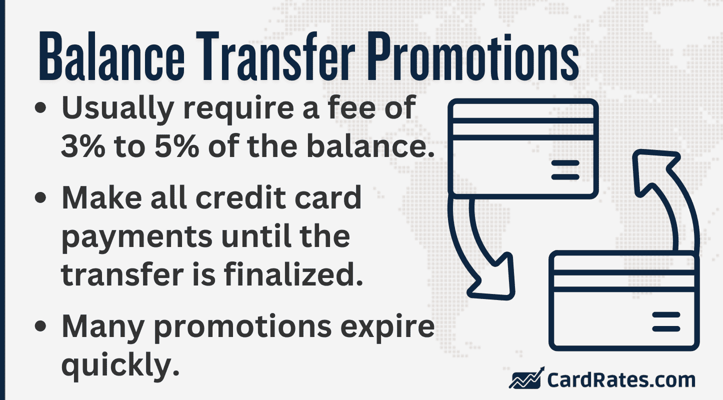
A common mistake during the balance transfer process is that people often stop making payments on the account they’re transferring from. Keep in mind, these transfers can take some time to complete.
If you have a monthly payment due while the balance transfer is still taking place — and you don’t pay it — you may face a late fee and damage to your credit score.
The time it takes to complete your credit card balance transfer depends on your new card’s issuer and the bank you’re transferring your old balance from. Based on our research with major credit card issuers, here’s what you can expect regarding the transfer timeline:
American Express: 5 to 7 business days Barclays: Up to 3 weeks Capital One: Up to 15 business days Citi: Between 2 and 21 business days Discover: Between 4 and 14 business days Chase: Between 7 and 21 business days
Keep these time frames in mind when planning your credit card balance transfer strategy. If any payment you make during the transfer exceeds the amount you owe, the credit card company will issue a refund after the balance transfer is complete.
Although most people associate balance transfer offers with only newly opened credit card accounts, you may be able to take advantage of a balance transfer to your existing credit card account as well.
In fact, if you have an open credit card account with a large available credit limit, your credit card issuer may even offer you lower-interest balance transfer promotions from time to time.
4. What is a Balance Transfer Promotional Period?
You might be tempted by a low introductory interest rate on a balance transfer, but keep in mind these rates only last for a specific time. The promotional periods can vary greatly, depending on the issuer and the specific offer.
Once the promotional period has ended, you will be charged your new account’s regular interest rate on any balance left over from your initial transfer of funds.
If you want to get the most bang for your buck, then, by all means, you should aim to pay off your full balance before the end of the intro period. Failing to eliminate your credit card balance during the promotional period negates some of your potential savings from a lower-rate or 0% introductory APR.
5. How Do You Find the Best Balance Transfer Credit Cards?
Applying for promotional balance transfer cards just to find out which one gives you the best terms is not a wise financial move. You’d be loading up your credit reports with damaging inquiries and new accounts that will certainly lower the average age of your credit, neither of which is good for your credit scores.
Before applying for a balance transfer card, it’s wise to thoroughly research your options. Doing your homework in advance can ensure you make the right choice.
Online research is the easiest way to find the best available deals on balance transfer credit card offers at any time. When searching for the best offer, pay close attention to all applicable fees, terms, and conditions, including:
Introductory APR and balance transfer APR
Balance transfer fees
When your low introductory rate expires
What your new APR will be on the remaining balances after the intro rate ends
Credit limits and any maximum transfer caps that may be set by the issuing bank
The comparison boxes provided above can give you a good idea of the terms of the best balance transfer credit cards without your actually having to apply for any of them.
Despite the fact that most cardholders don’t read their cardholder agreements, you should at least take the time to become somewhat familiar with them. The full terms and conditions of the offer, including those pertaining to any introductory rates, may be available only through a separate link on the card issuer’s website. And, in some cases, they’ll be mailed to you.
If you have difficulty locating the terms and conditions on a credit card offer, you can always call the issuing bank with questions before applying.
6. How Do Balance Transfers Impact Your Credit Scores?
The impact a balance transfer has on your credit scores is going to depend on a variety of factors. Also, because no two people have the exact same credit reports, a new balance transfer may not affect your credit scores the exact same way it affects my credit scores.
Those statements aside, a balance transfer can be a positive move from a credit scoring perspective in many cases. Credit scoring models like VantageScore and FICO heavily consider the balances on your credit card accounts. More specifically, they consider how the credit card balances displayed on your reports relate to your available credit limits.
The higher your balances relative to your credit limits, the higher your credit utilization rate (or ratio) will be. That’s not good for your scores.
A lower credit utilization ratio will often impact your credit scores positively. Provided you leave your existing credit card account(s) open, and you don’t run up additional credit card debt, a new balance transfer card should lower your revolving utilization ratio — a potential win-win for both your credit scores and your wallet.
Here’s an example of how to calculate CUR for someone who has three credit cards and a $10,000 overall credit limit:
Card A
Card B
Card C
Overall
Balance
$500
$0
$2,150
$2,650
Credit Limit
$2,000
$3,000
$5,000
$10,000
Utilization Ratio
25%
0%
43%
26.50%
Opening a new balance transfer card could have a negative impact on your scores a couple of ways, albeit probably only slightly. First, when a lender pulls one of your credit reports as part of the application for your new account, a hard inquiry will be recorded on that report.
That hard inquiry might slightly lower your credit scores on that specific report. Generally, a single inquiry isn’t a big deal from a credit scoring perspective. But if you apply for numerous balance transfer cards in a short time, multiple inquiries can have a more significant negative impact on your score.
Opening a new account of any kind can lower the average age of accounts on your credit reports. From a scoring perspective, older accounts generally contribute positively to your credit score.
Lowering this average account age could have a slightly negative impact on your credit scores. And, if you open several cards in a short period, you’ll lower the average age of your accounts considerably.
Despite the factors discussed above, a balance transfer commonly has a positive overall credit score impact. Of course, for any positive impact to stick, it is important to lower the amount of your credit card debt.
7. Do You Need Excellent Credit for a Low-Interest Credit Card Offer?
Low-interest cards and qualifying balance transfer deals are normally reserved for consumers who have good credit or excellent credit scores. You will likely need to have good-to-excellent credit if you hope to qualify.
Lenders typically will not extend their most attractive promotional balance transfer offers to consumers they consider to be high-risk applicants, as indicated by their lower credit scores.
Now and then, you may come across a balance transfer offer marketed to consumers with fair credit ratings. However, these promotional deals typically are not quite as sweet as the promos you may land if you had good credit, and they may have extra fees, such as a high annual fee.
FICO Score Range
Credit Rating
Balance Transfer Offer Outlook
300–579
Poor
Low-interest promotional offers may be difficult to qualify for.
580–669
Fair
Some offers may be available, but terms can be less favorable.
670–739
Good
Applicants are generally better positioned for competitive offers.
740–799
Very Good
Applicants are generally well positioned for competitive terms.
800–850
Exceptional
Applicants may have access to the most favorable available offers.
Approval requirements vary by issuer, and your credit score is only one factor considered.
If your credit rating is not great right now, it’s wise to focus on improving your creditworthiness before applying for new low-interest card offers. Applying for prime credit card offers with a subprime score is likely to lead to rejection.
And, to add insult to injury, the credit inquiry may lower your credit score even more.
Keep in mind that you can also leverage prequalification forms through many of the biggest credit card issuers. These forms will run a soft credit check on your account that won’t leave a hard inquiry behind. Based on the data provided, the credit card issuer can often make a non-binding decision on whether you qualify for the card before you officially apply.
While prequalification doesn’t guarantee card approval, it usually indicates a good chance once you submit your official application.
8. What is a Balance Transfer Fee?
Most balance transfers involve a small transaction fee, typically ranging from 3% to 5% of the amount transferred. These fees are set by the card issuer for the new account.
Let’s say, for example, you have a card with a $1,500 balance, and the balance transfer fee is 5%. That means your balance transfer fee would be $75. When debt balances are higher, you can see how this amount can significantly increase. Another example, if you had a $10,000 credit card balance, that same 5% fee would cost you $500.
9. Can You Earn Cash Back or Rewards on Balance Transfers?
Although every issuer sets its own policies, you typically cannot qualify for cash back, miles, or rewards points on balance transfers. Credit card issuers almost always include language in their agreements that excludes balance transfers from earning rewards or qualifying for a signup bonus and instead limits rewards only to new qualifying purchases.
You typically cannot qualify for cash back, miles, or rewards points on balance transfers.
If you think about it, you likely received some form of credit card rewards when you first incurred the debt. Getting rewarded for it again, without making a new purchase, doesn’t really make sense for the new issuer. If you want to qualify for rewards and signup bonuses, you will likely have to rely on new purchases rather than balance transfers to earn such perks from your card issuer.
10. Do Balance Transfer Credit Cards Require a Monthly Payment?
When you transfer an existing balance from one credit card account to another, you will be required to make at least the minimum payment due on the account each billing cycle moving forward.
Of course, for you to really benefit financially from a balance transfer, you should plan to follow a much more aggressive repayment schedule.
Before you decide which card you want to apply for, be certain that you understand the full time frame for the card’s interest-free promotion. At times, a card may offer two different 0% APR windows — such as 18 months for new purchases and six months for balance transfers. Don’t assume that the window is the same for both types of transactions.
But, if you are fortunate enough to qualify for a balance transfer card and then you rack up a much higher balance or you miss payments or you charge up the pre-existing card, then you’re going to find yourself in trouble twice over.
This is a bad idea. One of the biggest mistakes you can make with a new balance transfer card is to miss your payments.
You might be offered an introductory rate on a new card or for a balance transfer. The introductory rate has to stay in effect for at least six months, unless you are more than 60 days late on a payment. — CFPB
If you make late payments, your card issuer might charge a late fee.
Make it a point to always pay your minimum payments on time, no matter what. Missing payments, whether it’s a balance transfer card or another credit type, never leads to anything good.
Editorial Note: Our site content is not provided or commissioned by any credit card issuer(s). Opinions expressed on CardRates.com are the author's alone, not those of any credit card issuer, and have not been reviewed, approved, or otherwise endorsed by credit card issuers. Every reasonable effort has been made to maintain accurate information; however, all credit card offer details, including information about rewards, signup bonuses, introductory offers, and other terms and conditions, is presented without warranty. Clicking on any offer on CardRates.com will direct you to the issuer's website, where you can review the current terms and conditions of the offer.
The information on this page was reviewed for accuracy on .
About the Author
John Ulzheimer
Credit Expert
John Ulzheimer is an expert on credit reporting, credit scoring, and identity theft. The author of four books on the subject, Ulzheimer has been featured thousands of times in media outlets including the Wall Street Journal, NBC Nightly News, New York Times, CNBC, and countless others.
With over 33 years of credit-related professional experience, including with Equifax, FICO, Experian, VantageScore, and Credit.com Ulzheimer is the only recognized credit expert who actually comes from the credit industry.
He has been engaged as an expert witness in over 800 credit-related lawsuits and has been qualified to testify in both federal and state courts on the topic of consumer credit. In his hometown of Atlanta, Ulzheimer is a frequent guest lecturer at Emory University's School of Law.
Share the Knowledge!
Our finance experts work hard to show you the best credit cards. Want to show your appreciation? Share this page!
Advertiser Disclosure: The credit card offers that appear on this site are from credit card companies from which CardRates.com receives compensation. This compensation may impact how and where products appear on this site (including, for example, the order in which they appear). CardRates.com does not include all credit card companies or all available credit card offers. See the credit card issuer's website for specific terms and conditions of each card.