

Writer: Jon McDonald


Editor: Lillian Guevara-Castro


Reviewer: Ashley Fricker

When I applied for the Capital One Quicksilver Cash Rewards Credit Card in 2015, I’d already heard Samuel L. Jackson talk about its “1.5% cash back everywhere, every day” in commercials for a few years.
Now, I can’t remember if those commercials factored into my decision to apply, but the card’s simplicity definitely appealed to me.
At the time, I’d never owned a flat-rate cash back card, and I thought getting one would give me an easy way to earn rewards without needing to do, well, anything. Over the last 10+ years, this card’s ease of use has certainly lived up to my expectations.
If you’re thinking about adding the Capital One Quicksilver Cash Rewards Credit Card to your wallet, you’ve come to the right place. I’m going to tell you why I think it is an excellent card to own and give you a close-up look at everything you need to know before submitting your application.
Using My Capital One Quicksilver Cash Rewards Credit Card
When I apply for a credit card, I always go in with a plan for how I’m going to use it, and this time was no different. Sometimes things change (as you’ll see below), but not having an idea of how I’ll use a new credit line has always seemed like a recipe for overspending.
When I submitted my application, my plan was to use the card to autopay many of my monthly bills — cable, internet, cellphone, car insurance — so I could earn a steady stream of cash back. My initial credit limit was $3,000, which was more than enough to cover them.
Everything went according to plan for the first few months — until my car broke down. It cost around $1,200 to fix it, and even though I intended to use it only for a handful of monthly bills, I decided to charge that to my Capital One Quicksilver Cash Rewards Credit Card.
The reason: The card had an introductory 0% APR offer on purchases and balance transfers for the first eight months. While I didn’t have any other high-interest balances to transfer, that offer meant I could cover this unexpected expense and have until January 2016 to pay it off without adding interest to the mix.
Once I paid that off, I got back on track with using it almost exclusively for monthly bills. Over the years, I have switched internet providers and cellphone carriers, changed car insurance companies, and ditched cable.
Speaking of cable, that one was satisfying to cancel, but I’m not sure I’m actually saving any money now that I have 15 streaming services. Anyway, back to the card!
I still use my Capital One Quicksilver Cash Rewards Credit Card to pay my internet, cellphone bill, and car insurance — and earn a steady 1.5% cash back for my efforts.
Perks & Benefits of the Card
While the 1.5% cash back has remained the same, some of the other details have changed in the last 10 years. Today’s applicants get a much better introductory deal than I did in 2015. Here’s what the card all offers today:

- Earn a one-time $200 cash bonus after you spend $500 on purchases within 3 months from account opening
- Earn unlimited 1.5% cash back on every purchase, every day
- $0 annual fee and no foreign transaction fees
- Earn unlimited 5% cash back on hotels, vacation rentals and rental cars booked through Capital One Travel
- No rotating categories or sign-ups needed to earn cash rewards; plus, cash back won’t expire for the life of the account and there’s no limit to how much you can earn
- 0% intro APR on purchases and balance transfers for 15 months; 18.49% – 28.49% variable APR after that; balance transfer fee applies
- Top rated mobile app
It has an intro APR offer of 0% for 15 months on purchases and balance transfers, which is much longer than I had.
The card has also added a cash signup bonus you can earn by meeting the spending requirement detailed above. I could easily take care of that by using the card to buy groceries for a couple of weeks.
Purchase Protections and Cash Back Boost
The Capital One Quicksilver Cash Rewards Credit Card has a handful of other features that make earning rewards more straightforward — and more valuable. First, it doesn’t charge annual or foreign transaction fees.
That means I can use it anywhere, and I won’t need to calculate how many rewards I need to earn to offset those added charges. Keeping these fees out of the mix also aligns with its overall vibe of simplicity.
Second, I can earn unlimited 5% cash back when booking hotels or rental cars through Capital One Travel. My first thought was: “Whoa, so that means 6.5% total cash back if I book a hotel or rental car?” But after a little research, I realized that is not the case.
That 5% cash back includes my flat-rate 1.5% rate, so there’s no double-dipping. Capital One is already generous with its rewards, but 6.5% cash back might be a little too generous.
Finally, Capital One has a few other benefits that I’ve never used — but I’m glad my card has them. These include extended warranty protection on eligible purchases and travel accident insurance. Just because I haven’t used them yet doesn’t mean I never will, and it’s nice to know I have the option.
The Capital One Mobile App and CreditWise
When I got this card, Capital One’s mobile app was less than a year old. I don’t remember how well it worked back then, but I do remember using it to link my bank account and setting up automatic payments quickly.
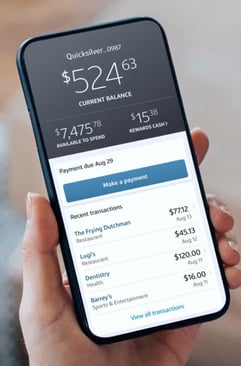
Today, the app is much more sophisticated, which also makes it easier to use. Since I use autopay, I don’t check it too often, but I will log in periodically to redeem rewards or check my credit score.
CreditWise is included on the Capital One mobile app, where I can get my credit score, credit report, and even credit and identity alerts. I check my credit score and report monthly, and I occasionally get alerts that my personal information was compromised.
Sometimes I can act on that information. When I’m told my email address was found in a data breach, and my password was exposed, I always change my password. If my Social Security number is compromised, I can click on the “Let’s Take Action” button at the bottom of the CreditWise alert.
There, I can find plenty of information and links to sources that can help me prevent identity theft. According to this resource, the most important thing is to stay vigilant. That means checking your credit report regularly for any suspicious activity. But if you check your credit reports as often as I do, you should be well ahead of the game.
Highly Ranked Customer Support
J.D. Power puts out a yearly study that ranks credit card issuers based on how satisfied their customers are, and a big part of that includes customer support. Capital One frequently ranks in the top five, and the bank even acquired Discover, which also ranks near the top every year.
I can access plenty of support services through the mobile app’s Help tab, which opens a chat with Capital One’s Eno digital assistant. It can answer basic questions, such as: “What is my interest rate?” or “Can I change my due date?”
Capital One has dedicated lines for a variety of cardholder situations, or you can call the general support line (1-877-383-4802), and someone will get you to the right place.
If I have more specific questions about my account or rewards, I can type “Customer support” into the Eno chat, and a Contact Us link pops up. When I click on that, it gives me the option to search all help topics or find the right number to call a representative (depending on what questions I have).
When I called the general Capital One customer service number at 10 AM on a Wednesday, I was able to get a live representative on the line in less than two minutes. So, if there’s an issue, I know I’ll be able to speak with someone quickly.
What Credit Score You Need to Qualify
My credit score was around 750 when I applied. Today, Capital One’s website says excellent credit is needed to be approved for the Capital One Quicksilver Cash Rewards Credit Card. On the FICO scale, a credit score of 800 or above is considered excellent.
So, does Capital One require a score of 800 or higher to be approved? While the company doesn’t state any minimum score explicitly, there seems to be at least some wiggle room.
| FICO Score Categories | Score Range |
|---|---|
| Exceptional | 800-850 |
| Very Good | 740-799 |
| Good | 670-739 |
| Fair | 580-669 |
| Poor | Below 580 |
According to Capital One’s Credit Level Guidelines chart, I could have excellent credit if “I’ve never declared bankruptcy or defaulted on a loan; I haven’t been more than 60 days late on any credit card, medical bill, or loan in the last year; I’ve had a loan or credit card for 3 years or more with a credit limit above $5,000.”
Someone could easily meet those requirements but not have an 800 credit score. But since Capital One doesn’t set a minimum score for its excellent credit threshold, it could be a little more flexible.
This is just one of the many reasons why I’d recommend getting preapproved for this card — as I’ll discuss more in the application section.
How to Apply (A Step-by-Step Guide)
I don’t remember exactly what information I had to give Capital One on my application all those years ago, although it was probably close to what the company asks for now. Luckily, Capital One’s application is pretty accessible, so I don’t need to make any guesses about today’s requirements — I can just look at them.
Capital One actually has two types of applications: a preapproval and a full application. Both types ask for basically the same information, but I would recommend going through the preapproval process because it won’t impact your credit score, and it’ll give you a good indication of whether you’ll qualify.
I can’t remember if I took my own advice when I applied — or if preapproval was even a thing way back then.
But skipping straight to filling out a full application and getting denied would have been the worst of all worlds — no credit card, a credit score ding, and a hard inquiry that stayed on my credit report for two years.
The current application is pretty easy and takes about five minutes to fill out. However, the terms at the end are an important read, so I’d recommend devoting 15-20 minutes to reading them.
Here is a complete look at all the steps necessary to apply for the Capital One Quicksilver Cash Rewards Credit Card:
Note: I didn’t apply during this process; this look at the application is for informational purposes.
Step 1: Basic Information and SSN
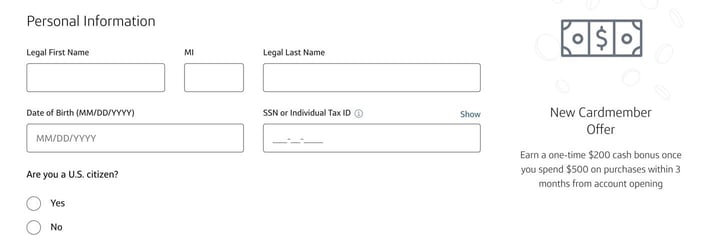
The application requires my legal name, date of birth, Social Security number, and U.S. citizenship status on the first page.
Step 2: Address and Contact Info
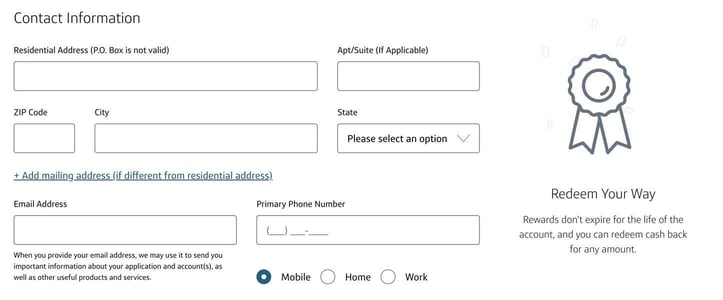
On the next page, it asks for a residential address, email address, and primary phone number. Pretty standard stuff.
Step 3: Employment and Finances
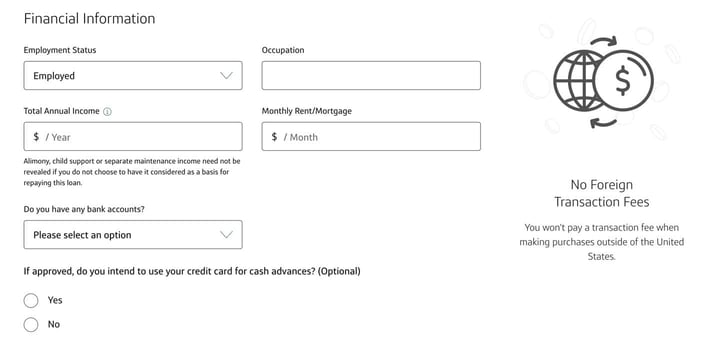
The third page of the application deals with employment and finances, including details about my occupation, annual income, monthly rent or mortgage payment, and what type of bank account I have (or I can say I don’t have one).
I don’t enter any actual banking details at this stage. Capital One also wants to know if I intend to use my card for cash advances, but that’s an optional question. I’d imagine it is probably a red flag when someone answers yes to that question, but that’s just my opinion.
Step 4: Add an Authorized User
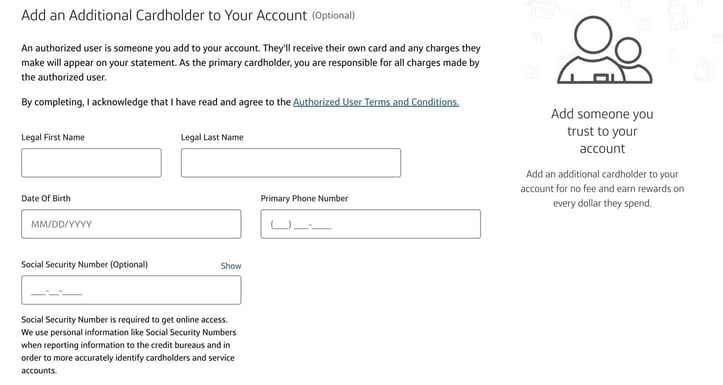
By this point, I’m close enough to submitting the application that Capital One wants to know if I’ll be adding any additional cardholders to the account. I can add an authorized user by filling out their information on this page, but I can also add one to the account at any time.
Step 5: Review the Details
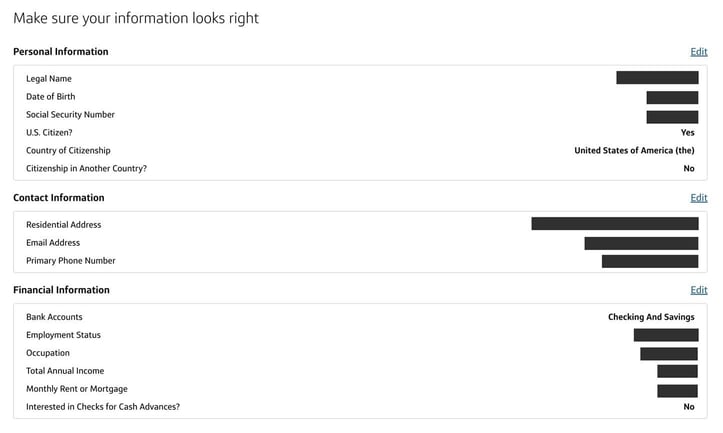
This step is just looking over the details I’ve submitted and making sure they are correct. Obviously, the details you enter won’t be redacted, but they also won’t be published all over the internet. So, I definitely redacted most of mine.
Step 6: Application Terms — Always Read Them in Full
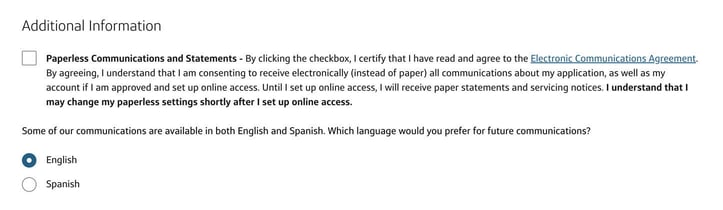
The next page asks for my communication language preference and lets me opt in to paperless communication, meaning Capital One won’t print and send me a bill once I set up an online account. I mostly choose this because I hate getting mail I have to shred, but partly because it makes me feel like Captain Planet.
Below the Additional Information section are more Important Disclosures. Like I said earlier, I’d recommend setting aside 15-20 minutes to look over this document, as it will answer a lot of questions about interest rates, fees, rewards, and even legal rights.
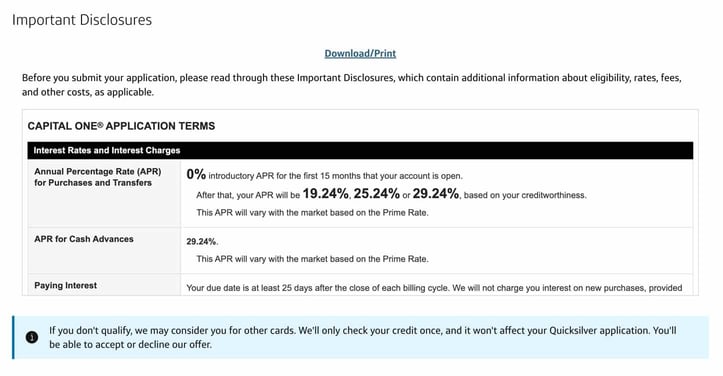
I also suggest downloading it so you don’t have to spend the entire time scrolling through a tiny box on your computer or mobile device. Cardholders also have access to this document through the Capital One mobile app.
But I wouldn’t suggest printing it out because, hey, I’m Captain Planet.
Step 7: Submit the Application
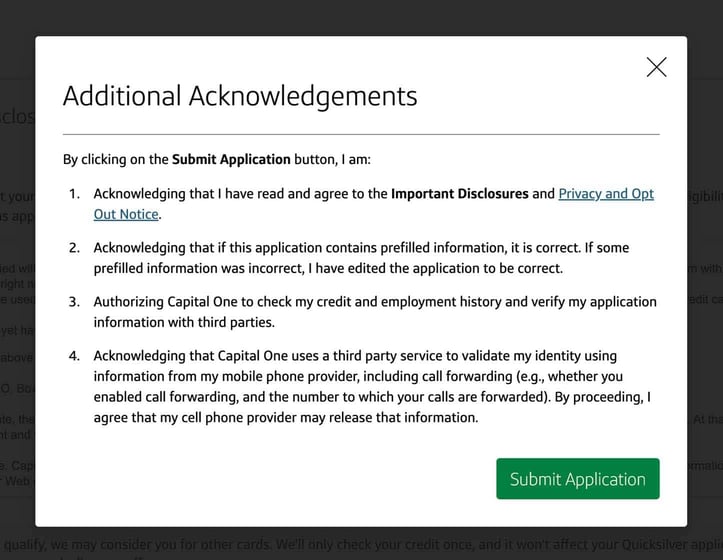
The last step before submitting the application is an Additional Acknowledgments pop-up, but this isn’t where Capital One thanks all the little people who believed in it.
This is where I acknowledge that I’ve read and agreed to all the notices, that all the information I entered is accurate, and that I allow Capital One to check my credit history and verify everything in my application. I’m also allowing the bank to verify my identity with help from my mobile provider.
I acknowledge all of those things by clicking Submit Application. Once I do, Capital One will usually respond in less than two minutes (they aim for 90 seconds) with an approval or denial.
Sometimes, an application can get hung up if the bank can’t verify information fast, but this is rare. An approval or denial decision should come in less time than it takes to watch a video on TikTok.
What Credit Limit to Expect
Your credit limit will mostly depend on your credit score, credit report, and ratios like debt-to-income and credit utilization. As we’ll discuss a little later in the credit criteria section, you’ll need excellent credit to qualify. And most people with excellent credit will pass financial checks with flying colors.
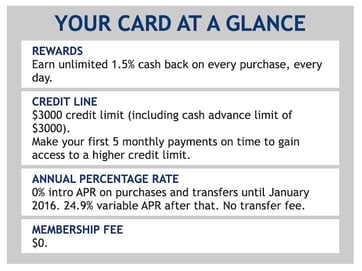
Capital One doesn’t list any specific minimum or maximum credit limit for this card, so I can only relay my own experience.
As I mentioned above, my credit limit started at $3,000. Over the years, I’ve had increases to $3,500, $5,000, and $8,000, which is my current limit. That limit definitely gives me some peace of mind if something unexpected happens. Even though this time, I’d be looking at paying a much higher APR than 0%.
No matter what your initial credit limit is, you can easily request an increase on the Capital One app. I wouldn’t recommend doing this unless your income increases, as that is one of the first questions Capital One will ask. But if your financial situation has improved, it could be worth an ask — but I’d limit requests to one per year.
How I Like to Redeem My Cash Back
Over the last 10 years, I have redeemed approximately $710 in cash back rewards, which I earned by spending an average of $394 per month. By setting up autopay and connecting a few necessary bills to my account, I basically earned $700 (and counting) for doing nothing. That’s a pretty great ROI.
From the beginning, my plan for redeeming cash back was simple: I would wait until my cash back reached around $100, then apply it as a statement credit through the app. I have actually stuck to this plan through the years, and it has made everything incredibly easy.
Every once in a while, I end up paying $100 less on my monthly credit card bill, which is pretty satisfying, and I never need to track anything. The Capital One app homescreen tells me how much cash back I’ve earned right below my balance, so I’m aware of it when I open the app. But I don’t pay much attention until I see it get to around $90. Then I know it’s close.
And while I prefer statement credit, that doesn’t mean everyone does. That’s why Capital One offers a handful of ways to redeem cash rewards. Cardholders can:
- Redeem rewards for cash: Capital One will mail you a check.
- Cover a recent purchase: As far as I can tell, this is practically the same as redeeming for a statement credit.
- Redeem cash back for a gift card: Choose from 100+ different places, including stores, restaurants, and hotels.
- Use them at Amazon.com: Put cash back directly toward an Amazon purchase. I am firmly on team statement credit, but I might need to try this one.
- Use rewards at PayPal checkout: Add your Quicksilver card to PayPal and use your rewards when you check out.
- Book a trip: Redeem rewards for flights, hotels, or rental cars through Capital One Travel.
- Redeem them for tickets or experiences: Use cash back (or points/miles if you have another Capital One card) for tickets to concerts, shows, sporting events, and cardholder-exclusive experiences — the list is in the thousands — through Capital One Entertainment.
- Transfer to another Capital One account: If you have another Capital One card that earns miles, such as a Venture or VentureOne card, you can transfer your points to that card and boost your miles. (I don’t have a Capital One miles card, so this isn’t an option for me, but it’s still worth mentioning for those who do.)
I can redeem my cash back for any of these directly through the app. All I need to do is open it up and tap “Explore Rewards and Benefits,” and I am whisked away to a page dedicated to helping me track and use my cash back.
Once I land on that page, all of these redemption options are at my fingertips, and it is simple to browse the categories and find new ways to use my rewards.
Other Cards Worth Considering
While unlimited 1.5% cash back on everything is nice, there are options out there that offer 2% cash back. But that 2% cash back comes with some catches you won’t find with the Capital One Quicksilver Cash Rewards Credit Card.
Here are two other cards that offer 2% cash back, and what you need to know about the fine print:
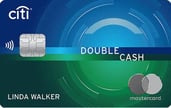
- The Citi Double Cash® Card offers 2% cash back, but has a different payout structure. It gives 1% cash back on purchases and another 1% when they’re paid for. That ends up as 2% cash back on purchases, but you won’t earn it all at the same time if you carry a balance.
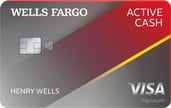
- The Wells Fargo Active Cash® Card’s flat 2% cash back rate on almost all purchases is the highest I’ve seen. And I say “almost” all purchases because that doesn’t include certain categories like gift cards, lottery tickets, or online gambling. The biggest drawback is that it charges a 3% foreign transaction fee. So, you’d likely want to leave this card at home when traveling abroad, which could reduce some of its earning power.
As you can see, both of these cards offer 2% cash back, but in different forms, and with different catches. I still prefer the simplicity and all-around flexibility of the Capital One Quicksilver Cash Rewards Credit Card, so I won’t be making the switch.
Pros and Cons
I’ve written at length about the benefits and drawbacks of the Capital One Quicksilver Cash Rewards Credit Card, but it’s nice to see how they stack up at a glance. Here are some of the card’s biggest pros and cons:
Pros
- The flat-rate cash back is perfect for people like me who don’t like managing bonus categories
- Easy to earn signup bonus
- 0% introductory APR offer is great for large purchases or balance transfers
- No annual fee or foreign transaction fees
Cons
- Not the highest cash back percentage on the market
- You need excellent credit to be approved for this card
Cardholders may find plenty of other benefits, and maybe even a few pitfalls, based on their own situations. These are just the most important ones to be aware of, and if any are dealbreakers, you may want to consider another card.
Would I Recommend the Capital One Quicksilver Cash Rewards Credit Card?
As I’ve mentioned a few times, what I like most about the Capital One Quicksilver Cash Rewards Credit Card is how simple it is. I basically set mine on autopilot and earn a steady drip of cash back that I redeem along the way.
But it can work for plenty of other types of cardholders, too. Adventurers can take advantage of 5% cash back on hotels and car rentals through Capital One Travel while avoiding foreign transaction fees.
Those who have much higher monthly expenses can use it to rack up enough cash back rewards to go on a tropical vacation. People who want to get some breathing room from other high-interest credit card debt can use its appealing balance transfer option.
What I like most about the Capital One Quicksilver Cash Rewards Credit Card is how simple it is. I basically set mine on autopilot and earn a steady drip of cash back that I redeem along the way.
The only downside I can think of is that I know there are a handful of cards out there that offer 2% cash back. Some of that might just be a fear of missing out, but I can also quickly calculate that I would have earned about $236 more in rewards over the last 10 years with a different card.
A different card would have also come with different variables, like credit limits, APR promotions, ease of use, and redemption options. Considering that and my experience, I’m happy with my decision to apply for the Capital One Quicksilver Cash Rewards Credit Card.
And I’d recommend it to anyone who enjoys earning cash back without any complicated redemption strategies.
Editorial Note: Our site content is not provided or commissioned by any credit card issuer(s). Opinions expressed on CardRates.com are the author's alone, not those of any credit card issuer, and have not been reviewed, approved, or otherwise endorsed by credit card issuers. Every reasonable effort has been made to maintain accurate information; however, all credit card offer details, including information about rewards, signup bonuses, introductory offers, and other terms and conditions, is presented without warranty. Clicking on any offer on CardRates.com will direct you to the issuer's website, where you can review the current terms and conditions of the offer.
About the Author

![[card_field card_choice='5856' field_choice='title'] VS. [card_field card_choice='5816' field_choice='title'] (4 Key Differences)](https://www.cardrates.com/images/uploads/2016/02/capital-one-quicksilver-vs-discover-it.jpg?width=164&height=85 "[card_field card_choice='5856' field_choice='title'] VS. [card_field card_choice='5816' field_choice='title'] (4 Key Differences)")
![[card_field card_choice='68495' field_choice='title'] vs. [card_field card_choice='5909' field_choice='title'][updated_month_year before=" (" after=" Comparison)"]](https://www.cardrates.com/images/uploads/2018/02/chase2.png?width=164&height=85 "[card_field card_choice='68495' field_choice='title'] vs. [card_field card_choice='5909' field_choice='title'][updated_month_year before=\" (\" after=\" Comparison)\"]")
![[card_field card_choice='39321' field_choice='title'] vs. [card_field card_choice='31445' field_choice='title'] Review[updated_month_year before=" (" after=")"]](https://www.cardrates.com/images/uploads/2018/02/ink.png?width=164&height=85 "[card_field card_choice='39321' field_choice='title'] vs. [card_field card_choice='31445' field_choice='title'] Review[updated_month_year before=\" (\" after=\")\"]")
![[card_field card_choice='5853' field_choice='title'] vs. [card_field card_choice='5855' field_choice='title'][updated_month_year before=" (" after=" Review)"]](https://www.cardrates.com/images/uploads/2018/03/shutterstock_1190829136.jpg?width=164&height=85 "[card_field card_choice='5853' field_choice='title'] vs. [card_field card_choice='5855' field_choice='title'][updated_month_year before=\" (\" after=\" Review)\"]")
![[card_field card_choice='68438' field_choice='title' link_type='none'] Review & Alternatives[updated_month_year before=" (" after=")"]](https://www.cardrates.com/images/uploads/2022/03/Citi-Secured-Credit-Card-Review.jpg?width=164&height=85 "[card_field card_choice='68438' field_choice='title' link_type='none'] Review & Alternatives[updated_month_year before=\" (\" after=\")\"]")
![[card_field card_choice='29774' field_choice='title' link_type='none'] vs. The Luxury Card[updated_month_year before=" (" after=")"]](https://www.cardrates.com/images/uploads/2022/05/Chase-Sapphire-Reserve-vs.-Luxury-Card.jpg?width=164&height=85 "[card_field card_choice='29774' field_choice='title' link_type='none'] vs. The Luxury Card[updated_month_year before=\" (\" after=\")\"]")
![[card_field card_choice='16924' field_choice='title' link_type='none'] Review & Alternatives[updated_month_year before=" (" after=")"]](https://www.cardrates.com/images/uploads/2022/06/Surge-Mastercard-Reviews.jpg?width=164&height=85 "[card_field card_choice='16924' field_choice='title' link_type='none'] Review & Alternatives[updated_month_year before=\" (\" after=\")\"]")
![[card_field card_choice='49613' field_choice='title' link_type='none'] Benefits, Applying & Alternatives](https://www.cardrates.com/images/uploads/2022/06/Mastercard-Black-Card.jpg?width=164&height=85 "[card_field card_choice='49613' field_choice='title' link_type='none'] Benefits, Applying & Alternatives")