
Writer: Jon McDonald


Editor: Adam West


Reviewer: Ashley Fricker

Key Takeaways
Paying your mortgage with a credit card is tricky, but possible. I’ll show you how to do it and why these two cards are my favorites for this strategy:
-
Discover it® Cash Back: Best for cash back and intro bonus. See rates & fees
-
Capital One Venture Rewards Credit Card: Best for travel rewards & bonus miles. See rates & fees
I use a credit card to automate payments for all of my major monthly expenses. That means I earn rewards when I pay for streaming services, internet, utilities, and my family’s cell phone plan.
I also autopay the entire statement balance on all those credit cards each month to avoid interest. I pay the same amount I normally would and reap some pretty hefty rewards.
However, there’s one massive bill I want to pay with a credit card each month that isn’t as simple: my mortgage. Call it my white whale, my Everest, my millstone (thanks, thesaurus!), but I wanted to find a way to earn rewards by paying it every month.
I did a deep dive to find why it’s so much harder to pay my mortgage with a credit card and when it actually makes sense. So, follow me down this rabbit hole, and I’ll tell you which credit cards are best for mortgage payments, and when the juice is worth the squeeze.
Why Mortgage Lenders Don’t Accept Credit Card Payments
Virtually no mortgage lenders accept credit card payments, and the reason is pretty simple: money. Mainly because they want to keep it.
Credit card companies charge processing fees as high as 3.5% to merchants, and it doesn’t matter if it’s a mom-and-pop local business or a multinational mortgage conglomerate; they have to pay.
If I make a $2,000 mortgage payment with a credit card that charges a 3% processing fee, the lender is out $60. Using a credit card to make all the payments on a 30-year mortgage means the lender would make $21,600 less (and it’d have to pay that to a credit card company, ouch!).
Lenders don’t want to lose out on up to 3.5% of the monthly payments they receive on each mortgage, so they don’t make this an option. There are other minor reasons (chargeback concerns, the optics of paying secured debt with unsecured debt), but losing out on that much money is the primary factor.
But there are ways to (legally) get around this widespread policy. It really just comes down to the situation, the type of credit card, and how much time I’m willing to spend to set it up.
How to Use a Credit Card for Mortgage Payments
So, I understand why my mortgage company won’t accept my rewards credit card for my payment, but I still want to give it a shot. The best option I found to make a payment with a general credit card is through a third-party service.
The most popular choice is Plastiq, a company that converts credit card payments into ACH payments a mortgage lender will accept. Generally, credit card companies code these payments as standard purchases, not cash advances, so I’d earn rewards.
But make double, triple, and quadruple sure your credit card issuer does this before trying to make a mortgage payment using a third-party payment platform. If not, your mortgage payment could be a lot higher.
| When Payments Are Coded as Purchases vs. Cash Advances | ||
|---|---|---|
| Category | Codes as a Purchase | Codes as a Cash Advance |
| Rewards Earned | Yes | None |
| Upfront Issuer Fee | $0 | Typically 3%–5% |
| Interest Grace Period | Yes (if paid in full) | None (interest starts day 1) |
Another important note: Plastiq only accepts Mastercard and Discover for these types of payments. It does not accept Visa or American Express, as both issuers prohibit using their cards for being used for mortgage payments.
And Plastiq doesn’t do this work out of kindness; the company charges 2.99% for its trouble, and may also charge additional fees based on which card you use and how the payment is delivered (e.g., check, ETF, or ACH bank transfer).
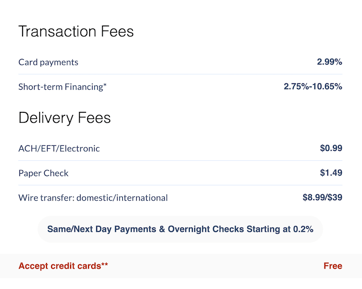
That means math (my most intense frenemy) will determine if I win or lose on this deal.
From what I could tell, this is the only mainstream service currently offering this capability. I didn’t find any others that made it clear I could consistently pay my mortgage with a credit card.
So, as a Mandalorian would say: “This is the way.”
Of course, there are other, far more costly ways to pay mortgage payments with a credit card, including cash advances and balance transfer checks. I’ll tell you why those are such a bad idea a little later.
Right now, I want to highlight the best credit cards for mortgage payments, what situations they’re best for, and if they can actually pay off.
Best Cash Back Credit Cards for Mortgage Payments
If I don’t get more value back from my credit card than what the processing fee costs, then the math isn’t really mathing for me. But there is one strategy that can make the numbers add up in my favor: Using a cash back card that has a signup bonus
I’d want a credit card with a spending threshold for that bonus that I could meet with a single mortgage payment. Plus, the cash back I’d earn would come close to negating the fee, so I’d definitely come out ahead.
Here are two cards that meet the criteria, and they have a few other tricks up their sleeves, as well.
Discover it® Cash Back
The Discover it® Cash Back is one of the best overall cards on the market. I’ve had this card for more than a decade, and if I made a Mount Rushmore of credit cards, this would definitely be on it.
It offers an intro bonus with an easily attainable spending threshold and flat-rate cash back on all purchases.
The card also has a 0% Intro APR for 15 months on purchases and 0% Intro APR for 15 months on balance transfers. Just know that it reverts to the regular APR after the no-interest window closes.
And new cardholders can take advantage of its Cashback Match program that matches all cash back earned in the first year.

- Get a 0% intro APR for 15 months on purchases and balance transfers; balance transfer fee applies. Then 18.74% to 28.74% Standard Variable Purchase APR applies, based on credit worthiness
- INTRO OFFER: Receive a $200 statement credit when you spend $500 on purchases in your first 3 months of account opening
- UNLIMITED CASHBACK MATCH: Discover will automatically match all the cash back you’ve earned at the end of your first year! There’s no minimum spending or maximum rewards. You could turn $150 cash back into $300
- Earn 5% cash back on everyday purchases at different places you shop each quarter like grocery stores, restaurants, gas stations, and more, up to the quarterly maximum when you activate. Plus, earn unlimited 1% cash back on all other purchases
- Redeem cash back for any amount. No annual fee
- Terms and conditions apply
As for making a mortgage payment with this card through a third-party service, I’d only want to do it once, shortly after I’m approved. That’s because I’d easily earn the intro bonus and get the flat-rate cash back (which would be matched with Cashback Match at the end of my first year).
And I would absolutely want to ensure I paid off the entire balance well before the 0% intro APR promo ends. Once that goes away, the regular APR applies to the entire balance, which would result in paying more interest, effectively wiping out any rewards or bonuses.
But the Discover it® Cash Back is also a good card to keep around for the long-term because it offers higher cash back amounts on certain categories that rotate every quarter. And here’s a pro tip: If the rotating category is ever utilities, jump on it.
Utilities are costly (especially in Florida during the summer), so I’ll take every bit of cash back relief I can find.
Citi Double Cash® Card
I like it when something has a name that tells you exactly what it does. Whether it’s a hot tub, bubble wrap, or a Post-It note, I don’t have to think about it.
The Citi Double Cash® Card is refreshing because it does exactly what its name suggests, allowing cardholders to earn double cash back on purchases. And it does so in a unique way.
For example, if I used the card to make a purchase, I’d get 1% cash back immediately, and then another 1% back when I made a payment to cover that purchase. So, in effect, I can earn double cash back.
- Earn $200 cash back after you spend $1,500 on purchases in the first 6 months of account opening. This bonus offer will be fulfilled as 20,000 ThankYou® Points, which can be redeemed for $200 cash back.
- Earn 2% on every purchase with unlimited 1% cash back when you buy, plus an additional 1% as you pay for those purchases. To earn cash back, pay at least the minimum due on time. Plus, earn 5% total cash back on hotel, car rentals and attractions booked with Citi Travel.
- Balance Transfer Only Offer: 0% intro APR on Balance Transfers for 18 months. After that, the variable APR will be 18.49% – 28.74%, based on your creditworthiness.
- Balance Transfers do not earn cash back. Intro APR does not apply to purchases.
- If you transfer a balance, interest will be charged on your purchases unless you pay your entire balance (including balance transfers) by the due date each month.
- There is an intro balance transfer fee of 3% of each transfer (minimum $5) completed within the first 4 months of account opening. After that, your fee will be 5% of each transfer (minimum $5).
Additional Disclosure: Citi is a CardRates advertiser.
It also has an intro bonus and a 0% intro APR offer that can come in handy if I use it to make a mortgage payment. Just keep in mind that the spending threshold to earn the bonus is slightly higher on this card, so it might take a couple of mortgage payments to reach it.
The bonus is sizable compared to the fees I’d incur from a third-party payment platform, so it should be worth it. And the double cash back would also help with bridging the gap.
I’d probably stop using it for mortgage payments once I hit that spending threshold, but it would still be a great addition to my wallet for the cash back alone.
Oh, and as for things that don’t do what their name implies, I’ve always been confused by Bluetooth. I use it every day (and even know the backstory), but it still sounds like made-up gobbledygook every time I say it out loud.
Best Travel Rewards Card for Paying Your Mortgage
Just like I’m big on cash back, many people are big on travel rewards. So, I’d be remiss if I didn’t talk about an option for all of the frequent flyers out there.
Some travel rewards cards have huge airline miles bonuses that can be just as lucrative as any other signup bonus, especially for someone who books a lot of flights. Here’s a great option for those who may want to use a mortgage payment as a springboard to a spring break trip.
Capital One Venture Rewards Credit Card
The Capital One Venture Rewards Credit Card is the quintessential travel rewards credit card. I wouldn’t get this card just to earn its generous miles bonus and then shelve it; I’d make sure I could use it to supplement my jet-setting lifestyle.
One reason is that it has an annual fee of $95, so I’d need to plan to offset that every year. Luckily, this card has a ton of features that make that pretty easy.
- LIMITED-TIME OFFER: Enjoy $300 to use on hotel and vacation rental bookings through Capital One Travel in your first cardholder year, plus earn 75,000 bonus miles once you spend $4,000 on purchases within the first 3 months from account opening – that’s more than $1,000 in travel value
- Earn unlimited 2X miles on every purchase, every day
- Earn 5X miles on hotels, vacation rentals and rental cars booked through Capital One Travel
- Miles won’t expire for the life of the account and there’s no limit to how many you can earn
- Receive up to a $120 credit for Global Entry or TSA PreCheck®
- Use your miles to get reimbursed for any travel purchase—or redeem by booking a trip through Capital One Travel
- Enjoy a $50 experience credit and other premium benefits with every hotel and vacation rental booked from the Lifestyle Collection
- Transfer your miles to your choice of 15+ travel loyalty programs
- Top rated mobile app
It offers 2 Miles per dollar on every purchase, every day and a bonus miles rate on hotels, vacation rentals, and even rental cars if I book through the Capital One Travel portal. And Capital One often has limited-time offers on this card, such as a hefty Capital One Travel credit in the first year that can more than offset the annual fee. So, check what the current promotion is before applying.
It would take me a few mortgage payments to meet the spending threshold for the hefty miles bonus, and I’d earn miles instead of cash back to offset the fees. But I probably wouldn’t be thinking about that while I was sitting on a beach after using the miles to cover my flight (and possibly even flights for my wife and kids).
Just know that this card doesn’t have a 0% APR period, so paying off the entire balance before the statement due date is key. Sand under my feet feels great, but if I had to pay all that interest, it’d start to feel more like quicksand.
Best 0% Intro APR Credit Card for Mortgage Payments
So far, I’ve focused on using mortgage payments to earn rewards and meet thresholds for signing bonuses. But those certainly aren’t the only motivations to use a credit card to pay a mortgage.
I understand how precarious financial situations can be, and that someone may need to use this strategy as a last resort rather than miss a mortgage payment completely.
If I needed to make a mortgage payment (or two) to get some breathing room and find my financial footing, rewards and fees might not concern me as much as having time to pay it off.
If that situation sounds familiar, here’s an option to consider.
BankAmericard® credit card
The BankAmericard® credit card could help bridge a short-term financial gap thanks to its lengthy 0% intro APR period. While it doesn’t offer rewards, this interest-free window may provide some breathing room if you decide to use it to make a mortgage payment.
But I want to be clear: This is not a long-term solution. If you plan to make more than a couple of payments this way, you should reevaluate your finances or try to work out a payment plan with your mortgage company.
If I planned to go this route, I’d want to know how it would help and what financial commitment I’d be making. So, let’s say my mortgage payment was $1,500 per month, and I used this card through Plastiq to pay my mortgage via ACH transfer for two months.
- 0% Intro APR for 21 billing cycles for purchases, and for any balance transfers made in the first 60 days. After the Intro APR offer ends, a Variable APR that’s currently 15.24% – 26.24% will apply. A 5% fee applies to all balance transfers. Balance transfers may not be used to pay any account provided by Bank of America.
- No annual fee.
- No penalty APR. Paying late won’t automatically raise your interest rate (APR). Other account pricing and terms apply.
- This offer may not be available elsewhere if you leave this page. You can take advantage of this offer when you apply now.
Additional Disclosure: Bank of America is a CardRates advertiser.
The math is pretty simple for how much extra I’d pay: $3,000 x 0.0299 (2.99% transaction fee) + $1.98 (ACH Bank Transfer delivery fee) = $91.68.
That means I would put $3,091.68 total on this credit card. I would plan to pay that off in 12 months (which is far shorter than the 0% intro APR period) to eliminate this debt and get back to my regular monthly mortgage payment.
I’d want to pay a little more than $257 each month, starting with my first billing statement, and after the two months, I’d resume my regular mortgage payment. At that point, I’d basically be paying around $1,750 per month for my mortgage for a while.
If that breathing room works for you, and you know you’ll be able to afford the extra payment amount until your credit card hits $0, this could offer some relief. But I can’t stress enough that the balance needs to be paid before the 0% APR period closes, or else the regular APR will kick in and be added retroactively to the initial $3,000.
The Bilt Card Ecosystem: A Specialized Option for Mortgages
Bilt is the most prominent issuer of credit cards that are designed for making mortgage payments. Its three credit card options are for different applicant tiers: the Bilt Blue Card, Bilt Obsidian Card, and Bilt Palladium Card.
Each sounds far more luxurious than the last, and the Obsidian and Palladium versions have annual fees to match their elevated stature. Anyway, this seems to be the card lineup I’m looking for, right? I can use a Bilt card to pay my mortgage with no added fees and earn rewards, so I’m thinking about signing up on the spot.
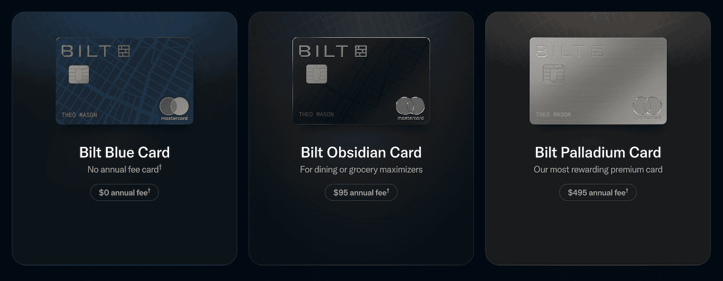
But then I check out the terms and conditions and come back down to earth a little bit. As a side note, reading the terms and conditions for any credit card can always help ground me if I’m getting too excited.
There, I find that the rewards program is more complex than I initially thought. The short version is that I get 1.25X points per dollar I spend on my mortgage payment. But the catch is that I also need to spend an equal (or greater) amount than my mortgage payment on the card to earn the full rewards amount.
If not, I’d drop down to a flat minimum of 250 points, according to the card’s updated terms. And redeeming Bilt points isn’t as straightforward as it is with many other credit cards. As of this writing, 1 Bilt point is worth about $0.0055 in statement credit and up to $0.07 if transferred to a premium travel partner.
With its complex rewards system, it’s hard to say if I’d get enough value out of this card. And I’d probably need a few thousand more words to explain it.
The Math: Rewards Earned vs. Processing Fees
If I paid my mortgage with a credit card, I would want to come out ahead. Unless I was in a financial pinch like the example in the BankAmericard® credit card section. So, before I made any transactions, I would sit down with my old frenemy, math, and hash out the numbers.
Here are some general examples of how much I’d earn based on some common cash back percentages and intro bonuses:
| Example Earnings Based on a $1,500 Mortgage Payment | ||||
|---|---|---|---|---|
| Cash Back % | Processing Fees | Rewards Earned | Intro Bonus & Spending Threshold | Approx. Net Value After First Payment |
| 1% | $45.84 | $15.00 | $200 bonus (Spend $500 in 3 mos.) | +$169.16 |
| 1.5% | $45.84 | $22.50 | $200 bonus (Spend $500 in 3 mos.) | +$176.66 |
| 2% | $45.84 | $30.00 | $200 bonus (Spend $1,500 in 6 mos.) | +$184.16 |
With cash back, the math is pretty straightforward. But with miles, it gets a little complicated (but possibly a lot more lucrative). Imagine, hypothetically, I had a travel rewards credit card that paid 2X miles on all purchases and had a 75,000-mile intro bonus after spending $4,000 within three months.
Now, let’s plug that into our example calculations for a mortgage payment of $1,500 through a third-party payment network. At first glance, I don’t like the fact that I’d pay $137 in fees just to pay my mortgage for three months. But if I’m choosing between that and finding $4,000 worth of purchases to make, it could be a wise choice.
And I would earn an absolute windfall of rewards, totaling — are you ready for this? — 84,000 total miles. I wasn’t even ready for that.
Even at a base value of $0.01 per mile, that’s worth $840 (or $702 after the fees). That is starting to make me rethink my whole strategy of using cash back cards.
Overall, the math can be favorable as long as I know my card’s benefits and limitations. Oh, and only if I stop making mortgage payments with my credit card once I hit all of my goals.
Frequently Asked Questions
Can I Use a Credit Card Cash Advance to Pay My Mortgage?
Yes, you can use a credit card cash advance to pay your mortgage. I could also eat tomato soup while sitting on my wife’s favorite white rug.
But both of these decisions would likely result in regret and money coming out of my wallet (because I know I’d just make the rug worse if I tried to clean it).
Credit card cash advances don’t have grace periods. They start accruing interest immediately, typically at a higher rate than the regular APR. That means interest starts the moment the cash hits your hand, and it doesn’t stop until you pay back the full amount.
So, this isn’t as much of a strategy as it is a desperate last resort.
Is It Worth Paying a Mortgage With a Credit Card?
It is only worth it if I don’t pay more than what my mortgage costs. If I can navigate the intricacies of a Bilt card and come out ahead, great.
If I can meet a spending threshold to earn a credit card bonus that surpasses any fees, superb.
Even if I need some financial breathing room for a couple of months, it could be worth it.
Having a plan and fully understanding your card’s terms and conditions are the keys to making it work. And while making that plan, the value (or cost) of this strategy should become clear.
Is Paying My Mortgage With a Card a Good Long-Term Strategy?
Probably not. At least that is the case if you use a general credit card. And it’s likely not possible with a Visa or American Express card (unless you know something I don’t).
Seemingly, the only way this strategy can be beneficial for more than a few months is if I become well-versed in the Bilt ecosystem and use one of its cards to pay my mortgage every month.
Even then, I’d need to spend more money on the card to unlock my rewards (which I can only use as statement credit) and still pay off the balance in full every month so I don’t accrue interest. Because I’m already paying enough interest on my mortgage.
Crunch the Numbers Before Using a Credit Card to Pay Your Mortgage
In the end, I found plenty of ways to earn bonuses and cash back by using a credit card to make mortgage payments. I also learned that there were plenty of limitations to what I can realistically accomplish.
I’d likely stop seeing any benefits after a few months if I used a general credit card, so it isn’t really a long-term strategy.
And with the Bilt lineup, I came in feeling like Jewel (“You were meant for me”) and left feeling like Avril Lavigne (“Why’d you have to go and make things so complicated?”).
It seemed perfect at first, but as I got into the weeds, I realized I’d be spending a lot of time with an eye on my Bilt points balance. So, if I do try this strategy, it’ll be with a focus on cash back and intro bonuses.
And I’ve also made another important decision. I have realized that a Credit Card Mount Rushmore would be pretty boring, even if I called it Mount Chargemore. It would just be flat rocks with EMV chips chiseled into them. That’s an idea I’ll definitely set aside for now.
Editorial Note: Our site content is not provided or commissioned by any credit card issuer(s). Opinions expressed on CardRates.com are the author's alone, not those of any credit card issuer, and have not been reviewed, approved, or otherwise endorsed by credit card issuers. Every reasonable effort has been made to maintain accurate information; however, all credit card offer details, including information about rewards, signup bonuses, introductory offers, and other terms and conditions, is presented without warranty. Clicking on any offer on CardRates.com will direct you to the issuer's website, where you can review the current terms and conditions of the offer.
About the Author