

Writer: Erica Sandberg


Editor: Lillian Guevara-Castro


Reviewer: Adam West

Our experts and industry insiders blog the latest news, studies and current events from inside the credit card industry. Our articles follow strict editorial guidelines.
The good news: credit cards are accessible to a wide range of individuals. Nearly anyone can qualify for an account of some type — even applicants with low incomes or a troubled credit history. That level of opportunity is powerful.
The bad news: Consumers with low credit scores are often lower-income borrowers, and statistically, they represent a bigger risk for lenders. On average, they’re more likely than their higher-income counterparts to miss payments and ultimately default on their obligations.
This elevated risk can be offset by a powerful counterbalance. A large population of high-income borrowers who charge frequently and pay consistently.
For the credit card industry, the stakes are clear: Growth depends on balancing accessibility with risk.
The ability to serve both high-income, reliable borrowers and riskier, lower-income applicants determines not only profitability, but also long-term stability in an increasingly competitive payments market.
High-income borrowers don’t just benefit themselves — they underwrite the system that allows issuers to keep credit accessible to millions of others.
When They Spend, Issuers Can Lend
An August 2025 Federal Reserve Bank of Boston report found that while high-income households have lower average credit card debt, they are fueling strong spending growth. In contrast, spending growth among low-income consumers is sluggish.
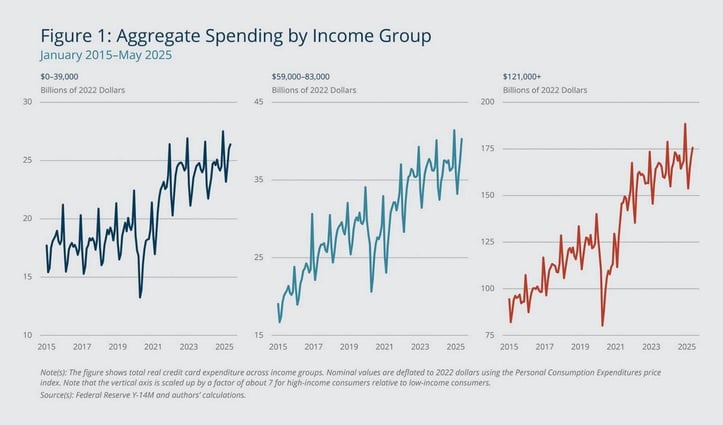
While criticizing the 1% may be in vogue on social media platforms, the reality is that high-net-worth individuals play a critical role in the credit ecosystem. Their spending power and repayment reliability help make it possible for issuers to offer credit cards to a wide spectrum of applicants, evening out the playing field.
In short, including well-off consumers in the credit system doesn’t just benefit them, it supports broader financial inclusion. Somehow this message has been lost in the noise.
Transaction Fees Help Mitigate Losses
How do credit card issuers earn revenue? In my experience, most people will correctly cite interest on revolving balances. Far fewer will mention the critical role of interchange fees.
The average swipe fee is 1.97% for Visa and 1.79% for Mastercard, according to 2025 data. The more frequently cardholders use their credit cards, especially for larger purchases, the more consistent revenue issuers generate from interchange.
Who spends the most? High-income cardholders. Their regular, high-volume spending generates steady interchange revenue that bolsters the financial health of credit portfolios. This, in turn, enables issuers to take calculated risks on borrowers who may be less financially stable.
When lower-income borrowers understand the way interchange fees support inclusive credit access, it can help reframe the way they view the role of more affluent cardholders.
Balancing Out Defaults
High-income consumers do charge more, but they also repay more reliably.
According to the 2025 Federal Reserve Diary of Consumer Payment Choice, households earning $100,000 or more use credit cards for a whopping 89% of their payments, but only 37% carry a balance. That means that the majority (63%) pay their debts off in full each month.
In contrast, 56% of households earning $25,000 or less carry a balance each month, increasing their likelihood of late payments and falling into default.
When cardholders don’t pay their balances, eventually the account is charged off.
Charge-off rates are rising across the board. In Q2 2025, the Federal Reserve Bank of St. Louis reported a 4.31% charge-off rate on credit card debt for Q2, up from 4.01% for the same quarter in 2020 but down when compared with the same quarter a year ago when the rate was 4.73%. Net charge-offs are staggering among the major issuers.
For example, in the second quarter of this year 2025:
- Bank of America lost $1.525 billion
- Chase lost $2.3 billion
- Capital One lost $3.1 billion
Such losses can force credit card issuers to tighten their qualification criteria. But with predictable income streams from high-income, reliable spenders, they can continue to extend credit to more financially vulnerable consumers.
When Everyone Charges, Everyone Gains
Credit cards are important payment tools that should be available to people of various income levels. Once they are granted, issuers can help financially vulnerable cardholders succeed by providing educational resources and fair access.
Clearly having a strong base of well-off borrowers brings essential stability to a lender, particularly when lower income households struggle to make ends meet. When the more affluent are active members of the charging system, everyone benefits. This message has not been conveyed enough.
Editorial Note: Our site content is not provided or commissioned by any credit card issuer(s). Opinions expressed on CardRates.com are the author's alone, not those of any credit card issuer, and have not been reviewed, approved, or otherwise endorsed by credit card issuers. Every reasonable effort has been made to maintain accurate information; however, all credit card offer details, including information about rewards, signup bonuses, introductory offers, and other terms and conditions, is presented without warranty. Clicking on any offer on CardRates.com will direct you to the issuer's website, where you can review the current terms and conditions of the offer.
About the Author