

Writer: Gerri Detweiler


Editor: Jon McDonald


Reviewer: Ashley Fricker

There’s a common saying in downsizing circles that “no one wants your stuff.” When it comes to a collection of mugs or figurines, that may be true.
But when it comes to your personal information, there may be someone interested in what’s in your trash. What do you do with all those credit card statements and documents you (or older family members) have let pile up? Can you throw them out?
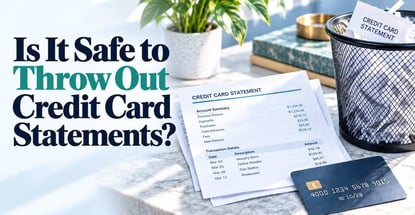
Before you just toss credit card statements in the trash or recycling bin, make sure you understand how to do that safely. In this guide, we’ll explore options for disposing of credit card statements and other related documents.
Risks of Trashing Credit Card Statements
While credit card statements don’t list your full account number, they list personal information such as your name, address, and recent transactions.
Along with other personal information found in your trash bin or online, statements can give crooks what they need to take over your account or open a new one.
The Truth About Dumpster Diving and Identity Theft
Dumpster diving is no longer near the top of the list when it comes to ways your information can be compromised.
Stolen items only accounted for 16% of identity theft cases reported to the Identity Theft Resource Center, and within that category, only 3.9% were due to stolen mail, according to its 2026 Trends in Identity Report.
But those low numbers don’t matter if you’re the one whose identity is hijacked by someone who rifled through your garbage or recycling bin.
How to Identify Sensitive Information
Personal information in the wrong hands can make it easy for someone to take over one of your accounts, open new ones, or even create what’s known as a “synthetic identity,” combining elements of your real identity with fake ones.
Higher risk information can include your Social Security number, date of birth, account numbers, and even your transaction history. While you’re not likely to see full Social Security numbers or account numbers on financial statements anymore, older statements could list those details.
High-Risk Information You Should Keep Safe
- Social Security Number
- Date of Birth
- Account Numbers
- Transaction History
Pitching a box of old documents could provide a crook with a goldmine of information.
Even junk mail can be risky, especially if you discard pre-approved offers for credit cards. These can be filled out with some fake details (someone else’s cellphone number, for example) and used to open an account you know nothing about.
Know What Paperwork You Should Keep
You may be holding onto old paperwork because you’re not sure when it’s safe to get rid of it. Here are a few guidelines.
Credit Card Statements and Financial Reports
You don’t have to keep credit card statements indefinitely. Review them carefully each time you get a new statement. Once you’ve determined the charges are legitimate, you can shred or discard the statement.
If you need to return an item you charged to your card, you’ll need your receipt, not the statement.
And if you need another copy of your statements, you can request it from your issuer or set up online access.
Receipts (or copies of receipts) should be kept for as long as you need them. If an item is under warranty, you’ll want to keep a copy of the receipt until the warranty expires.
You may also need to keep records longer for items that could be covered by insurance. Otherwise, you can just keep those receipts until the window to return them expires.
Tax-Related Documents and Records
The Internal Revenue Service generally recommends keeping records as long as needed to amend your tax records to claim a credit or a refund, or as long as the IRS can assess additional tax.
Property records should be kept until the period of limitations expires for the year in which you dispose of the property. (This can vary depending on the type of property you get rid of or sell.)
You can review the IRS guidelines for keeping records here.
Just keep in mind that credit card statements aren’t typically considered specific enough proof for a tax deduction or business expenses. Instead, you’ll need itemized receipts.
How to Get Rid of Credit Card Statements Securely
Shredding documents with a cross-cut shredder remains the safest way to dispose of paperwork with sensitive information. If you don’t have a shredder, look for free shred days in your community.
These events are often run by local community organizations or financial institutions like credit unions or local banks, and accept a certain amount of documents to be professionally shredded.
Here is an overview of ways to get rid of documents:
| Method | How It Works | Considerations |
|---|---|---|
| Shredding | Purchase a shredder to shred your own documents | Cheap shredders may jam frequently or accept limited amounts of paper at a time. A cross-cut shredder is the best way to ensure documents can’t be read. |
| Bleach/Pulp | Soak documents in water or a combination of bleach and water, stirring periodically over several days or a week, to create a slurry of unreadable paper pulp | Can be time-consuming and messy. Can also be challenging to dispose of, especially when trying to get rid of a lot of documents |
| Burning | Burn documents in a fireplace or firepit | Creates pollution. Some documents may contain coatings that can release harmful chemicals into the air. Not possible in all areas or types of housing. |
| Shredding Scissors | Scissors with multiple blades can be used to cut up sections of documents that list sensitive information | May be time-consuming and less effective than a crosscut shredder, but it is inexpensive. |
| Blackout Stamps | Roller stamps can be rolled over documents with personal information | Sometimes details can be read through the ink, and the ink must be refilled. Can be helpful if traveling or if other methods aren’t possible. |
| Paid Shredding Services | Pay to have documents shredded professionally. | Can dispose of large quantities of documents safely at one time. Cost can add up for large quantities. |
| Shred Days | Free community events offer shredding for personal documents | You’ll need to find an event you can attend, and you may be limited to a certain number of documents. |
While going paperless is the easiest way to stop getting statements you’ll need to get rid of later, it’s not a good option for everyone. If you don’t regularly review your accounts online, for example, you may miss fraudulent purchases and end up paying for something you didn’t buy.
If you still want to get statements in the mail, consider also setting up online access so you can get rid of paper copies after you’ve reviewed them, while still pulling up online copies if you need them.
Stay Safe When Getting Rid of Credit Card Statements
Throwing out or recycling entire paper statements leaves you more vulnerable to identity theft. Find a safe way to get rid of them that works for you and your budget.

I’ve owned a shredder, taken advantage of shred days, and used a blackout stamp when traveling. I’ve also helped my dad add statements to his fire pit when he insisted on burning them.
When I downsized from a large home to a tiny house, I filled a large bin from a professional shredding service with documents, and given the quantity, I was happy to pay to get rid of them safely.
If you choose to continue to get paper statements, find a method for disposing of them that works for you and keeps your information safe.
Regardless of the approach you choose, it’s also a good idea to monitor your credit reports regularly. The ITRC says that “regularly checking your credit report is the single most effective way to detect new financial account fraud.” It points out that nearly a quarter (23%) of all new account fraud cases in its dataset were discovered this way.
Editorial Note: Our site content is not provided or commissioned by any credit card issuer(s). Opinions expressed on CardRates.com are the author's alone, not those of any credit card issuer, and have not been reviewed, approved, or otherwise endorsed by credit card issuers. Every reasonable effort has been made to maintain accurate information; however, all credit card offer details, including information about rewards, signup bonuses, introductory offers, and other terms and conditions, is presented without warranty. Clicking on any offer on CardRates.com will direct you to the issuer's website, where you can review the current terms and conditions of the offer.
About the Author


![3 FAQs: ATM Card vs. Debit Card vs. Credit Card[updated_month_year before=" (" after=")"]](https://www.cardrates.com/images/uploads/2016/05/atm-card-vs-debit-card-vs-credit-card--1.png?width=164&height=85 "3 FAQs: ATM Card vs. Debit Card vs. Credit Card[updated_month_year before=\" (\" after=\")\"]")

![Can You Pay a Credit Card with a Credit Card? 3 Ways Explained[updated_month_year before=" (" after=")"]](https://www.cardrates.com/images/uploads/2017/02/card-with-card-2.png?width=164&height=85 "Can You Pay a Credit Card with a Credit Card? 3 Ways Explained[updated_month_year before=\" (\" after=\")\"]")


![What Card is in the Jennifer Garner Credit Card Commercial?[updated_month_year before=" (" after=")"]](https://www.cardrates.com/images/uploads/2018/05/jennifer-2.jpg?width=164&height=85 "What Card is in the Jennifer Garner Credit Card Commercial?[updated_month_year before=\" (\" after=\")\"]")