


Writer: Mike Senecal


Editor: Lillian Guevara-Castro


Reviewer: Jon McDonald

Our experts and industry insiders blog the latest news, studies and current events from inside the credit card industry. Our articles follow strict editorial guidelines.
Ideally, higher education is a formative learning and developmental experience. But it’s also an investment that can yield a lucrative return, depending on the student’s approach and commitment.
Students may consider college a chance to build their identity and explore new ways of thinking. But they may sour on the experience if they don’t consider the bottom line.
Unlike many developed nations, the U.S. asks students to pay tuition. College costs tend to rise at rates higher than inflation, and many students feel pressure to rack up credit card debt.
This list of student credit card debt statistics puts the financial implications of college in perspective.
Student Credit Card Debt By the Numbers
1. In a 2023 survey of U.S. undergraduate students, 42.1% reported having credit card debt, down from 46.1% the previous year.1
2. Younger consumers (those more likely to attend college) were more likely to prioritize increasing emergency savings (36%) than paying down credit card debt (16%) in 2025 survey data. To be fair, 39% reported pursuing both goals equally. Unfortunately, 10% reported pursuing neither.2
3. Debt leads to debt? A demographic study of the impact of financial education on credit card management found that students with undergraduate degrees but no student debt had $10,000 less non-student credit card debt than undergrads who obtained $25,000 or more in student loans and other debt while in college.3
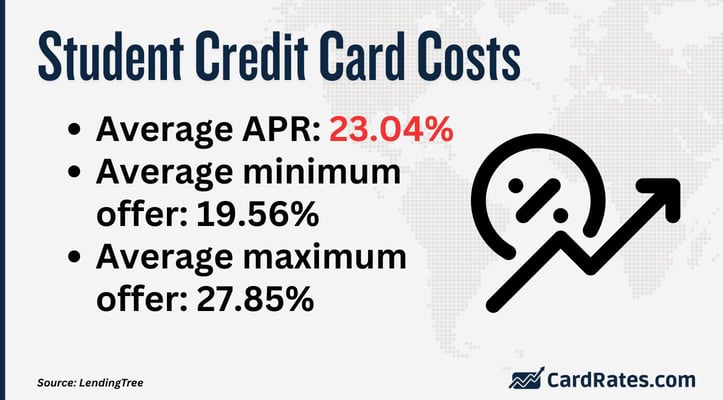
4. Data from 2024 indicated the average APR for a student credit card was 23.04%. The minimum APR was 19.56%, and the maximum was 27.85%.4
5. Demographic data comparing average credit card debt in late 2023 and late 2024 found that Gen Z members (those most likely to attend college) increased their debt by 10.28%, a higher rate than any other generational cohort.5
6. Slightly more than 1 in 10 Americans (11%) own a student credit card.6
7. In 2024, 13% of American families used parent-owned credit cards to pay for college, averaging $2,808 per user.7
8. A 2025 demographic study of credit card holders in Texas revealed that Gen Z cardholders up to age 25 (who make up the highest percentage of American college students) are least likely among all cardholders (28%) to carry a “highly utilized” card (with a balance of at least 75% of its limit).8
9. A 2025 research paper reported that 85% of students have a credit card.9
10. The Federal Reserve does not explicitly measure student credit card use in its influential Household Debt and Credit Report. But with most American college students aged 18-29, the latest data has that cohort holding “only” $80 billion in credit card debt, out of a total debt figure of $1.05 trillion.10
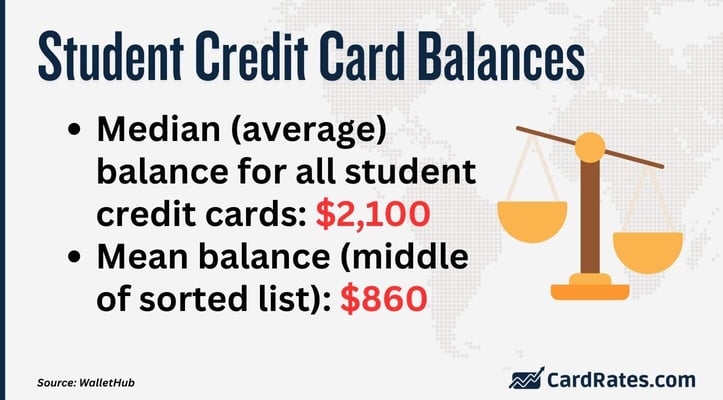
11. Some students have high credit card balances, but many others have very low balances. The average, or median, credit card balance among college students was $2,100 as of Q1 2025. But the mean balance, which signifies the middle value in a sorted list, was only $860.11
12. A 2024 survey of nearly 9,000 American high school and college students found that more than a third (37%) owned a credit card they used to pay for at least some of their expenses.12
13. More than half (52%) of American Gen Z members reported having ever used a credit card in a 2024 study. That figure was 40% for Gen Z members in the UK.13
14. A 2025 consumer survey by a platform that connects consumers with debt relief solutions and educational content found that 32% of Gen Zers (the generational cohort mostly likely to have involvement with higher education) had recently “maxed out” or exceeded their credit card limit.14
15. Gen Z individuals aged 18 to 27 (likely college-age years) reported a much greater increase in total debt burden (30.9% to nearly $80 billion) from 2023 to 2024 than any other generation. In contrast, millennials reported a 5.3% increase and Gen Xers a 1.5% increase, while older Americans reported decreases.15
16. A 2025 article published on a campus news website reported that credit card debt in college was 6% more common than student loan debt.16
17. You might think that college-age individuals aged 18-24 are leading the push toward non-cash payments. But the Federal Reserve reported in 2025 that only 10% of individuals aged 25-54 used cash for payments, while the younger cohort reported 14%.17
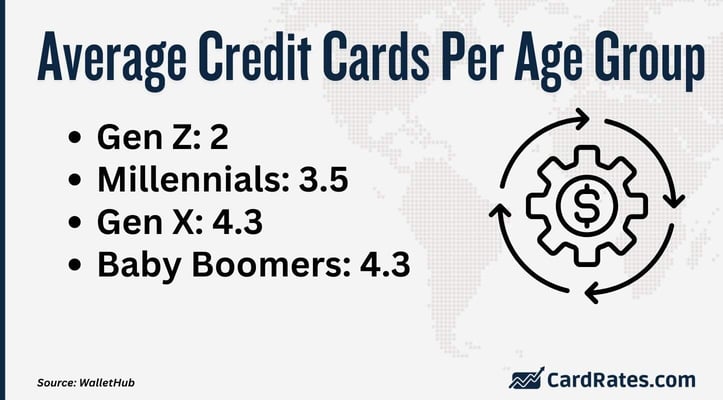
18. A 2025 article reported that college-age individuals aged 18 to 27 held an average of two credit cards. Millennials held an average of 3.5 cards, while Gen Xers and baby boomers carried 4.3 cards on average.18
19. In a 2024 report on the role of financial education in college choice, 57% of respondents said they occasionally had to choose between paying for school and meeting their basic needs.19
20. A 2023 survey of about 2,000 high school and college students found that 16% either missed or had a late credit card payment in the past six months.20
21. In a credit card trends survey, nearly half (46%) of Gen Z members (individuals in the generation mostly likely to attend college) reported not owning a credit card. That’s 32% higher than millennials, the next oldest generational cohort.21
22. Many high school seniors are either preparing for credit card use or honing their skills, with 20% reporting they already own a card and more than half of the rest planning on obtaining one within a year.22
23. In 2024, 10% of American families used student credit cards to pay for college, averaging $2,268 per user.7
24. Only 19.3% of respondents in a 2023 survey of U.S. undergraduate students knew that credit scores measured their risk of default on their credit cards. Slightly more than 12% thought the term referred to knowledge about borrowing money.1
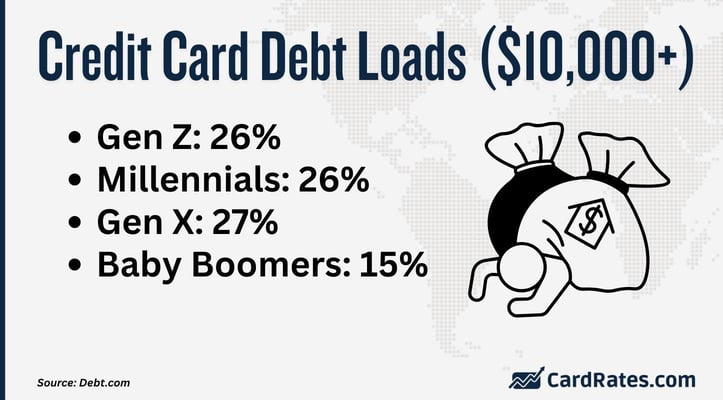
25. More than one quarter (26%) of Gen Z members surveyed in 2025 reported carrying a credit card debt load of $10,000 or more.14
26. Nearly one third (28%) of students used their credit card to pay for meal plans and groceries.12
27. Not surprisingly, younger people are more likely to own student credit cards. While nearly one quarter (22%) of Gen Z members have a student credit card, that figure is only 10% for millennials, 5% for Gen X members, and 4% for baby boomers.6
28. A 2025 survey found that a strong majority (56%) of first-time credit card holders were aged 18 to 24. Only 9% of respondents obtained their first credit card after age 45.14
29. Among the 42.1% of 1,200 students surveyed in 2023 who reported having credit card debt, slightly more than half (50.9%) reported owing $1,000 or less.1
30. Nearly two-thirds (60%) of Gen Z Texans owned at least one credit card by the time they reached their early 20s. When they were the same age, only 54.5% of millennials and 57% of Gen X consumers owned a card.8
31. Research from 2024 revealed that American families tend to rely less on credit cards to pay for college as their income increases — up to a point. Credit cards contributed $460 in average annual value in families with less than $50,000 in income. That figure was $376 for families with incomes between $50,000 and $100,000, $328 for families with incomes between $100,000 and $150,000, and only $230 for families with incomes above $150,000.7
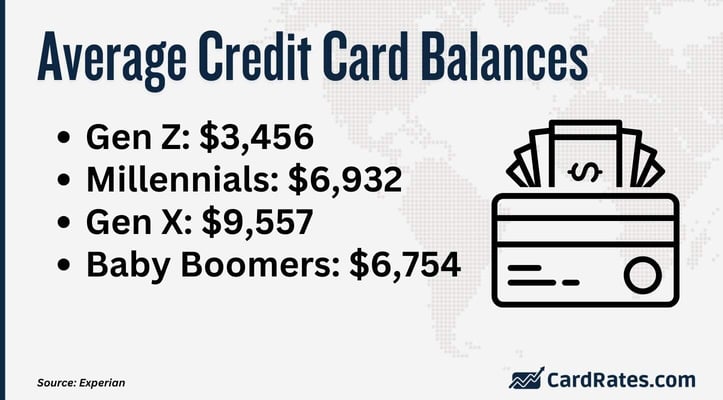
32. Average credit card balances increase during the productive middle years of a person’s life. While college-age Gen Z members reported an average balance of $3,456 in 2024 data, millennials reported $6,932, and Gen Xers, $9,557.15
33. While 27% of respondents in a 2023 survey of U.S. undergraduate students said they knew that carrying a revolving balance meant paying less than the total amount due, just under 23% thought the term referred to spending the same amount each month. About 16% thought it meant transferring a balance to a different credit card.1
34. College-age individuals aged 18 to 24 prefer using cards and mobile wallets to pay. They reported holding an average of $28 in cash.17
35. A 2023 survey of U.S. undergraduate students revealed that 52.7% had a credit card in their name, a nearly 22% decrease from the previous year’s survey.1
36. Among students with access to a credit card in a 2025 article, 25% reported they were authorized users on their parents’ cards, and 17% reported they used a cosigner.11
37. In American families with incomes above $150,000, student credit cards contribute only $102 in average annual value toward paying for college.7
38. A 2025 student news article reported that the top two credit card spending categories for college students were shopping (70.1%) and dining (50%).16
39. In a 2023 survey, 49.1% of respondents with credit card debt reported accruing debt to pay for college essentials, including books and fees. Almost one-half (48.5%) of respondents said they had gone into greater debt to pay for living expenses, including housing. Other spending categories contributing to greater student debt were transportation (21.2%), nonessentials such as dining and shopping (24.2%), and impulse purchases (21.8%).1
40. Race was insignificant in distinguishing average value from student credit cards, which contributed toward annual college expenses. Cards owned by students reporting their race as white averaged $257, while cards owned by Hispanics averaged $253, and those owned by African Americans averaged $250.7
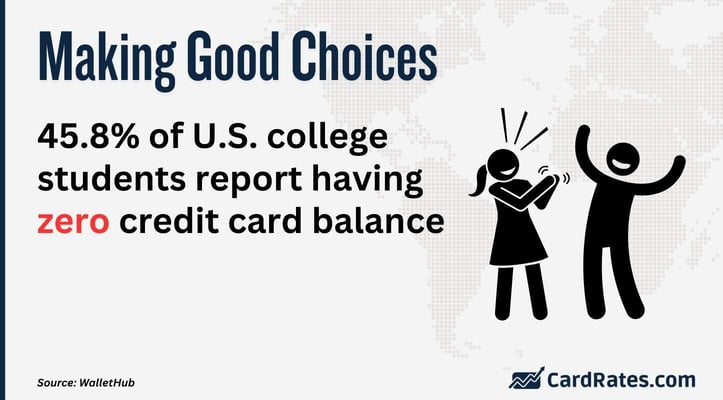
41. While 17% of college students reported having a credit card balance of more than $2,500 as of Q1 2025, 17% reported a balance of $500 or less. Meanwhile, a whopping 45.8% reported a zero balance.11
42. According to a 2023 survey, missing a credit card payment does not always deter college students from planning large future purchases. More than half (55%) reported the intention to carry on with their plans despite financial setbacks.20
43. Respondents in a 2023 survey of U.S. undergraduate students reported making several mistakes with credit cards, including carrying a balance from month to month (almost 24%), forgetting to pay their credit card bill (nearly 19%), and failing to realize they needed to make monthly payments (just over 18%).1
44. The Federal Reserve’s Household Debt and Credit Report does not measure student credit card use. But according to that report, consumers aged 18-29, who make up a strong majority of U.S. college students, held $80 billion of credit card debt as of Q1 2025.10
45. A 2025 study of credit card holders in Texas found that when members of the millennial and Gen X generations had high utilization rates during their 20s (during their likely college years), they were more likely to have a card in serious delinquency (90+ days past due) while in their 30s.8
46. Only 26.6% of respondents in a 2023 survey of U.S. undergraduate students understood that a credit utilization ratio described the relationship between a credit limit and available credit. Nearly 18% thought the term referred to the frequency of credit card use.1
47. The number of individuals aged 18-24 who reported owning a credit card is 25% higher in 2025 than it was in 2017.21
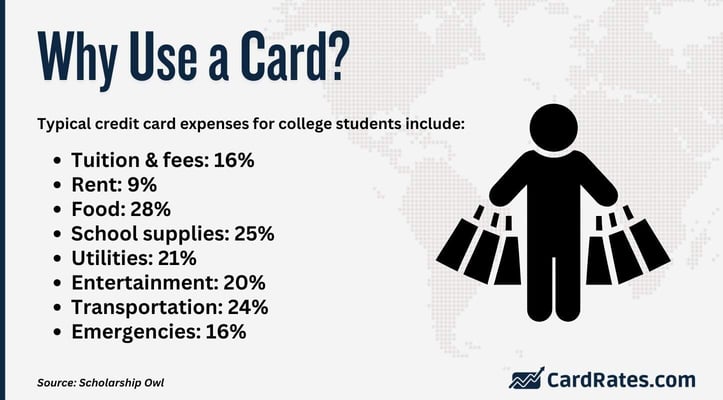
48. Among the 37% of students who reported using a credit card to pay for at least some of their expenses, 16% reported using a card to pay for tuition and fees, and 25% for books, supplies, and laptops for school.12
49. While Gen Z members (those at the age most likely to attend college) increased their average credit card debt from late 2023 to late 2024 at a higher rate than any other generation (10.28%), their total average credit card debt was $3,764 — far lower than the $10,221 average for Gen X.6
50. Less than half (49.1%) of students who said they had credit card debt in a 2023 survey reported owing $1,000 or more. Slightly more than one-fifth (20.8%) reported having debt between $1,000 and $1,999. Only 6.5% reported having debt of $5,000 or more.1
51. A U.S. student news site reported that 65% of college students held credit card debt in 2024.16
52. Student credit card limits display a bimodal distribution, with most cardholders using cards with relatively low or relatively high limits. Nearly one third (32%) have a limit of $500 or less on their card, while another 20% have a limit of $5,000 or more. That leaves less than half of survey respondents (48%) in the middle.11
53. Amid increasing use of interest-free Buy Now, Pay Later services instead of credit cards, a 2024 youth trends survey reported that 67% of U.S. Gen Z members were unaware that misuse of those installment-plan services could affect their credit score. That figure was only 33% for Gen Z members in the UK.13
54. Among thousands of high school and college students who reported owning a credit card in a 2024 survey, only 4% reported never using it.12
55. More than one-third (36%) of credit card holders reported obtaining their first card through the assistance of parents. Another 9% reported signing up at college.14
56. A 2025 article reported that among the 85% of students who reported having access to a credit card, 64% reported they owned an unsecured card independently.11
57. A 2024 study of youth consumer trends revealed that 29% of U.S. and 23% of UK Gen Z members had never used any form of credit financing, including credit cards.13
In Conclusion
College is highly associated with personal and career advancement. But attendance is not mandatory. Many students today seek alternatives in trade-based careers.
Those who pursue higher education vary widely in financial status. Many take out student loans, which can create a debilitating burden. Others treat college as an entrepreneurial adventure and fund it with credit cards.
For some, credit cards can lead to more financial challenges than they would experience with student loans, as these student credit card debt statistics attest.
Data Sources:
1 https://money.usnews.com/credit-cards/articles/survey-over-42-of-college-students-have-credit-card-debt
2 https://www.bankrate.com/banking/savings/emergency-savings-report
3 https://papers.ssrn.com/sol3/papers.cfm?abstract_id=5122021
4 https://www.lendingtree.com/credit-cards/credit-card-debt-statistics
5 https://www.creditkarma.com/insights/i/state-of-debt-and-credit-report
6 https://www.fool.com/money/research/how-gen-z-millennials-gen-x-baby-boomers-use-credit-cards
7 https://www.salliemae.com/about/leading-research/how-america-pays-for-college
8 https://www.dallasfed.org/cd/communities/2025/2502
9 https://www.researchgate.net/publication/388385656_Should_Students_Have_Credit_Cards
10 https://www.newyorkfed.org/microeconomics/hhdc.html
11 https://wallethub.com/edu/cc/credit-card-statistics-for-college-students/25535
12 https://scholarshipowl.com/blog/uncategorized/gen-z-students-are-increasingly-relying-on-student-loans-and-credit-cards-to-pay-for-college
13 https://www.wearepion.com/resources/reports/youth-trends-report-2025
14 https://www.debt.com/research/credit-card-survey
15 https://www.experian.com/blogs/ask-experian/research/consumer-debt-study
16 https://thecrimsonwhite.com/119287/opinion/opinion-from-convenience-to-crisis-the-real-cost-of-credit-cards-for-college-students
17 https://www.frbservices.org/binaries/content/assets/crsocms/news/research/2025-diary-of-consumer-payment-choice.pdf
18 https://www.forbes.com/advisor/credit-cards/average-credit-card-debt
19 https://www.ellucian.com/news/national-survey-reveals-59-college-students-considered-dropping-out-due-financial-stress
20 https://www.sparkinstitute.org/news/spark-institute-corporate-insight-report-preliminary-survey-results-supporting-need-to-improve-financial-literacy-among-high-school-college-students
21 https://www.gwi.com/blog/credit-card-trends
22 https://everfi.com/blog/state-of-financial-literacy-urgent-call-next-generation
Editorial Note: Our site content is not provided or commissioned by any credit card issuer(s). Opinions expressed on CardRates.com are the author's alone, not those of any credit card issuer, and have not been reviewed, approved, or otherwise endorsed by credit card issuers. Every reasonable effort has been made to maintain accurate information; however, all credit card offer details, including information about rewards, signup bonuses, introductory offers, and other terms and conditions, is presented without warranty. Clicking on any offer on CardRates.com will direct you to the issuer's website, where you can review the current terms and conditions of the offer.
About the Author

![19 Eye-Opening Student Debt Statistics[updated_month_year before=" (" after=")"]](https://www.cardrates.com/images/uploads/2020/11/shutterstock_674141887.jpg?width=164&height=85 "19 Eye-Opening Student Debt Statistics[updated_month_year before=\" (\" after=\")\"]")
![[updated_month_year after=" "]Credit Card Debt Statistics (Average U.S. Debt)](https://www.cardrates.com/images/uploads/2018/04/shutterstock_243114739-edit.jpg?width=164&height=85 "[updated_month_year after=\" \"]Credit Card Debt Statistics (Average U.S. Debt)")


![15 Disturbing Credit Card Fraud Statistics[updated_month_year before=" (" after=")"]](https://www.cardrates.com/images/uploads/2020/08/15.jpg?width=164&height=85 "15 Disturbing Credit Card Fraud Statistics[updated_month_year before=\" (\" after=\")\"]")
![18 Revealing Credit Card Ownership Statistics[updated_month_year before=" (" after=")"]](https://www.cardrates.com/images/uploads/2023/11/00-credit-card-ownership-statistics-feature.jpg?width=164&height=85 "18 Revealing Credit Card Ownership Statistics[updated_month_year before=\" (\" after=\")\"]")
![25 Shocking Credit Card Processing Statistics[updated_month_year before=" (" after=")"]](https://www.cardrates.com/images/uploads/2023/11/credit-processing-stats.jpg?width=164&height=85 "25 Shocking Credit Card Processing Statistics[updated_month_year before=\" (\" after=\")\"]")
![25 Fascinating Credit Card vs. Cash Spending Statistics[updated_month_year before=" (" after=")"]](https://www.cardrates.com/images/uploads/2023/12/Credit-Card-vs.-Cash-Spending-Statistics.jpg?width=164&height=85 "25 Fascinating Credit Card vs. Cash Spending Statistics[updated_month_year before=\" (\" after=\")\"]")