

Writer: Lucy Lazarony


Editor: Ashley Fricker


Reviewer: Catherine McNally

We deploy a step-by-step methodology to each piece of research we publish to ensure our studies offer complete coverage and meet our rigorous editorial standards.
Key Takeaways
- 45% of people surveyed think singles get fewer offers of help with time- or money-saving tasks, including airport pickups, shared rides, and moving assistance.
- Men were more likely to see a gap regarding offers for help, with 51% believing singles receive fewer offers of help, compared with 40% of women.
- 71% said people should proactively offer single friends practical or financial help, even when it’s inconvenient.
- 3 in 4 respondents with children under 18 at home support proactively assisting singles, versus 68% of those with no children at home who are not expecting.
During the holiday season rush, offering a lift to or from the airport for a single friend may be the best gift you can give them. Single pet owners will be relieved to know a friend is checking in on their pet while they’re away. And moving help is appreciated by singles year-round, but it may be especially true during the hectic holiday season.
That’s because singles getting by without these friendly favors have to shell out extra money, since they handle these practical matters on their own rather than having a partner to help out. This is known as the “singles tax,” and it also covers the costs associated with living alone.
We surveyed 1,000 U.S. adults ages 18 to 64 to see just how much the singles tax actually affects people. It turns out, 45% of our survey respondents believe singles are less likely to receive offers of everyday assistance that would save them time or money. And 71% of those surveyed said people should proactively offer help to single friends with practical or financial help even if it’s inconvenient.
“It appears painfully clear from our study that single adults do face more financial issues than those who are paired up. There are plenty of benefits to being on your own, but not being able to share expenses is a downside. Handling regular tasks can be expensive and labor-intensive, too,” says Erica Sandberg, consumer finance expert at CardRates.com.
52% of Gen Z Think Singles Receive Fewer Offers of Money or Time-Saving Help
Small favors can have real financial value, and younger respondents in our survey were more likely to believe singles miss out on offers of that help.
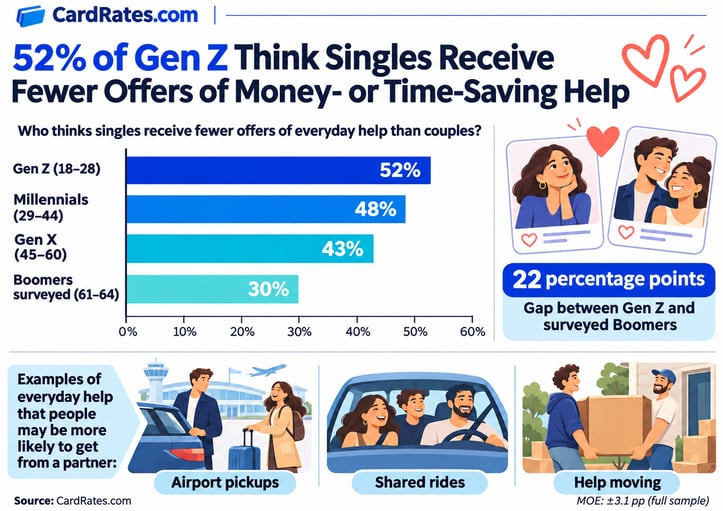
In fact, Gen Z adults aged 18 to 28 were 22% more likely than boomers to perceive this gap. This could be because younger people know more single friends and see the help that they may need.
Let’s look at the data. With Gen Z adults, 52% believe singles receive fewer offers of help, the most of any age group. With millennials, aged 29 to 44, 48% said they believe singles receive fewer offers of help, and of Gen Xers, aged 45 to 60, 43% also said they believe singles get less help.
The baby boomers, ages 61 to 64, are less likely to believe singles get fewer offers of help, with just 30% believing this to be true.
Airport pickups, shared rides, and help moving were examples of cost savings included in our survey question.
51% of Men Think Singles Miss Out on Money- or Time-Saving Help
When it comes to helping singles, men are more likely to think singles get fewer offers of help. In fact, 51% of men believe singles receive fewer offers of everyday help than couples, compared with 40% of women.
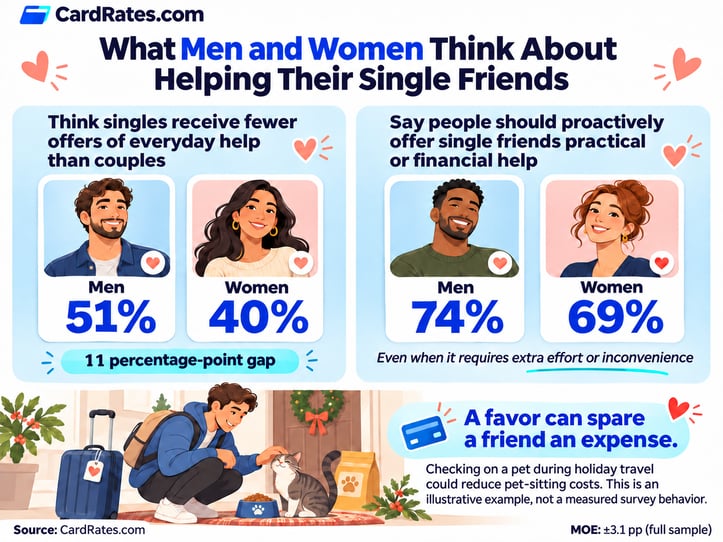
On whether people should take the initiative to help singles, both groups believed in lending a hand. Among men, 74% say people should proactively offer single friends practical or financial support — even when it’s inconvenient — as do 69% of women.
With holiday travel approaching, that support could take another form, such as checking on a friend’s cat so they can skip the pet-sitting bill. It may never make anyone’s gift guide, but keeping an expense off a friend’s credit card has its appeal.
71% Say Single Friends Deserve More Proactive Financial or Practical Support
Turns out most people are in favor of taking the initiative to help their single friends. Overall, 71% of those surveyed support proactively offering help to single friends, even when it would require extra effort or be inconvenient.
Parents are especially in favor of lending a helping hand: 3 in 4 parents with children under 18 at home say they agree with proactively helping single friends, compared with 68% of those without children at home who are not expecting.
Among the survey respondents who perceive a support gap for singles, 82% favor proactive assistance. Even among those who don’t see a support gap, 63% would still support taking the initiative and helping.
Sandberg adds, “The winter holidays can be especially costly and hectic, so it’s great to be able to offer some tips that can relieve some of the financial burdens. Even a small gesture can have a significant impact.”
What Can Be Done to Assist a Single Friend?
With the busy holiday season approaching, we can do several things to lend a hand to our single friends.
- Offer to drive them to or pick them up from the airport during their holiday travels. Airport parking is expensive!
- Watch their pet while they’re away. Pet-sitting expenses can really add up the longer they’re away.
- Invite them to carpool to holiday gatherings and/or split gas costs.
- Share bulk grocery purchases or extra ingredients to reduce food costs and waste.
- Offer to help hang holiday decorations or tackle a household task they’d otherwise handle alone.
- Offer babysitting so a single parent can shop, wrap gifts, or attend a holiday event.
- Include them in group plans early so they have time to budget and book travel.
Take the initiative to offer your single friends help this holiday season. Mull over the best practical gift you can give them.
What kind of help would be most appreciated by a single friend? Make a specific, manageable, and thoughtful offer of help. In doing so, you may make your friend’s holiday a little easier to manage, and they will appreciate the kindness.
Methodology
CardRates.com surveyed 1,000 U.S. adults ages 18 to 64 in the U.S. Respondents were asked about the everyday assistance offered to single people and whether people should proactively offer single friends practical or financial help. Results are based on raw, unweighted responses.
The approximate margin of error is ±3.1 percentage points for the full sample at the 95% confidence level. Margins of error are larger for demographic subgroups. Percentages may not total 100% due to rounding.
For any media inquiries, please contact catherine@cardrates.com.
Editorial Note: Our site content is not provided or commissioned by any credit card issuer(s). Opinions expressed on CardRates.com are the author's alone, not those of any credit card issuer, and have not been reviewed, approved, or otherwise endorsed by credit card issuers. Every reasonable effort has been made to maintain accurate information; however, all credit card offer details, including information about rewards, signup bonuses, introductory offers, and other terms and conditions, is presented without warranty. Clicking on any offer on CardRates.com will direct you to the issuer's website, where you can review the current terms and conditions of the offer.
About the Author