
Writer: Lucy Lazarony


Editor: Ashley Fricker


Reviewer: Catherine McNally

We deploy a step-by-step methodology to each piece of research we publish to ensure our studies offer complete coverage and meet our rigorous editorial standards.
Key Takeaways
- 32% of Americans surveyed intentionally bought a knockoff or dupe instead of the original over the last year.
- 47% of Gen Z respondents said they bought dupes, compared with 38% of Gen Xers, 37% of millennials, and 15% of baby boomers.
- 33% of respondents in households earning $100,000 or more bought knockoffs or dupes, similar to 34% in households earning below $50,000.
- Among respondents who bought dupes, 65% estimated saving at least $100 over the previous year.
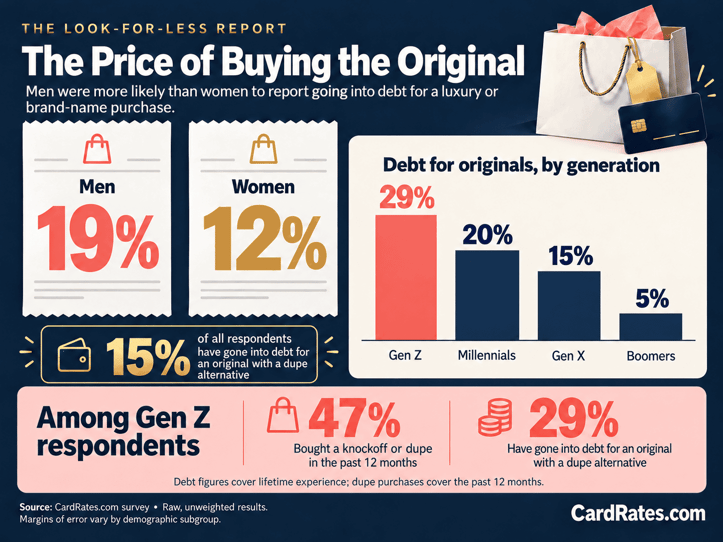
- 19% of men said they went into debt for a luxury or brand-name item they could have bought a dupe of instead, compared with 12% of women.
It is an age-old shopping dilemma. Should you shell out a high price for an original item, or should you save a bunch of cash and buy a nifty knockoff or dupe instead? It is a dilemma many shoppers will be facing this holiday season and into the New Year.
Maybe you can afford an authentic original item, and it won’t bust your budget. But if you find a knockoff or dupe that you really like, you could save yourself $100 and maybe even much more, depending on what it is. And you wouldn’t be alone; the dupe trend is going strong.
CardRates.com recently surveyed 1,000 people to see how widespread dupe shopping is, how much shoppers estimate they saved, and whether buying originals has led shoppers into debt.
Knockoff or dupe shopping is more popular than many people realize, with 32% of respondents intentionally buying a knockoff or dupe during the past 12 months. Now let’s take a look at some more data.
“That almost one-third of Americans are deliberately eschewing higher-priced originals and opting for lower-cost dupes instead is significant,” said Erica Sandberg, consumer finance expert at Cardrates.com. “It’s a clear indicator that value is important, but so is the look of luxury. Certainly there are financial benefits, since it can free up cash for necessities.”
47% of Gen Z Bought Dupes Instead of Originals
It seems Gen Zers want those less expensive, knockoff versions of designer items. In fact, when it comes to buying knockoffs or dupes, Gen Z leads all generations. In the past 12 months, 47% of Gen Zers have reported buying a knockoff or dupe.
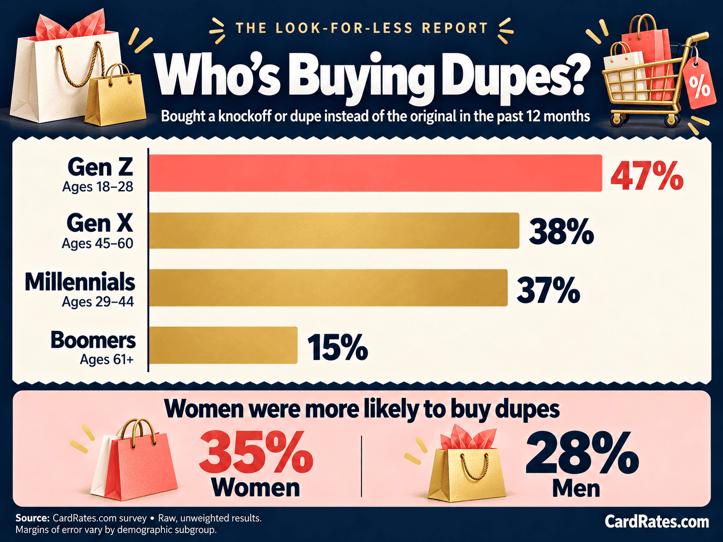
Buying into the dupe economy is definitely big with the younger generation. Gen Z respondents are ages 18 to 28, and they reported buying dupes at more than three times the 15% rate of baby boomers who are aged 61 and up. Gen X and millennials reported similar dupe-buying rates, at 38% and 37%, showing that dupe shopping extends beyond Gen Z shoppers.
Sandberg adds, “Gen Zers seem to be driving the dupe rate surge, with nearly half of our study respondents saying they participate in this shopping strategy. Social media is making it not only more acceptable, but their peers are sharing how to best do it.”
In addition, women were more likely to buy a knockoff or dupe than men, with 35% of women reporting buying dupes compared with 28% of men.
33% of Americans in $100K+ Households Bought Dupes
Here is something that may surprise you. When it comes to dupe buying, both higher-income and lower-income survey respondents report buying a less expensive knockoff or dupe. So 34% of those who earn less than $50,000 bought a dupe, but so did 33% of those earning $100,000 or more.
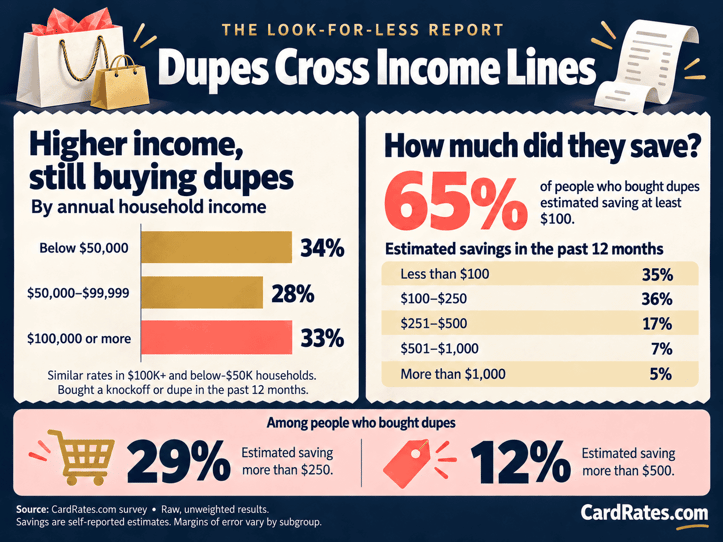
Not to neglect those in the middle, 28% of those earning between $50,000 and $99,999 also bought a knockoff or dupe.
Among people who bought dupes, 65% estimated saving at least $100 during the previous 12 months. And some dupe shoppers saved even more, with 17% estimating that they saved more than $250 and 12% more than $500.
A majority of shoppers— 65% — purchased dupes that saved them more than $100 in the past 12 months, proving that buying dupes can save money. Indeed, 36% of those buying dupes saved $100 to $250, 17% saved $251 to $500, and 7% saved $501 to $1,000. And 5% of dupe shoppers were able to save more than $1,000 with their purchases.
19% of Men Have Gone Into Debt for Brand-Name Purchases
When it comes to dupe shopping, women reported buying dupes more often. Men, on the other hand, more often reported going into debt from purchasing brand-name items.
According to Sandberg, “This is not to say that Americans are rejecting the real thing entirely, and that they won’t overuse their credit cards for the desired brand. Our study found that men were a bit more willing to go into debt for a brand name than women.”
The results of this study indicate that dupes have wide appeal and can be a smart final alternative to splurging on the designer option.
Indeed, 19% of men have gone into debt buying a luxury or brand-name item when they could have bought a less expensive dupe instead, and 12% of women reported this same experience.
Overall, 15% of survey respondents reported going into debt from buying an expensive original item.
Here’s the age breakdown of respondents going into debt after buying an original item: It is interesting to note that Gen Z respondents reported both the highest rate of recent dupe purchases (47%) and the highest rate of debt for originals (29%). The debt question asks whether they “ever” went into debt for a brand-name purchase, while the purchase questions cover the previous 12 months, and Gen Z came out tops in both instances.
One-fifth of millennials (20%) surveyed also said they fell into debt after buying an original when a dupe alternative was available, as did 15% of Gen Xers and 5% of boomers. So the tendency to get into debt over an original decreased as respondents grew older in age.
In Summary
As the holiday shopping season takes hold, choosing a recognizable brand is a key consideration, especially as holiday sales offer discounts on name-brand items. Savvy shoppers will check out the sales, but they won’t want to overlook the affordable value of an inexpensive knockoff or dupe.
And they won’t be alone in their dupe shopping. Our findings show that choosing alternatives to original items spans both generations and income levels.
Splashing out and buying the original sometimes involves going into debt. So shop carefully if you have your eye on an original item. To avoid going into the red this holiday season, establish a budget, stick with it, and shop smartly. And don’t overlook the value of a dupe.
Methodology
CardRates.com surveyed 1,000 U.S. adults in April 2026. Findings on savings are based on the 318 respondents who reported buying a knockoff or dupe during the previous 12 months. The data are raw and unweighted.
Assuming simple random sampling, the approximate margin of error is ±3.1 percentage points for the full sample and ±5.5 percentage points for the subgroup at the 95% confidence level. Margins are larger for demographic subgroups. Percentages may not total 100% because of rounding.
For media inquiries, please email catherine@cardrates.com.
Editorial Note: Our site content is not provided or commissioned by any credit card issuer(s). Opinions expressed on CardRates.com are the author's alone, not those of any credit card issuer, and have not been reviewed, approved, or otherwise endorsed by credit card issuers. Every reasonable effort has been made to maintain accurate information; however, all credit card offer details, including information about rewards, signup bonuses, introductory offers, and other terms and conditions, is presented without warranty. Clicking on any offer on CardRates.com will direct you to the issuer's website, where you can review the current terms and conditions of the offer.
About the Author