

Writer: Lynn Cadet


Editor: Ashley Fricker


Reviewer: Adam West

We deploy a step-by-step methodology to each piece of research we publish to ensure our studies offer complete coverage and meet our rigorous editorial standards.
Key Takeaways
- South Dakota ranks as the best state for credit building, thanks to a variety of financial factors, including strong credit outcomes scores and stable economic conditions.
- High-ranking states can attribute their healthy credit-building landscape to solid labor markets, higher household incomes, and accessible lending opportunities, creating a foundation that supports responsible credit behavior.
- A sharp regional trend also appears in our rankings. Notably, the lowest-ranked states are in the South, where broader economic pressures and barriers may impact credit improvement.
Building and maintaining healthy credit can be challenging for many Americans. But depending on where you live, the path to stronger credit may be easier — or far more difficult — than you might expect.
Credit building is on the radar of most Americans in 2026. In fact, 72% of U.S. adults say improving their credit score is a top financial goal for the year.
Yet achieving that goal takes more than just a shift in personal habits. Broader economic conditions, such as income and cost of living, can influence how easily consumers build and maintain healthy credit behaviors.
Where you live can also influence these conditions in meaningful ways. While some states provide a stronger financial foundation for credit access and stability, others present economic pressures that can make building credit more challenging.
To identify the best and worst states to build credit in 2026, CardRates.com analyzed 14 economic and financial indicators in all 50 states. View the full methodology below.
Using a weighted 100-point scoring system that evaluates credit accessibility, household financial stability, economic conditions, and consumer credit outcomes, we ranked the states where residents may have the strongest and weakest structural support for building and maintaining healthy credit.
The Top 5 States to Build Credit in 2026:
- South Dakota
- New Hampshire
- Massachusetts
- Utah
- Minnesota
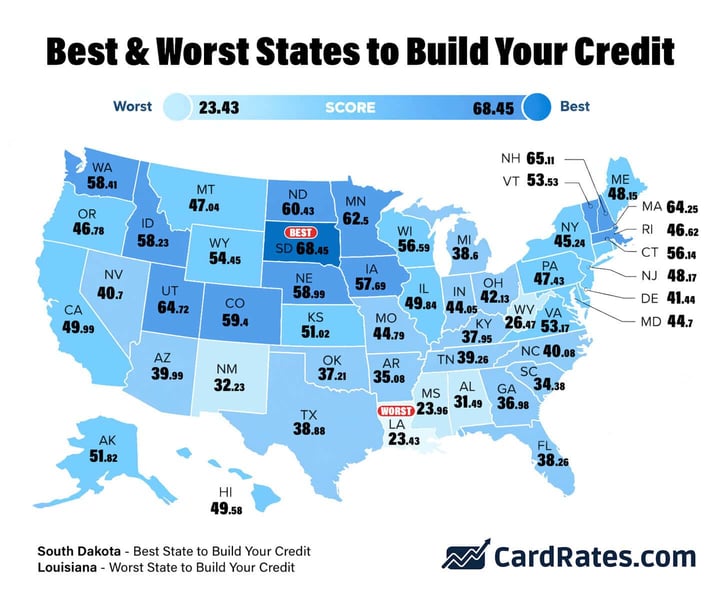
States in the Midwest and New England come out on top, while many Southern states gather near the bottom — highlighting how regional economic conditions can shape credit outcomes.
“The results of this study show that areas where residents have greater financial stability also have increased power to create and maintain excellent credit,” said Erica Sandberg, consumer finance expert at CardRates.com. “Jobs tend to be more prolific, well-paying, and secure. This puts them in a position to obtain prime credit products.”
Main Findings
The table below ranks all 50 states across four key dimensions: credit access, household financial stability, economic conditions, and consumer credit outcomes.
Best States for Credit Building in 2026
| Rank | State | Total Score | Credit Access | Household Stability | Economic Conditions | Consumer Credit Outcomes | Approval Rate | SBA Loan Approvals per 100k | Branches per 10K People | Median Household Income | Labor Force Participation Rate | Mortgage 30-89 Day Delinquency | Avg Adjusted Gross Income | Poverty Rate | Per Capita Personal Income | Unemployment Rate | Purchasing Power Incl. Rent | Regional Price Parity | Credit Score by State | Subprime Credit Population |
|---|---|---|---|---|---|---|---|---|---|---|---|---|---|---|---|---|---|---|---|---|
| 1 | South Dakota | 68.45 | 62.6 | 58.2 | 82.7 | 81.7 | 88.4% | 132.8 | 4.4 | $69,457 | 67.6% | 1.1% | $87,285 | 12.3% | $75,699 | 2.2% | 190.4 | 90.6 | 734 | 21.0% |
| 2 | New Hampshire | 65.11 | 59.0 | 79.5 | 62.8 | 59.6 | 80.6% | 116.9 | 4.7 | $90,845 | 66.6% | 1.2% | $105,017 | 7.3% | $83,192 | 3.1% | 154.4 | 97.8 | 720 | 26.0% |
| 3 | Utah | 64.72 | 63.9 | 69.7 | 54.5 | 81.0 | 83.0% | 116.7 | 6.3 | $86,833 | 69.4% | 1.3% | $93,212 | 8.5% | $67,333 | 3.6% | 164.2 | 99.1 | 730 | 19.8% |
| 4 | Massachusetts | 64.25 | 61.2 | 76.8 | 52.0 | 76.0 | 81.2% | 60.8 | 17.4 | $96,505 | 67.1% | 1.3% | $118,359 | 9.9% | $93,607 | 4.8% | 163.0 | 105.1 | 732 | 22.9% |
| 5 | Minnesota | 62.5 | 57.5 | 68.7 | 51.1 | 95.6 | 84.8% | 78.7 | 4.7 | $84,313 | 68.7% | 1.1% | $91,722 | 9.3% | $75,603 | 4.1% | 163.3 | 102.7 | 742 | 17.5% |
| 6 | North Dakota | 60.43 | 54.4 | 70.1 | 60.7 | 59.6 | 80.6% | 115.1 | 4.7 | $73,959 | 69.1% | 0.6% | $91,535 | 10.8% | $71,749 | 2.6% | 154.4 | 97.8 | 720 | 26.0% |
| 7 | Colorado | 59.4 | 52.5 | 70.0 | 53.0 | 76.7 | 82.9% | 54.8 | 4.2 | $87,598 | 68.6% | 1.3% | $100,175 | 9.6% | $83,055 | 3.8% | 154.4 | 103.1 | 731 | 22.2% |
| 8 | Nebraska | 58.99 | 47.9 | 60.8 | 66.8 | 79.3 | 86.9% | 38.5 | 3.4 | $71,722 | 68.8% | 1.2% | $84,813 | 10.4% | $72,701 | 3.0% | 158.5 | 91.8 | 731 | 21.0% |
| 9 | Washington | 58.41 | 45.7 | 76.5 | 47.0 | 92.5 | 81.4% | 31.4 | 7.2 | $90,325 | 64.6% | 1.0% | $110,850 | 9.9% | $85,187 | 4.7% | 169.1 | 108.5 | 735 | 16.4% |
| 10 | Idaho | 58.23 | 47.5 | 66.2 | 54.7 | 90.3 | 86.3% | 79.6 | 4.8 | $70,214 | 62.9% | 0.6% | $83,761 | 11.0% | $62,323 | 3.6% | 169.2 | 98.4 | 730 | 15.5% |
| 11 | Iowa | 57.69 | 49.7 | 57.1 | 63.1 | 77.6 | 89.6% | 38.6 | 5.8 | $70,571 | 66.6% | 1.3% | $82,232 | 11.1% | $65,225 | 3.5% | 158.0 | 89.6 | 730 | 21.4% |
| 12 | Wisconsin | 56.59 | 46.5 | 61.4 | 58.0 | 81.2 | 85.4% | 56.6 | 4.4 | $72,458 | 65.7% | 1.0% | $82,180 | 10.7% | $67,755 | 3.1% | 152.9 | 95.8 | 738 | 22.7% |
| 13 | Connecticut | 56.14 | 45.9 | 72.3 | 53.1 | 64.4 | 81.3% | 32.7 | 4.7 | $90,213 | 66.0% | 1.7% | $119,366 | 10.1% | $95,067 | 4.2% | 146.5 | 103.5 | 726 | 26.0% |
| 14 | District of Columbia | 54.85 | 51.4 | 71.0 | 43.8 | 56.0 | 79.0% | 21.0 | 2.9 | $101,722 | 72.0% | 1.2% | $134,291 | 15.1% | $111,185 | 6.7% | 159.7 | 108.9 | 715 | 25.7% |
| 15 | Wyoming | 54.45 | 39.0 | 66.0 | 64.0 | 63.6 | 80.6% | 42.7 | 4.7 | $72,495 | 65.7% | 1.5% | $104,799 | 10.7% | $86,477 | 3.4% | 154.4 | 96.5 | 725 | 26.0% |
| 16 | Vermont | 53.53 | 40.1 | 65.7 | 60.5 | 59.6 | 80.6% | 51.2 | 4.7 | $74,014 | 64.9% | 0.6% | $79,966 | 10.4% | $71,287 | 2.6% | 154.4 | 97.8 | 720 | 26.0% |
| 17 | Virginia | 53.17 | 41.1 | 64.9 | 60.1 | 54.9 | 80.7% | 24.1 | 2.7 | $87,249 | 65.7% | 1.5% | $98,769 | 10.0% | $77,351 | 3.6% | 169.0 | 99.2 | 723 | 29.3% |
| 18 | Alaska | 51.82 | 47.5 | 60.7 | 41.6 | 72.3 | 84.1% | 41.2 | 1 | $86,370 | 66.7% | 1.3% | $86,805 | 10.5% | $76,234 | 4.8% | 153.4 | 105.4 | 722 | 20.8% |
| 19 | Kansas | 51.02 | 41.4 | 47.5 | 61.7 | 71.7 | 84.2% | 26.8 | 6.8 | $69,747 | 66.2% | 2.0% | $82,637 | 11.6% | $65,856 | 3.8% | 158.9 | 89.8 | 722 | 21.1% |
| 20 | California | 49.99 | 45.2 | 68.0 | 31.1 | 71.5 | 78.2% | 56.0 | 6.4 | $91,905 | 63.8% | 1.1% | $107,609 | 12.1% | $86,232 | 5.5% | 135.6 | 110.7 | 722 | 21.2% |
| 21 | Illinois | 49.84 | 45.1 | 55.7 | 46.6 | 62.1 | 80.6% | 45.2 | 11.4 | $78,433 | 65.2% | 1.8% | $95,026 | 11.8% | $74,522 | 4.6% | 153.2 | 101.2 | 720 | 24.8% |
| 22 | Hawaii | 49.58 | 42.0 | 62.8 | 33.0 | 88.4 | 77.3% | 37.1 | 4.2 | $94,814 | 64.6% | 1.2% | $83,590 | 9.6% | $71,019 | 2.2% | 100.8 | 111.0 | 732 | 17.1% |
| 23 | New Jersey | 48.17 | 37.5 | 70.7 | 39.7 | 55.8 | 73.2% | 17.4 | 5.7 | $97,126 | 66.1% | 1.5% | $108,727 | 9.7% | $84,893 | 5.4% | 166.3 | 110.7 | 724 | 29.2% |
| 24 | Maine | 48.15 | 37.6 | 52.4 | 56.2 | 59.6 | 80.6% | 69.0 | 4.7 | $68,251 | 62.2% | 1.5% | $76,569 | 10.9% | $68,932 | 3.2% | 154.4 | 97.8 | 720 | 26.0% |
| 25 | Pennsylvania | 47.43 | 47.2 | 48.9 | 47.3 | 45.1 | 78.3% | 15.0 | 35.7 | $73,170 | 62.9% | 2.0% | $86,935 | 11.8% | $70,678 | 4.2% | 148.3 | 99.9 | 722 | 33.4% |
| 26 | Montana | 47.04 | 34.4 | 54.1 | 55.2 | 59.6 | 80.6% | 47.8 | 4.7 | $66,341 | 63.0% | 1.2% | $81,667 | 12.4% | $69,240 | 3.4% | 154.4 | 97.8 | 720 | 26.0% |
| 27 | Oregon | 46.78 | 34.6 | 60.2 | 37.6 | 85.2 | 81.2% | 28.3 | 2.7 | $76,632 | 62.5% | 1.0% | $85,804 | 11.9% | $70,823 | 5.2% | 150.9 | 104.4 | 732 | 18.6% |
| 28 | Rhode Island | 46.62 | 42.2 | 49.6 | 46.4 | 57.7 | 75.4% | 77.4 | 6.6 | $81,370 | 64.9% | 2.0% | $84,331 | 11.2% | $70,622 | 4.3% | 154.4 | 101.8 | 721 | 27.2% |
| 29 | New York | 45.24 | 39.8 | 58.0 | 28.1 | 77.8 | 82.7% | 19.5 | 7 | $81,386 | 62.9% | 1.5% | $104,189 | 13.6% | $85,552 | 4.6% | 108.4 | 110.8 | 721 | 17.9% |
| 30 | Missouri | 44.79 | 34.3 | 45.4 | 60.5 | 46.0 | 83.3% | 31.9 | 3.8 | $65,920 | 62.9% | 1.7% | $78,291 | 12.8% | $64,920 | 3.9% | 165.8 | 91.8 | 714 | 30.0% |
| 31 | Maryland | 44.7 | 36.8 | 59.1 | 49.5 | 28.2 | 73.7% | 12.4 | 1.8 | $98,461 | 67.2% | 2.1% | $95,425 | 9.3% | $79,259 | 4.2% | 157.0 | 103.4 | 715 | 38.6% |
| 32 | Indiana | 44.05 | 36.4 | 44.6 | 57.1 | 40.6 | 82.5% | 37.2 | 4.9 | $67,173 | 63.9% | 1.8% | $75,934 | 12.3% | $64,077 | 3.5% | 154.8 | 93.7 | 712 | 31.7% |
| 33 | Ohio | 42.13 | 32.7 | 44.0 | 50.6 | 54.2 | 78.5% | 25.1 | 11.2 | $66,990 | 63.2% | 1.7% | $77,021 | 13.3% | $64,464 | 4.5% | 151.0 | 93.8 | 716 | 27.0% |
| 34 | Delaware | 41.44 | 33.2 | 44.1 | 44.7 | 59.6 | 80.6% | 10.3 | 4.7 | $79,325 | 62.3% | 2.5% | $84,246 | 11.1% | $68,061 | 5.2% | 154.4 | 97.8 | 720 | 26.0% |
| 35 | Nevada | 40.7 | 32.6 | 55.5 | 40.3 | 36.9 | 77.4% | 52.9 | 2.5 | $71,646 | 63.3% | 1.5% | $93,968 | 12.7% | $69,805 | 5.2% | 145.9 | 100.3 | 701 | 29.3% |
| 36 | North Carolina | 40.08 | 27.8 | 44.3 | 52.6 | 47.2 | 80.6% | 14.6 | 3.1 | $66,186 | 62.6% | 1.9% | $83,366 | 13.3% | $65,634 | 3.9% | 152.2 | 95.7 | 709 | 27.6% |
| 37 | Arizona | 39.99 | 28.8 | 48.5 | 43.2 | 55.6 | 79.5% | 30.8 | 1.9 | $72,581 | 60.5% | 1.7% | $85,098 | 13.1% | $65,798 | 4.3% | 150.4 | 101.8 | 712 | 24.8% |
| 38 | Tennessee | 39.26 | 24.7 | 45.2 | 56.7 | 38.8 | 79.8% | 7.4 | 4.2 | $64,035 | 61.9% | 1.6% | $82,297 | 14.0% | $66,504 | 3.6% | 149.3 | 93.2 | 706 | 30.4% |
| 39 | Texas | 38.88 | 29.7 | 42.8 | 55.0 | 25.4 | 77.0% | 18.4 | 3.1 | $73,035 | 65.1% | 2.2% | $91,778 | 13.9% | $69,823 | 4.3% | 165.1 | 96.4 | 695 | 32.4% |
| 40 | Michigan | 38.6 | 31.3 | 44.5 | 39.6 | 50.7 | 79.3% | 31.7 | 7.6 | $68,505 | 61.5% | 1.7% | $77,948 | 13.1% | $63,690 | 5.0% | 138.8 | 97.8 | 719 | 29.7% |
| 41 | Florida | 38.26 | 23.4 | 56.2 | 43.9 | 38.7 | 72.5% | 43.0 | 8.9 | $67,917 | 59.4% | 1.7% | $100,802 | 12.9% | $73,006 | 4.3% | 144.8 | 102.5 | 707 | 30.8% |
| 42 | Kentucky | 37.95 | 25.6 | 35.9 | 56.2 | 47.0 | 83.7% | 12.7 | 3.4 | $60,183 | 59.5% | 1.4% | $70,378 | 16.1% | $58,256 | 4.5% | 175.2 | 92.5 | 705 | 26.2% |
| 43 | Oklahoma | 37.21 | 26.4 | 34.2 | 58.8 | 33.8 | 81.1% | 17.9 | 4.7 | $61,364 | 61.2% | 1.9% | $73,147 | 15.2% | $63,708 | 3.6% | 147.1 | 89.6 | 696 | 28.9% |
| 44 | Georgia | 36.98 | 27.2 | 39.4 | 57.4 | 18.9 | 75.9% | 28.6 | 2.4 | $71,355 | 63.6% | 2.2% | $82,142 | 13.5% | $63,006 | 3.6% | 162.2 | 94.5 | 695 | 35.4% |
| 45 | Arkansas | 35.08 | 20.9 | 33.4 | 63.7 | 24.6 | 79.9% | 8.9 | 9.2 | $56,335 | 58.2% | 1.8% | $73,721 | 16.2% | $59,320 | 4.2% | 178.8 | 88.5 | 695 | 32.8% |
| 46 | South Carolina | 34.38 | 26.2 | 36.9 | 41.3 | 43.5 | 78.8% | 13.4 | 10.2 | $63,623 | 60.4% | 2.1% | $77,130 | 14.4% | $60,776 | 4.8% | 139.6 | 96.4 | 700 | 26.0% |
| 47 | New Mexico | 32.23 | 19.2 | 26.7 | 51.5 | 49.7 | 79.3% | 27.9 | 1.9 | $58,722 | 57.6% | 1.5% | $65,641 | 18.3% | $58,249 | 4.3% | 166.7 | 95.5 | 702 | 23.8% |
| 48 | Alabama | 31.49 | 18.6 | 26.7 | 61.7 | 19.8 | 76.9% | 24.1 | 5.3 | $59,609 | 58.0% | 2.5% | $73,839 | 15.7% | $57,311 | 2.7% | 148.1 | 89.4 | 692 | 33.9% |
| 49 | West Virginia | 26.47 | 17.8 | 7.9 | 51.5 | 45.1 | 81.7% | 3.4 | 11.6 | $55,217 | 53.2% | 3.5% | $65,172 | 16.8% | $55,351 | 4.6% | 154.4 | 89.9 | 702 | 26.0% |
| 50 | Mississippi | 23.96 | 16.0 | 3.1 | 56.2 | 27.3 | 80.6% | 4.4 | 4.7 | $52,985 | 57.2% | 3.2% | $62,554 | 19.2% | $52,074 | 3.7% | 154.4 | 89.0 | 680 | 26.0% |
| 51 | Louisiana | 23.43 | 16.4 | 9.8 | 52.3 | 13.2 | 77.1% | 9.3 | 4 | $57,852 | 59.3% | 3.1% | $71,424 | 18.7% | $61,897 | 4.2% | 137.5 | 89.4 | 690 | 36.2% |
In-Depth Look at the Top 5 States to Build Credit
Our results reveal some unexpected leaders. Smaller states, including South Dakota and New Hampshire, dominate the top 5 list, surprisingly beating out larger, wealthier states.
1. South Dakota
South Dakota comes in at the top for the best state for building credit in 2026. Its ranking is driven by its solid performance in two key areas: credit health and financial stability.
Marked by an average credit score of 733 and a subprime borrower rate of just 21%, South Dakota residents know how to keep up healthy credit behavior. Steady economic conditions, including an unemployment rate of just 2.2%, may place fewer financial pressures on residents, allowing them to manage and repay debt more effectively.
Together with a mortgage approval rate of 88.4%, these factors create an environment where consumers can foster responsible credit habits and wellness.
2. New Hampshire
New Hampshire earns second place thanks to its well-balanced performance across all financial and economic metrics.
The state boasts one of the highest financial stability scores in the country, supported by a median household income of $90,845, a poverty rate of just 7.3%, and steady labor force participation of 66.6%. These factors come together to create a stable, secure environment for consumers to build credit with fewer financial complications and stress.
New Hampshire’s accessible credit infrastructure also contributes to its financial security, with a mortgage approval rate of 80.6%, giving residents greater opportunities to establish and expand credit more responsibly.
3. Utah
Utah secures its third-place position, particularly due to its strong credit outcomes and household financial stability. With an average credit score of 730 and a subprime borrower rate of 19.8%, residents clearly maintain healthy borrowing-repayment routines.
While Utah has a lower economic stability score than some in the top five, its strong labor force participation rate of 69.4% and a poverty rate of 8.5% provide support to offset financial pressures, giving residents the financial breathing room to reduce debt effectively.
4. Massachusetts
Massachusetts takes the fourth spot in our rankings. As one of the wealthier states on the list, with a median household income of $96,505 and an average adjusted gross income (AGI) of $118,359, the state boasts strong income levels and an average credit score of 732, among the highest in the country.
While Massachusetts may post higher cost-of-living scores than its peers, this doesn’t weigh down the state’s overall economic environment scores. Thanks to strong earning power and a subprime borrower rate of 22.9%, the state provides ample support for residents to overcome financial strain while building credit.
Combined with 17.4 bank branches per 10,000 people — one of the densest banking infrastructures in the study — and strong labor markets, these metrics help create a stable financial environment for residents to build credit, offsetting affordability pressures that may weigh on the state’s economy.
5. Minnesota
Minnesota closes out the top five with a particularly high consumer credit outcomes score of 95.6. The state boasts one of the best consumer credit profiles in the country, with residents carrying an average credit score of 742 — the highest in the top five — and a subprime borrower rate of just 17.5%, the lowest of any top-ranked state.
Steady economic conditions, a median household income of $84,313, and a mortgage approval rate of 84.8% also contribute to the state’s credit makeup, helping create a well-balanced financial ecosystem where residents can manage credit responsibly.
The States Where Building Credit Is Most Challenging
We found a recurring thread among the states facing the most credit-building challenges. Notably, the three lowest-ranking states are located in the South, reflecting broader economic pressures that may influence credit conditions.
50. Louisiana
Louisiana ranks as the worst state for credit building due to a combination of unfavorable conditions, including low credit accessibility and weaker economic conditions. This reflects the myriad of financial challenges residents face in the state.
A median household income of $57,852, combined with a poverty rate of 18.7% contribute to creating an unstable economic landscape for residents, putting financial security at risk. This is reinforced by Louisiana’s subprime borrower rate of 36.2% — the highest of any state in the study.
Together, these factors create weaker structural support and fewer opportunities for progress among Louisianans in their journey toward credit health, reflected in an average credit score of just 690 — the lowest in the country.
49. Mississippi
Mississippi takes the next lowest ranking due to regional economic pressures and weak credit outcomes.
With a household financial stability score of just 3.1, the lowest in the study by a significant margin, Mississippi underscores the strain that economic pressures place on residents. This is reflected in a subprime borrower rate of 26% and an average credit score of just 680.
A median household income of $52,985, the lowest of any state in the study, and a poverty rate of 19.2% stand as steep structural obstacles, making it more difficult for consumers to improve their credit profiles and establish good money management.
48. West Virginia
West Virginia joins Louisiana and Mississippi among the lowest-ranked states for building credit. Like its Southern counterparts, the state posts a household financial stability score of just 7.9 — the second lowest in the study.
With a median household income of $55,217 and a poverty rate of 16.8%, limited purchasing power and greater economic constraints make it harder for residents to improve their credit.
These pressures are reflected in an average credit score of 702 and a subprime borrower rate of 26%, alongside the lowest SBA loan approval rate in the entire study at just 3.4 per 100,000 residents, signaling significantly restricted access to credit and capital.
How to Build Credit No Matter Where You Live
While the right economic environment may better position you for credit building, personal financial habits and strategy are just as important in your quest for better credit.
Two of the most important drivers of a healthy score are consistent on-time payments and maintaining a credit utilization ratio below 30%. This shows that responsibly managing your debt and sticking to good payment habits can help shape your credit trajectory, no matter where you live.
We also need to add here that loans and credit-building products are available online, so despite not having “lots of banks” nearby, you can still build credit with the right products and education, which are both widely available regardless of where you live.
“Although lacking many nearby banks is cited as a factor in making credit building more difficult, a large span of credit-building products is available online,” Sandberg adds.
“When coupled with information and support on how to use them advantageously, location should not be a hardship. If borrowers pay on time and keep revolving debt low, their scores should escalate,” she said.
So whether you live in the state of New Hampshire or the state of California, disciplined money management can help you achieve the progress needed to build and maintain strong credit profiles.
Methodology
This ranking was generated in March 2026, using a weighted composite scoring model.
Overview
This study evaluates the best and worst states for building credit scores, focusing on various metrics that influence credit access, household financial stability, economic conditions, and consumer credit outcomes.
By analyzing a comprehensive set of data from reliable sources, we aim to provide a transparent and methodical assessment of how different states support or hinder credit score development. The findings are intended to guide individuals and policymakers in understanding the credit landscape across the United States.
Data & Sources
The analysis incorporates data from multiple authoritative sources, including the HMDA Mortgage Data, SBA Open Data, FDIC Summary of Deposits, U.S. Census Bureau, CFPB Mortgage Performance Trends, IRS Statistics of Income, Bureau of Economic Analysis, Bureau of Labor Statistics, Numbeo, Our Data, and Federal Reserve Economic Data (FRED).
Each source contributes specific metrics that reflect the financial environment in each state, ensuring a robust and comprehensive evaluation. The use of diverse data sources enhances the reliability of the findings and provides a well-rounded view of the credit-building landscape.
Scoring Approach
The scoring methodology assigns points to each state based on its performance across four key sections: Credit Access, Household Financial Stability, Economic Conditions, and Consumer Credit Outcomes. Each section comprises multiple metrics, with higher scores indicating better conditions for building credit.
The scoring is designed to reflect both the availability of credit resources and the economic stability of households, ensuring that the final rankings are grounded in factors that directly impact credit score development. Directionality is also considered, and metrics are scored so more favorable economic conditions receive higher scores. Seven metrics used state fallback filling (national median) for missing state values.
Caveats
While the study aims for comprehensiveness, there are limitations due to missing data for certain states. In such cases, national medians were used as fallback values to ensure that all states are represented in the analysis. This approach, while necessary, may introduce some bias, as national averages do not always reflect local conditions.
Additionally, the metrics chosen may not capture every nuance of credit-building opportunities, and the rankings should be interpreted with these considerations in mind. Metrics using fallback are annotated in section-level explanations.
States Evaluated
50
Sources Used
11
Sources: HMDA Mortgage Data, SBA Open Data, FDIC Summary of Deposits, U.S. Census Bureau, CFPB Mortgage Performance Trends, IRS Statistics of Income, Bureau of Economic Analysis, Bureau of Labor Statistics, Numbeo, BadCredit.org, Federal Reserve Economic Data (FRED)
Section and Metric Weights
Below we outline the exact sections and metrics we used to determine a state’s rankings:
Credit Access (40 pts · 5 metrics)
This section evaluates the availability of credit resources in each state, which is crucial for individuals looking to build or improve their credit scores. Metrics in this category assess mortgage approval rates, SBA loan approvals, the number of bank branches, median household income, and labor force participation. Together, these metrics provide insight into how accessible credit is for residents and the overall financial health of households.
1. Approval Rate
The Approval Rate metric measures the percentage of mortgage applications that were approved, including those that were originated and those that were approved but not accepted. This metric is significant as it indicates the willingness of lenders to extend credit to potential homeowners, which is essential for fostering home ownership and economic stability. A higher approval rate contributes positively to a state’s score, reflecting a more accessible credit environment.
2. SBA Loan Approvals per 100k Residents
The SBA Loan Approvals per 100k Residents metric normalizes the number of approved Small Business Administration loans by the population size. SBA loan approvals signal a broader lending environment where capital access is more available. A higher number of loan approvals per capita indicates a more favorable environment for entrepreneurship, positively impacting the overall score for states.
3. Branches per 10,000 People
Branches per 10,000 People measures the number of bank branches available per capita, providing insight into the accessibility of banking services. More branches typically mean easier access to financial services, which is vital for individuals aiming to build their credit.
In this study, states with a higher number of branches per capita receive better scores, reflecting a more favorable environment for credit access. State fallback fill was applied for nine states using the national median for this metric. While physical branch density remains a traditional measure of financial access, the rise of digital lending means residents can increasingly access credit regardless of geographic proximity to banks.
4. Median Household Income
The Median Household Income metric provides insight into the economic well-being of residents by measuring the median income adjusted for inflation over the past 12 months. This metric is significant as it serves as an indicator of the purchasing power and financial health of households in the state. A higher median income contributes positively to the state’s score, reflecting better credit accessibility and economic conditions.
5. Labor Force Participation Rate
The Labor Force Participation Rate metric measures the percentage of the population aged 16 and older actively participating in the labor force. This metric is essential as it indicates the level of economic engagement among residents, which can influence credit accessibility. A higher participation rate is scored favorably, reflecting a more engaged workforce and potentially better economic opportunities.
Household Financial Stability (25 pts · 3 metrics)
This section focuses on the financial health of households, which is a critical factor in determining credit scores. Metrics here include the mortgage delinquency rate, average adjusted gross income, and poverty rate. These indicators help assess the economic pressures faced by residents, which can directly affect their ability to maintain good credit standing.
1. Mortgage 30-89 Day Delinquency Rate
The Mortgage 30-89 Day Delinquency Rate metric measures the share of mortgages that are 30 to 89 days delinquent in the most recent month available. This metric is important as it indicates the level of financial stress among homeowners, which can affect overall economic stability. A lower delinquency rate is scored favorably, reflecting better financial management and stability within the state.
2. Average Adjusted Gross Income
Average Adjusted Gross Income (AGI) per tax return reflects the average income reported by taxpayers, providing insights into household financial stability. This metric is particularly relevant to the study as it highlights the financial health of households, which directly impacts their ability to build and maintain credit scores.
A higher average AGI indicates more disposable income, which can lead to better credit management. The raw transformation means that higher values are interpreted as a positive indicator of financial stability, essential for creditworthiness.
3. Poverty Rate
The Poverty Rate metric measures the percentage of the population living below the poverty line. This metric is significant as it reflects the economic challenges faced by residents, which can influence overall community stability. A lower poverty rate is scored positively, indicating a healthier economic environment and better living conditions for residents.
Economic Conditions (25 pts · 4 metrics)
This section assesses the broader economic environment in which residents operate, focusing on metrics that reflect income levels, employment rates, and purchasing power. Metrics include per capita personal income, unemployment rate, purchasing power index, and regional price parity.
Understanding these economic conditions is essential for evaluating how they influence credit-building opportunities. Several income-based indicators are included to capture different dimensions of household earning power and economic capacity, helping provide a more complete picture of residents’ financial resources.
1. Per Capita Personal Income
Per Capita Personal Income measures the average income earned per person in a state. This metric is important as higher income levels generally correlate with better creditworthiness and the ability to manage debt effectively. In the scoring system, states with higher per capita income receive better scores, indicating a more favorable economic landscape for credit building.
2. Unemployment Rate
The Unemployment Rate metric measures the percentage of the unemployed labor force. This metric is significant as it indicates the availability of jobs and the overall economic health of the state. A lower unemployment rate is scored positively, reflecting a more robust job market and better economic conditions for residents.
3. Local Purchasing Power Index
The purchasing power index, adjusted for rent, measures how far residents’ incomes stretch in terms of purchasing goods and services, including housing costs. This metric is important because it reflects the financial burden residents face; higher purchasing power indicates that individuals can allocate more resources toward debt repayment and credit-building activities.
States with higher purchasing power will rank better, suggesting a more supportive environment for improving credit scores. State fallback fill was applied for 10 states using the national median for this metric.
4. Regional Price Parity
The ‘Regional Price Parity metric assesses the cost of living in different regions relative to the national average, with a value of 100 representing the national baseline. This metric is relevant to the study as it helps contextualize income levels and purchasing power in relation to credit-building opportunities.
A lower Regional Price Parity indicates that the cost of living is less than the national average, which can enhance disposable income and facilitate credit access. Thus, interpreting this metric involves recognizing that lower values are favorable, suggesting a more affordable economic environment. State fallback fill was applied for six states using the national median for this metric.
Consumer Credit Outcomes (10 pts · 2 metrics)
This section focuses on the actual credit scores and creditworthiness of residents in each state. Metrics include the average credit score by state and the percentage of the population with subprime credit scores. These indicators are essential for understanding how well residents are performing in terms of credit management, which directly impacts their ability to secure loans and achieve financial goals.
1. Credit Score by State
The average credit score by state provides a direct measure of the creditworthiness of residents. This metric is particularly important as it reflects the overall ability of individuals to manage credit effectively; higher average scores indicate a population that is generally better at maintaining good credit.
States with higher average credit scores will score better in this section, highlighting their residents’ success in credit management. State fallback fill was applied for six states using the national median for this metric.
2. Subprime Credit Population
The subprime credit population metric measures the percentage of individuals with credit scores below 660, categorizing them as subprime borrowers. This metric is significant because a lower subprime rate indicates a healthier credit environment, where fewer individuals are struggling with poor credit.
States with lower subprime rates will rank better, reflecting a more favorable landscape for credit building and financial stability. State fallback fill was applied for 11 states using the national median for this metric.
Notes: Values are normalized comparatively within this specific study configuration and state set. Changing metrics, weights, section points, filters, tags, or divide-by choices changes the final rankings.
For any media inquiries, please contact catherine@cardrates.com.
Editorial Note: Our site content is not provided or commissioned by any credit card issuer(s). Opinions expressed on CardRates.com are the author's alone, not those of any credit card issuer, and have not been reviewed, approved, or otherwise endorsed by credit card issuers. Every reasonable effort has been made to maintain accurate information; however, all credit card offer details, including information about rewards, signup bonuses, introductory offers, and other terms and conditions, is presented without warranty. Clicking on any offer on CardRates.com will direct you to the issuer's website, where you can review the current terms and conditions of the offer.
About the Author