

Writer: Lynn Cadet


Editor: Ashley Fricker


Reviewer: Adam West

We deploy a step-by-step methodology to each piece of research we publish to ensure our studies offer complete coverage and meet our rigorous editorial standards.
Key Takeaways
- In the hardest-hit states, roughly 1 in 3 cardholders still carry last year’s holiday credit card debt, led by Arkansas (35%), Indiana (34%), and Washington (33%).
- In the least-burdened states, only about 1 in 6 cardholders remain in the red from 2024, with Michigan (16%) and New Jersey (17%) at the bottom of the rankings.
- Major population centers aren’t escaping the problem: about 30% of cardholders in Texas and New York and 24% in California are still paying off last year’s holiday gifts.
As Americans enter the final stretch of 2025 holiday shopping, many are still paying for last year’s celebrations. A recent CardRates.com study found that 1 in 4 (26%) surveyed Americans have yet to clear their 2024 holiday balances, a sign that seasonal splurging is turning into year-round debt for millions.
And for many, the ghost of holidays past hasn’t loosened its grip. While some cardholders have managed to put last year’s debt behind them, others remain haunted by balances that never fully went away.
In some states, last year’s bills are still biting; in others, residents are digging out faster. That divide reflects more than spending habits; it mirrors the cost of living, inflation pressures, wages, and financial cushions in different parts of the country. Holiday debt may be a national tradition, but the ability to shake it off varies dramatically from state to state.
States Where Holiday Debt Lingers the Longest
It may be the season of cheer, but financial strain is putting a damper on spending decisions this year. A substantial share of American households are entering the holiday season with a debt hangover, and some states are being hit harder than others.
According to our study, residents from these states struggle the most with the lingering financial debt of holiday shopping:
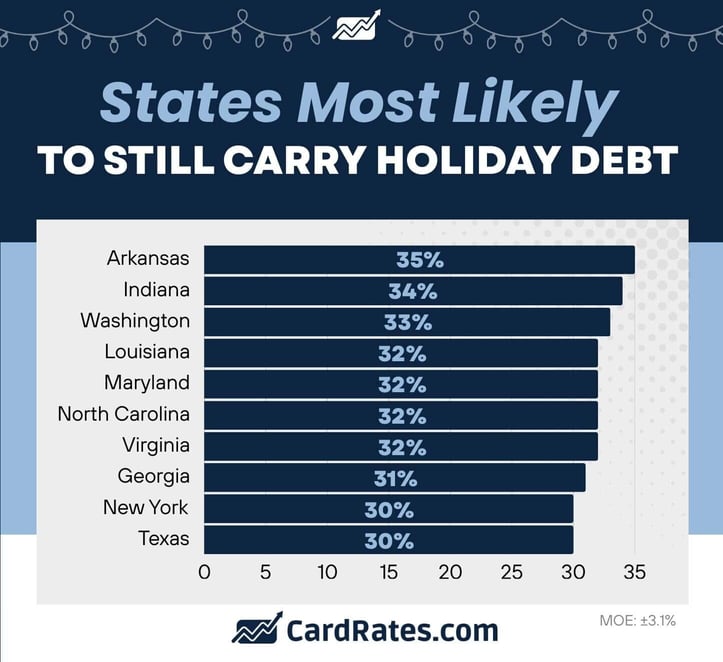
Our rankings show no single region is facing the most holiday debt. Instead, a mix of regions is being affected by holiday debt carryover. This mixture suggests that lingering balances aren’t limited to any single region or cost-of-living profile. Debt has become a universal experience.
In these states, holiday debt isn’t a short-term problem; it’s persisting well into the new year. This data shows how financially stretched consumers have become. Nationwide, consumers are facing student loan debt, rising inflation, and other existing financial obligations and are struggling to keep up with payments.
And lingering holiday debt has become just one piece of the puzzle. Overarching financial strain has caused many to defer payments this year, compounding debt and making it easier for cardholders to fall further into a pattern of year-round revolving debt.
States Least Likely to Still Carry Holiday Debt
While residents in some states are still bearing the burden of holiday debt, others are doing a better job of paying it off. Americans who reside in these states are the least likely to have a debt carryover:
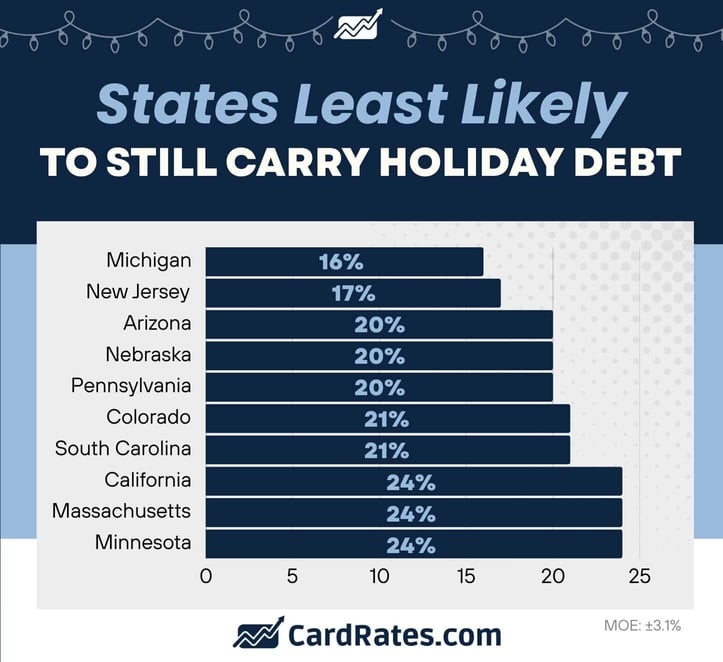
Interestingly enough, on the opposite end of the spectrum, we still find variances in the regions that have the lowest share of cardholders carrying holiday debt. Michigan (16%) and New Jersey (17%), located in the Midwest and the Northeast, respectively, top the list for the least amount of debt carryover, yet boast two very different regional backgrounds.
Residents from some states are less likely to stay stuck in revolving debt cycles than others. And it doesn’t exactly matter if a consumer is located in a high-cost region or not. For example, California landed closer to the low-debt group than the high-debt group, in spite of having one of the highest cost-of-living profiles in the country.
These results show that pay-down behavior may have less to do with regional location and more to do with individual household budgeting and debt planning. But we can’t skip over the fact that even in “low-debt” states, a considerable portion of people continue to miss their payments as they swipe again for this year’s gift.
Last Year’s Debt Is Colliding With This Year’s Holiday Rush
Where Last Year’s Holiday Credit Card Debt Still Remains
As Americans cross off their lists and wrap up their holiday spending this year, many have yet to recover from last year’s holiday rush. Instead, they are finding themselves racking up new charges on top of last year’s debt.
Lingering holiday debt is particularly risky in today’s climate. Total household debt recently hit $18.6 trillion at the end of the third quarter in 2025, increasing by $197 billion from the previous quarter, according to the New York Fed. Amid this rise, credit card balances also rose by $24 billion, and interest rates remain high.
With credit card reliance rising, many Americans are not only using credit cards for discretionary spending, such as holiday gifts, but they are also using them for everyday and essential purchases. This means even modest December spending can lead to costly consequences if added on top of existing balances, including last year’s debt.
“In the past, we’ve called this debt a holiday hangover,” said Bobbi Rebell CFP® at CardRates.com. “Hangovers go away, but for too many Americans, this debt does not. This is a call to action to put financial education systems in place before the debt spirals even more, poisoning holiday magic and creating endless financial anxiety and stress.”
Our state rankings help quantify this risk at a local level, revealing where people are most likely to struggle with holiday debt and where residents have broken the cycle of revolving debt.
As prices rise and economic uncertainty lingers, debt has become more challenging to pay off for many Americans. Within the highest- and the lowest-burdened states, residents are facing year-round revolving debt even as they shop this year.
For consumers, the focus this year-end should be on taking practical steps to curtail debt and keep rising balances at bay, no matter where they live. Hopefully, 2025’s holiday season spending doesn’t overlap with 2024’s debt.
Methodology
This survey was conducted in 2025 among 1,000 U.S. adult credit card holders via an online panel. The overall margin of error is approximately ±3.1 percentage points at the 95% confidence level. All questions were single-selection and received 1,000 completes.
State-level estimates are based on respondents’ self-reported state of residence. To avoid over-interpreting very small state samples, CardRates used an empirical Bayes adjustment that shrinks each state’s estimate toward the national average share of cardholders still carrying 2024 holiday credit card debt (26%).
The main rankings highlighted in this report include only states with at least 10 respondents; states with fewer respondents are shown in detailed tables but are not ranked.
For media inquiries, please reach out to catherine@cardrates.com.
Editorial Note: Our site content is not provided or commissioned by any credit card issuer(s). Opinions expressed on CardRates.com are the author's alone, not those of any credit card issuer, and have not been reviewed, approved, or otherwise endorsed by credit card issuers. Every reasonable effort has been made to maintain accurate information; however, all credit card offer details, including information about rewards, signup bonuses, introductory offers, and other terms and conditions, is presented without warranty. Clicking on any offer on CardRates.com will direct you to the issuer's website, where you can review the current terms and conditions of the offer.
About the Author

![List of Subprime Credit Cards[updated_month_year before=" (" after=")"]](https://www.cardrates.com/images/uploads/2018/10/list.jpg?width=158&height=120&fit=crop "List of Subprime Credit Cards[updated_month_year before=\" (\" after=\")\"]")

![[updated_month_year after=" "]List of Prepaid Debit Cards](https://www.cardrates.com/images/uploads/2022/03/List-of-Prepaid-Debit-Cards.jpg?width=158&height=120&fit=crop "[updated_month_year after=\" \"]List of Prepaid Debit Cards")


![5 Best Credit Cards For 18-Year-Olds[updated_month_year before=" (" after=")"]](https://www.cardrates.com/images/uploads/2018/03/18.png?width=158&height=120&fit=crop "5 Best Credit Cards For 18-Year-Olds[updated_month_year before=\" (\" after=\")\"]")
![Average Credit Card Interest Rate by Year (1995-[updated_month_year])](https://www.cardrates.com/images/uploads/2020/10/shutterstock_3976792.jpg?width=158&height=120&fit=crop "Average Credit Card Interest Rate by Year (1995-[updated_month_year])")