

Writer: Lynn Cadet


Editor: Ashley Fricker


Reviewer: Adam West

We deploy a step-by-step methodology to each piece of research we publish to ensure our studies offer complete coverage and meet our rigorous editorial standards.
Key Takeaways
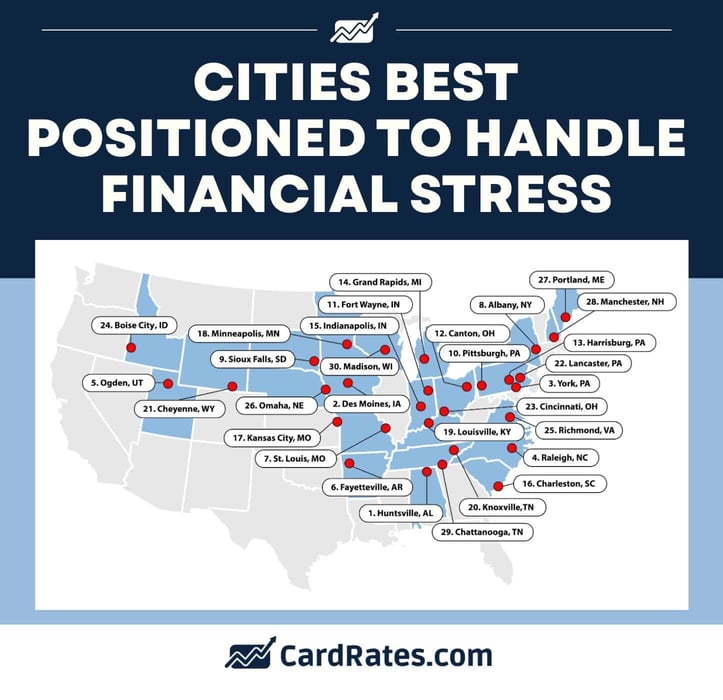
- The strongest metros for household financial resilience are concentrated in mid-sized cities with diversified job bases and lower housing cost pressure, led by Huntsville, AL; Des Moines, IA; York, PA; and Raleigh, NC.
- At the bottom of the rankings, metros such as Fresno and Bakersfield, CA; McAllen, TX; New Orleans, LA; and New York City show compounding affordability and income challenges that leave households more exposed to economic shocks.
- Large, high-cost metros tend to struggle on housing affordability metrics, while smaller metros with stable employment and lower home value–to–income ratios consistently rank higher.
Millions of Americans are entering 2026 carrying the financial stress of yesteryear. From high credit card debt to inflation pressures, amidst talk of an affordability crisis, households are grappling with intense economic stress and costs, as wage growth remains modest at best.
Yet not all Americans are facing the same level of financial strain, and where they live may have more to do with their standing than most would like to think.
CardRates.com set out with its first-ever Financial Resilience Report for 2026 to rank 151 U.S. metro areas to find out which U.S. cities are best positioned to overcome economic setbacks and which are more susceptible to financial shocks.
To identify which cities may be the best positioned to handle financial stress, we evaluated all 151 U.S. cities, mixing top designated market areas as well as smaller to mid-sized cities in 49 states, including Washington D.C. and Puerto Rico. Our data set includes factors such as unemployment, retirement income, housing affordability, job diversity, home value, and poverty rates.
Our results found a significant gap between cities with households that were more resilient in the face of economic turmoil and those that were more vulnerable to said challenges, shifting the scale at which Americans experience financial struggles.
Main Findings
The Top 5 Economically Resilient Metros in 2026
Nationwide, American households are juggling rising costs, high debt, and housing pressures. Though financial strain feels like a universal experience in this economy, some Americans are feeling the burden more than others.
Our report found that some cities are better positioned to face economic stress. These cities show the most financial resilience based on our dataset:
- Huntsville, AL — Rank #1 (Score: 82.1)
- Des Moines, IA — Rank #2 (Score: 75.0)
- York, PA — Rank #3 (Score: 72.4)
- Raleigh, NC — Rank #4 (Score: 71.6)
- Ogden, UT — Rank #5 (Score: 71.5)
A variety of factors can help explain why these metros perform better than most U.S. cities. Boasting a healthy mix of circumstances, including low poverty and unemployment rates, these cities are able to create an environment where residents can survive economic pressures without tipping into crisis.
For instance, Huntsville, AL, and Des Moines, IA scored low compared to other markets on housing burdens, including rent and mortgage payments, while also boasting low home value-to-income ratios. They also ranked well on unemployment, poverty, and uninsured rates.
With manageable housing payments and firmer income cushions, households in these U.S. cities are less likely to fall into economic downturns and more likely to have some sort of a safety net, i.e., income buffers, in times of financial crisis.
While no region is immune to economic stress, these results show that certain metros can set their residents up with a stronger footing, giving them more room to stay afloat financially than other cities.
The Bottom 5 Economically Resilient Metros in 2026
While some cities seem to exhibit built-in financial resilience, economic pressures loom greater for others. Our findings reveal the metropolitan areas under the greatest affordability pressure, making them more vulnerable to economic stresses.
These five metros ranked the lowest:
- Fresno, CA — Rank #151 (Score: 22.4)
- Bakersfield, CA — Rank #150 (Score: 23.4)
- McAllen, TX — Rank #149 (Score: 25.3)
- New Orleans, LA — Rank #148 (Score: 25.3)
- New York, NY — Rank #147 (Score: 25.4)
What these five areas have in common: low affordability, high poverty and unemployment rates, and little income cushioning, among other factors. These factors mixed together signal a higher susceptibility to financial hardship, making it more difficult for households in these areas to be financially flexible when prices rise.
“A major takeaway from this study is that residents of the most vulnerable metros, such as Fresno, California, and New York City, should prioritize building emergency funds. Without a safety net, financial shocks hit harder,” said Erica Sandberg, consumer finance expert at CardRates.com.
For example, New York, while a high-income city, ranks poorly due to high housing costs and cost-of-living metrics that outpace earnings. California’s Central Valley cities also face similar challenges, where a mismatch exists between home values and household incomes.
Our results indicate that residents of these areas are less likely to comfortably handle financial stress due to the unique pressures they already face.
Unlike the more resilient cities, these metros don’t carry as much financial buffering, meaning any minor economic shock — such as an unexpected rent increase or a medical bill — is more likely to lead to deeper financial distress for residents.
Sandberg adds, “I would also take proactive steps, like reducing consumer debt, cutting budgetary waste, and taking on side hustles. This way, you can weather the inherent volatility of place with actions you can control.
If you are considering a change of location and want to live in a relatively stable financial environment, focus on the metro areas that are the most economically resilient. The good news is that cities and towns from coast to coast, north to south, and everything in between are on the list!”
Affordability and Job Mix Matter More Than City Size
Our report shows that a city’s unique economic circumstances may matter more than its size when determining its financial resilience ranking. In fact, one of the clearest patterns revealed in the rankings was that mid-sized cities consistently outperformed larger metropolitan areas.
Measuring Financial Resilience
| City | State | Total Score | Resilience Rank | Unemployment | Household Below Poverty | Income Cushion | Job Diversity | Household Renter Burden | Mortgage Burden | Home Value Income | Uninsured Rate |
|---|---|---|---|---|---|---|---|---|---|---|---|
| Huntsville | AL | 82.1 | 1 | 97 | 71 | 76 | 97 | 93 | 100 | 75 | 48 |
| Des Moines | IA | 75 | 2 | 91 | 89 | 30 | 82 | 97 | 54 | 80 | 77 |
| York | PA | 72.4 | 3 | 56 | 93 | 89 | 71 | 71 | 34 | 85 | 80 |
| Raleigh | NC | 71.6 | 4 | 91 | 93 | 19 | 93 | 73 | 93 | 45 | 66 |
| Ogden | UT | 71.5 | 5 | 87 | 100 | 39 | 82 | 92 | 97 | 23 | 52 |
| Fayetteville | AR | 71.5 | 6 | 87 | 64 | 56 | 89 | 99 | 98 | 60 | 19 |
| St. Louis | MO | 71 | 7 | 71 | 74 | 74 | 39 | 88 | 54 | 88 | 80 |
| Albany | NY | 70.4 | 8 | 76 | 66 | 91 | 16 | 86 | 58 | 73 | 97 |
| Sioux Falls | SD | 70.4 | 9 | 100 | 97 | 12 | 29 | 100 | 99 | 62 | 64 |
| Pittsburgh | PA | 70.3 | 10 | 65 | 66 | 80 | 18 | 96 | 52 | 92 | 93 |
| Fort Wayne | IN | 70.1 | 11 | 87 | 51 | 53 | 39 | 95 | 93 | 91 | 52 |
| Canton | OH | 70 | 12 | 45 | 39 | 82 | 48 | 98 | 81 | 95 | 72 |
| Harrisburg | PA | 69.9 | 13 | 65 | 78 | 89 | 33 | 97 | 61 | 78 | 58 |
| Grand Rapids | MI | 69.4 | 14 | 65 | 81 | 51 | 64 | 68 | 76 | 68 | 82 |
| Indianapolis | IN | 66.8 | 15 | 87 | 69 | 31 | 55 | 70 | 89 | 75 | 58 |
| Charleston | SC | 66 | 16 | 65 | 60 | 92 | 83 | 51 | 43 | 68 | |
| Kansas City | MO | 65.9 | 17 | 78 | 78 | 47 | 67 | 90 | 56 | 70 | 41 |
| Minneapolis | MN | 65.6 | 18 | 76 | 95 | 39 | 44 | 71 | 64 | 51 | 85 |
| Louisville/Jefferson County | KY | 65.5 | 19 | 56 | 47 | 62 | 62 | 88 | 70 | 69 | 70 |
| Knoxville | TN | 65.4 | 20 | 91 | 41 | 64 | 57 | 78 | 95 | 56 | 41 |
| Cheyenne | WY | 65.4 | 21 | 94 | 81 | 87 | 47 | 75 | 45 | 38 | 56 |
| Lancaster | PA | 65.3 | 22 | 82 | 91 | 79 | 45 | 82 | 61 | 66 | 16 |
| Cincinnati | OH | 64.8 | 23 | 53 | 57 | 57 | 53 | 88 | 58 | 80 | 72 |
| Boise City | ID | 64.8 | 24 | 87 | 87 | 54 | 71 | 79 | 95 | 16 | 29 |
| Richmond | VA | 64.3 | 25 | 91 | 78 | 66 | 53 | 39 | 89 | 38 | 60 |
| Omaha | NE | 63.9 | 26 | 91 | 84 | 30 | 36 | 81 | 47 | 82 | 60 |
| Portland | ME | 63.6 | 27 | 96 | 98 | 77 | 18 | 80 | 17 | 32 | 91 |
| Manchester | NH | 63.6 | 28 | 91 | 100 | 47 | 57 | 62 | 10 | 49 | 93 |
| Chattanooga | TN | 63.4 | 29 | 87 | 39 | 47 | 78 | 85 | 84 | 66 | 21 |
| Madison | WI | 63.4 | 30 | 99 | 78 | 42 | 12 | 90 | 50 | 41 | 95 |
| Akron | OH | 63.1 | 31 | 45 | 45 | 70 | 42 | 64 | 70 | 89 | 80 |
| Dayton | OH | 62.3 | 32 | 38 | 36 | 83 | 33 | 91 | 58 | 94 | 65 |
| Fargo | ND | 62.1 | 33 | 99 | 58 | 10 | 6 | 99 | 97 | 52 | 76 |
| Wichita | KS | 61.8 | 34 | 69 | 35 | 62 | 39 | 95 | 74 | 93 | 27 |
| Cleveland | OH | 61.4 | 35 | 87 | 30 | 70 | 30 | 78 | 37 | 90 | 69 |
| Winston | NC | 61.4 | 36 | 69 | 26 | 74 | 36 | 86 | 89 | 67 | 44 |
| Wilmington | NC | 61.1 | 37 | 76 | 62 | 96 | 71 | 25 | 63 | 30 | 66 |
| Rochester | NY | 60.9 | 38 | 65 | 45 | 85 | 4 | 53 | 41 | 97 | 97 |
| Charlotte | NC | 60.6 | 39 | 69 | 69 | 17 | 98 | 70 | 85 | 46 | 31 |
| Salt Lake City | UT | 60.5 | 40 | 76 | 97 | 10 | 84 | 76 | 85 | 19 | 37 |
| Washington | DC | 59.8 | 41 | 53 | 97 | 40 | 66 | 72 | 72 | 25 | 53 |
| Lansing | MI | 59.6 | 42 | 53 | 35 | 76 | 14 | 64 | 64 | 87 | 84 |
| Urban Honolulu | HI | 59.6 | 43 | 99 | 87 | 93 | 49 | 6 | 42 | 2 | 99 |
| Syracuse | NY | 59.4 | 44 | 65 | 24 | 86 | 4 | 59 | 42 | 98 | 97 |
| Virginia Beach | VA | 59.3 | 45 | 78 | 66 | 84 | 47 | 27 | 70 | 40 | 62 |
| Billings | MT | 58.5 | 46 | 94 | 78 | 47 | 41 | 80 | 62 | 31 | 35 |
| Oklahoma City | OK | 57.8 | 47 | 82 | 26 | 33 | 60 | 72 | 89 | 82 | 18 |
| Tulsa | OK | 57.5 | 48 | 78 | 29 | 21 | 74 | 90 | 75 | 82 | 11 |
| Toledo | OH | 57.4 | 49 | 24 | 15 | 58 | 31 | 96 | 52 | 95 | 88 |
| Buffalo | NY | 57.3 | 50 | 53 | 27 | 90 | 9 | 52 | 45 | 85 | 97 |
| Gulfport | MS | 57 | 51 | 82 | 15 | 80 | 41 | 56 | 79 | 82 | 21 |
| Savannah | GA | 57 | 52 | 95 | 45 | 44 | 76 | 58 | 67 | 60 | 11 |
| Nashville | TN | 56.8 | 53 | 94 | 71 | 13 | 65 | 58 | 97 | 29 | 27 |
| Milwaukee | WI | 56.4 | 54 | 94 | 45 | 47 | 31 | 78 | 35 | 49 | 72 |
| Provo | UT | 56.3 | 55 | 76 | 91 | 2 | 29 | 82 | 100 | 18 | 52 |
| Colorado Springs | CO | 56.1 | 56 | 65 | 93 | 72 | 45 | 22 | 89 | 19 | 44 |
| Youngstown | OH | 56 | 57 | 20 | 8 | 93 | 30 | 75 | 61 | 97 | 64 |
| Greenville | SC | 55.9 | 58 | 49 | 35 | 51 | 62 | 56 | 93 | 68 | 33 |
| Hartford | CT | 55.9 | 59 | 65 | 82 | 70 | 18 | 51 | 8 | 66 | 87 |
| Springfield | MO | 55.6 | 60 | 91 | 26 | 44 | 25 | 78 | 84 | 70 | 27 |
| Detroit | MI | 55.6 | 61 | 24 | 32 | 76 | 78 | 51 | 24 | 73 | 87 |
| Anchorage | AK | 55.5 | 62 | 65 | 83 | 52 | 36 | 64 | 67 | 54 | 23 |
| Birmingham | AL | 55.1 | 63 | 95 | 23 | 48 | 41 | 43 | 79 | 77 | 35 |
| Charleston | WV | 54.9 | 64 | 38 | 10 | 60 | 39 | 89 | 100 | 48 | |
| Reno | NV | 54.4 | 65 | 45 | 66 | 56 | 99 | 49 | 79 | 12 | 29 |
| Pensacola | FL | 53.4 | 66 | 35 | 49 | 91 | 55 | 56 | 56 | 54 | 31 |
| Asheville | NC | 53.3 | 67 | 76 | 54 | 85 | 44 | 37 | 82 | 24 | 24 |
| Palm Bay | FL | 53.3 | 68 | 33 | 81 | 97 | 89 | 20 | 46 | 39 | 21 |
| San Jose | CA | 53.3 | 69 | 35 | 99 | 10 | 66 | 91 | 29 | 3 | 93 |
| San Francisco | CA | 53.1 | 70 | 33 | 91 | 25 | 80 | 75 | 26 | 2 | 93 |
| Atlanta | GA | 53 | 71 | 82 | 64 | 18 | 95 | 23 | 81 | 49 | 12 |
| Augusta | GA | 52.9 | 72 | 45 | 18 | 78 | 51 | 27 | 91 | 86 | 27 |
| Columbus | OH | 52.8 | 73 | 65 | 49 | 22 | 36 | 93 | 49 | 64 | 44 |
| Jacksonville | FL | 52.5 | 74 | 45 | 50 | 62 | 91 | 18 | 70 | 45 | 39 |
| Baltimore | MD | 52.4 | 75 | 45 | 81 | 64 | 23 | 43 | 39 | 44 | 80 |
| Denver | CO | 52.3 | 76 | 65 | 95 | 13 | 91 | 43 | 61 | 13 | 37 |
| Greensboro | NC | 51.9 | 77 | 53 | 16 | 35 | 52 | 61 | 81 | 72 | 45 |
| Little Rock | AR | 51.5 | 78 | 56 | 22 | 28 | 16 | 84 | 91 | 84 | 31 |
| Mobile | AL | 51.5 | 79 | 78 | 12 | 51 | 51 | 15 | 82 | 84 | 39 |
| Allentown | PA | 51.4 | 80 | 29 | 74 | 89 | 19 | 41 | 21 | 64 | 74 |
| Spartanburg | SC | 51.1 | 81 | 33 | 18 | 40 | 84 | 61 | 79 | 76 | 18 |
| Myrtle Beach | SC | 51.1 | 82 | 17 | 37 | 99 | 94 | 37 | 70 | 43 | 12 |
| Phoenix | AZ | 50.8 | 83 | 53 | 60 | 52 | 89 | 44 | 67 | 23 | 18 |
| Seattle | WA | 50.5 | 84 | 20 | 94 | 16 | 92 | 66 | 33 | 8 | 75 |
| Scranton | PA | 50.3 | 85 | 29 | 20 | 72 | 25 | 84 | 19 | 93 | 60 |
| Flint | MI | 50 | 86 | 8 | 15 | 95 | 47 | 37 | 23 | 91 | 84 |
| Spokane | WA | 49.8 | 87 | 71 | 47 | 59 | 23 | 41 | 56 | 27 | 74 |
| Reading | PA | 49.6 | 88 | 38 | 54 | 70 | 49 | 54 | 21 | 74 | 37 |
| Santa Rosa | CA | 49.4 | 89 | 33 | 93 | 81 | 65 | 16 | 11 | 5 | 91 |
| Chicago | IL | 48.6 | 90 | 49 | 62 | 23 | 64 | 67 | 12 | 62 | 50 |
| Vallejo | CA | 48.5 | 91 | 9 | 82 | 89 | 62 | 9 | 45 | 7 | 85 |
| Lexington | KY | 48.4 | 92 | 69 | 24 | 33 | 10 | 70 | 74 | 51 | 56 |
| Austin | TX | 48.4 | 93 | 69 | 81 | 8 | 95 | 66 | 33 | 25 | 10 |
| Oxnard | CA | 48.3 | 94 | 14 | 87 | 78 | 89 | 3 | 33 | 6 | 76 |
| Columbia | SC | 47.6 | 95 | 45 | 20 | 64 | 44 | 19 | 79 | 78 | 32 |
| Burlington | VT | 47 | 96 | 99 | 74 | 39 | 5 | 27 | 7 | 31 | 94 |
| Durham | NC | 47 | 97 | 82 | 47 | 42 | 2 | 62 | 74 | 28 | 39 |
| Providence | RI | 46.5 | 98 | 56 | 60 | 54 | 18 | 65 | 11 | 20 | 88 |
| Kiryas Joel | NY | 46.5 | 99 | 65 | 64 | 83 | 6 | 17 | 4 | 42 | 91 |
| Portland | OR | 45.6 | 100 | 17 | 84 | 31 | 68 | 39 | 30 | 12 | 84 |
| Albuquerque | NM | 45.4 | 101 | 65 | 18 | 67 | 21 | 41 | 63 | 55 | 33 |
| Dallas | TX | 44.9 | 102 | 49 | 69 | 5 | 97 | 45 | 37 | 53 | 4 |
| North Port | FL | 44.6 | 103 | 29 | 85 | 100 | 81 | 7 | 19 | 22 | 14 |
| Waterbury | CT | 44.6 | 104 | 45 | 74 | 74 | 8 | 30 | 3 | 49 | 74 |
| Worcester | MA | 43.8 | 105 | 33 | 74 | 39 | 9 | 53 | 9 | 33 | 100 |
| Ocala | FL | 43.5 | 106 | 12 | 21 | 99 | 76 | 25 | 49 | 56 | 10 |
| Beaumont | TX | 43.5 | 107 | 9 | 11 | 21 | 80 | 54 | 72 | 96 | 5 |
| Baton Rouge | LA | 43.4 | 108 | 49 | 13 | 26 | 33 | 19 | 94 | 61 | 52 |
| Killeen | TX | 43.1 | 109 | 17 | 29 | 74 | 39 | 61 | 45 | 72 | 8 |
| Philadelphia | PA | 42.6 | 110 | 29 | 54 | 56 | 12 | 45 | 14 | 51 | 80 |
| New Haven | CT | 42.6 | 111 | 69 | 57 | 52 | 1 | 29 | 4 | 47 | 82 |
| Sacramento | CA | 42.4 | 112 | 14 | 57 | 66 | 57 | 14 | 33 | 9 | 89 |
| Jackson | MS | 42.4 | 113 | 87 | 8 | 26 | 23 | 18 | 74 | 84 | 19 |
| Deltona | FL | 42.3 | 114 | 17 | 54 | 95 | 76 | 10 | 19 | 38 | 29 |
| Boston | MA | 42.3 | 115 | 49 | 89 | 19 | 14 | 48 | 6 | 14 | 99 |
| Cape Coral | FL | 41.6 | 116 | 24 | 54 | 97 | 93 | 4 | 17 | 38 | 6 |
| Bridgeport | CT | 41.6 | 117 | 71 | 85 | 28 | 60 | 22 | 1 | 21 | 45 |
| Naples | FL | 41.4 | 118 | 29 | 69 | 98 | 100 | 2 | 6 | 14 | 13 |
| San Antonio | TX | 41.3 | 119 | 49 | 31 | 34 | 60 | 37 | 49 | 64 | 6 |
| Salem | OR | 41 | 120 | 20 | 37 | 70 | 52 | 29 | 39 | 19 | 62 |
| Tampa | FL | 41 | 121 | 45 | 49 | 66 | 78 | 11 | 21 | 35 | 23 |
| Lafayette | LA | 40.4 | 122 | 65 | 6 | 6 | 26 | 46 | 61 | 57 | 56 |
| San Juan | PR | 40.3 | 123 | 20 | 1 | 3 | 86 | 33 | 89 | 21 | 69 |
| Lakeland | FL | 40.1 | 124 | 14 | 20 | 58 | 99 | 21 | 41 | 52 | 16 |
| Memphis | TN | 38.6 | 125 | 38 | 12 | 17 | 74 | 33 | 51 | 61 | 23 |
| San Diego | CA | 38.5 | 126 | 20 | 71 | 39 | 74 | 6 | 17 | 6 | 75 |
| Tucson | AZ | 38.4 | 127 | 29 | 21 | 86 | 19 | 30 | 46 | 35 | 41 |
| Stockton | CA | 38.4 | 128 | 5 | 41 | 44 | 90 | 29 | 26 | 12 | 60 |
| Port St. Lucie | FL | 38.4 | 129 | 24 | 57 | 94 | 71 | 2 | 12 | 33 | 14 |
| Orlando | FL | 38.1 | 130 | 53 | 51 | 18 | 97 | 4 | 37 | 29 | 16 |
| Trenton | NJ | 37.3 | 131 | 6 | 62 | 60 | 14 | 47 | 5 | 60 | 44 |
| Tallahassee | FL | 36.4 | 132 | 45 | 6 | 42 | 21 | 8 | 91 | 41 | 37 |
| Modesto | CA | 35.6 | 133 | 4 | 35 | 25 | 74 | 31 | 22 | 10 | 84 |
| Houston | TX | 34.6 | 134 | 24 | 30 | 4 | 86 | 33 | 39 | 58 | 3 |
| Fayetteville | NC | 34.3 | 135 | 33 | 10 | 8 | 23 | 48 | 26 | 76 | 50 |
| Visalia | CA | 32.3 | 136 | 1 | 7 | 14 | 64 | 52 | 37 | 27 | 56 |
| Salinas | CA | 32 | 137 | 11 | 41 | 27 | 84 | 12 | 27 | 4 | 50 |
| Riverside | CA | 31.8 | 138 | 6 | 49 | 33 | 80 | 5 | 15 | 10 | 56 |
| Corpus Christi | TX | 31.6 | 139 | 29 | 9 | 16 | 41 | 39 | 28 | 87 | 4 |
| Santa Maria | CA | 31 | 140 | 35 | 27 | 51 | 55 | 10 | 18 | 4 | 48 |
| Las Vegas | NV | 30 | 141 | 8 | 32 | 35 | 60 | 12 | 67 | 16 | 10 |
| Miami | FL | 28.9 | 142 | 76 | 35 | 5 | 89 | 1 | 2 | 15 | 8 |
| Springfield | MA | 28.4 | 143 | 11 | 16 | 29 | 3 | 23 | 8 | 39 | 98 |
| Los Angeles | CA | 27.6 | 144 | 10 | 41 | 6 | 80 | 8 | 13 | 1 | 62 |
| El Paso | TX | 26 | 145 | 24 | 4 | 7 | 24 | 31 | 27 | 89 | 2 |
| Brownsville | TX | 25.6 | 146 | 3 | 2 | 2 | 2 | 49 | 47 | 99 | 1 |
| New York | NY | 25.4 | 147 | 12 | 45 | 23 | 14 | 34 | 2 | 8 | 65 |
| New Orleans | LA | 25.3 | 148 | 35 | 6 | 21 | 29 | 14 | 33 | 35 | 29 |
| McAllen | TX | 25.3 | 149 | 5 | 2 | 1 | 10 | 59 | 24 | 99 | 2 |
| Bakersfield | CA | 23.4 | 150 | 2 | 3 | 11 | 68 | 13 | 15 | 27 | 48 |
| Fresno | CA | 22.4 | 151 | 2 | 4 | 14 | 29 | 16 | 30 | 17 | 67 |
Take a look at Huntsville, AL, the top-ranked metro. While the city may be one of the biggest in the South with 249,102 people, it’s significantly smaller in comparison to larger population areas, such as New York and Fresno, CA, which ranked toward the bottom of the list.
Size may be a factor, but it doesn’t truly dictate how a city handles financial shock. Instead, it more so comes down to that metro’s unique economic standing and makeup. While New York, for instance, may offer higher wages on paper, its higher housing costs wipe out much of the gain residents receive.
In contrast, smaller and mid-sized metros tend to benefit from lower home-value-to-income ratios and higher discretionary income due to lower cost-of-living metrics. The indicators of a financially sound metropolitan are better affordability, high employment, and low poverty rates — and all those factors matter far more than its size.
Our report makes one thing clear: financial resilience in the U.S. is highly local. While following national trends is important, it’s clear that economic trends don’t impact every American in the same way. Instead, household stability varies dramatically from metro to metro.
A city’s specific circumstances, including housing affordability and employment rates, tell more of the story than anything else. By understanding a metro’s unique metrics, households in these metros can know how to prepare when a financial shock hits.
For consumers, the lesson here is to recognize the pressures in their local communities and plan accordingly.
Methodology
CardRates analyzed 151 U.S. metro areas and cities using the most recent data from the U.S. Census Bureau’s American Community Survey and related public sources. Each metro or city was evaluated across eight indicators of household financial stress, including unemployment, retirement income, housing affordability (renters & owners), job diversity, home value, and poverty rates.
Raw values were ranked and converted into 0–100 percentile scores to allow consistent comparisons across metros. Metrics where higher values indicate greater stress were inverted so higher scores always reflect stronger financial conditions.
Each metro’s overall score is the simple average of its eight percentile scores, with no single factor weighted more heavily than others. Metros were then ranked from least to most financially stressed based on those overall scores.
For any media questions, please contact catherine@cardrates.com.
Editorial Note: Our site content is not provided or commissioned by any credit card issuer(s). Opinions expressed on CardRates.com are the author's alone, not those of any credit card issuer, and have not been reviewed, approved, or otherwise endorsed by credit card issuers. Every reasonable effort has been made to maintain accurate information; however, all credit card offer details, including information about rewards, signup bonuses, introductory offers, and other terms and conditions, is presented without warranty. Clicking on any offer on CardRates.com will direct you to the issuer's website, where you can review the current terms and conditions of the offer.
About the Author