

Writer: William Henry


Editor: Lillian Guevara-Castro


Reviewer: Adam West

Our experts and industry insiders blog the latest news, studies and current events from inside the credit card industry. Our articles follow strict editorial guidelines.
Key Takeaways
- Credit card APRs rose swiftly on the heels of a global pandemic based largely on a combination of enhanced reward structures and increases in projected losses.
- Recent credit card program profits show interest rates aren't being driven up by banking greed.
- Sustained inflationary pressure and regulatory oversight suggest credit card interest rates and fees are unlikely to fall in the near future.
Approximately 74% of U.S. adults have a credit card to their name. And 60% of those carry a balance from month to month, according to research by the New York Fed.
For those shopping for a new account today, APRs can extend beyond 29%. On top of this, some luxury cards include annual fees over $800. But prior to 2020, APRs over 15% were the exception instead of the rule — and in early 2017 the AMEX platinum card was $450 annually; today it’s $895.
So what’s changed?
Who’s to blame for elevated credit rates? And why are fees moving in the same direction? Are major credit card banks boosting profits at the expense of borrowers? Or is inflation once again the primary explanation?
President Donald Trump appears to believe that profit margins are to blame, and because of this, he’s suggested a 10% cap on interest rates. But if he’s wrong in his assessment, which we believe he is, then it isn’t only credit card banks that will suffer but also those who can’t obtain credit as a result of the policy change.
To come to a fuller picture of where we are today, we’ll briefly discuss credit trends over the past three decades, and then zoom into major explanations for rising APRs and fees.
Finally, we’ll offer an interpretation of who or what is truly to blame for these rising rates and fees as well as offer a forecast for where credit markets are headed in the near term.
A Brief History of Credit
In 1994, the Federal Reserve began measuring interest rates for commercial credit card accounts. Over the second half of the ‘90s, not much happened. Rates hovered between 15 and 16% percent, and no macro event toppled the market from its relative stability.
The 2000s are the mirror opposite. A recession in 2001 following the dot-com burst and another between 2007 and 2009 fundamentally challenged assumptions around risk in financial markets.
Legislation including the CARD Act of 2009 and Dodd Frank in 2010 piled on by increasing regulatory controls. Dodd Frank specifically altered how capital was treated in securitized credit card assets, requiring lenders to retain at least a portion of all assumed risk.
It should come as no surprise that by tying up a larger piece of the lender’s assets, profits would be negatively impacted, and the burden would eventually be transferred to the borrower. This is at least one step on the path toward increasing APRs.
The 2010s are largely a story of recovery. Delinquencies trended downward until hitting a then-low in 2015. With markets more or less recovered by the middle of the decade, three-month treasuries inched higher in 2016 with a corresponding increase in credit card interest.
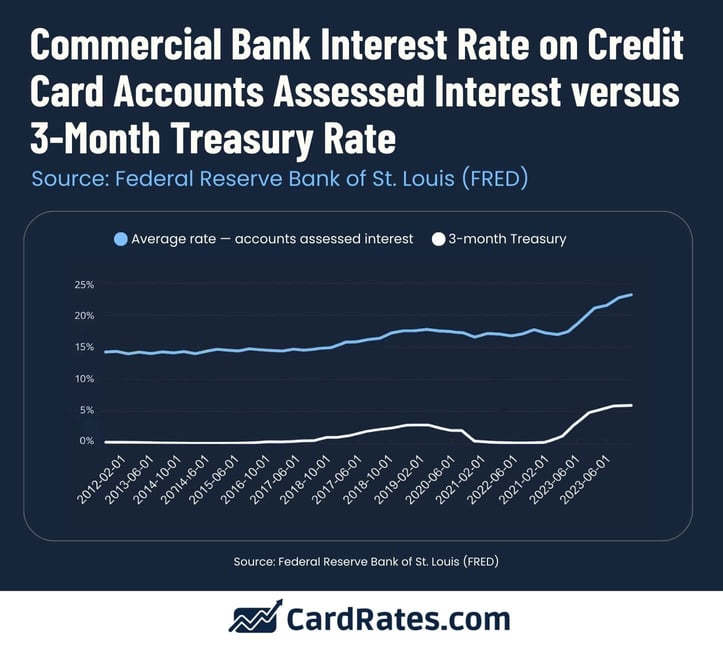
Above, co-movement can be seen between treasuries and the average rate of interest in commercial bank credit card accounts. The relationship is to be expected because as the cost of credit rises, so eventually does the price of borrowing.
The 2020s truly began with a bang. Nobody properly anticipated COVID-19 or its ensuing complications, and the government response was both swift and wide-reaching.
Three-month treasuries flatlined and delinquencies plummeted because of concerted action between the Fed’s lowering of rates and the government initiation of multiple cash transfers — both attempts to stabilize a reeling economy.
Major creditors believed these actions would wear off in time and left forward-looking risk assessments largely unchanged. So credit spreads remained more or less level until the government response ended, and inflation began to tick up.
And this is when credit rates took off. The gradual rise between 2016 and 2019 pales in comparison to increases between 2022 and 2024 — when rates went from near 17% to a peak in 2023 of 23.4% for accounts assessed interest.
Over the course of 2022, the annual percent change in CPI came in at 8%, higher than any measurements since 1981 — so inflation is at least another step on the path.
The recessions of the 2000s put to the test credit card banks’ calculations concerning risk. Over the course of 2009, major providers had a return on assets of -5.33%. These losses, coupled with new legislation, changed the way credit card banks both assess and price credit risk.
Though it didn’t happen overnight, markets of today value risk differently than before the recessions in the first decade of the century. And these trends were further complicated in the 2020s by a global pandemic, dramatic responses in monetary and fiscal policy, and inflation that inevitably followed.
Making Sense of the Credit Story
Commentary around the explanation for these rising rates abound. We’ll look specifically into three of the most popular explanations for elevated spreads and fees, and then after, we’ll offer a single through line in understanding these trends.
There’s a reason why we aren’t including excessive profit taking within this section, and it’s because the facts don’t support the interpretation. We will give more room to the question in the conclusion below.
Rising Rewards
Many of the largest credit card banks now offer perks for their higher fee accounts — American Express being the prime example. From travel miles to access to VIP lounges, the rewards have increased in value, and it’s no surprise these costs are being priced into credit cards through annual fees and APRs.
In 2022 alone, the six largest issuers of credit cards spent a total of $67.9 billion on reward redemptions and partner payments, according to Lending Tree. However, interchange fee revenue also increased from the previous year and more than covered the cost of these reward redemptions, netting $31.9 billion.
But expenses incurred by rewards rose by 23.7% from the previous year while the net from interchange fees increased by only 11.5%.
Interchange fees would have previously gone more or less toward the profit line. But today, part of that revenue is being set aside to cover increased rewards. Even if there are revenue streams to compensate for rising reward payments, it’s clear that these rewards have become a larger part of the expenses paid by major credit card banks.
Rising Projected Losses
Credit cards are the primary source of unsecured borrowing in America. That’s why the default risk to lenders is higher than in most other forms of debt. And it follows that the risk comes with its own rewards.
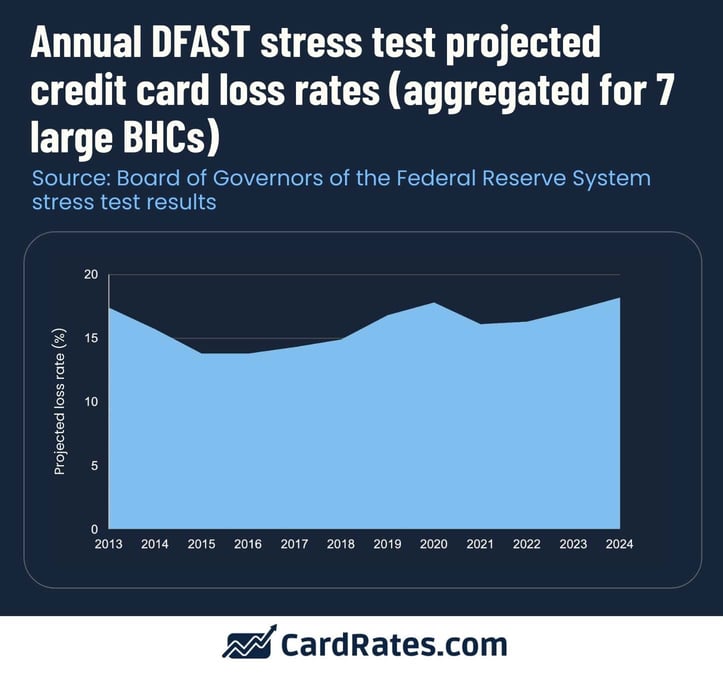
As seen above, projected losses have increased over the years where we’ve witnessed the highest growth in credit card interest rates.
These projected losses may not be paid out annually, and so in some ways they may be masking revenue from major credit card banks. But some of these are mandated and so out of the control of any one bank, and their stated objective is to be available in the case of shortfalls.
So even if these expenses go untouched in any given year, they can’t be perfectly equated to profits.
And the other problem with credit card debt is that it cannot be diversified away. During economic downturns, delinquencies are found across all FICO scores. Before Dodd-Frank, almost all of this risk was passed through to debt investors. But after Dodd-Frank, lenders had to assume a greater responsibility for these debts.
Rising Operational Costs
The cost of bringing new credit offerings to market and to service those accounts has risen in recent years.
Researchers from the Federal Reserve Bank of New York found credit card banks spending around 10 times the amount compared to other banks on their marketing expenses. These expenses average between 1 and 2% of assets.
These researchers concluded: “Consequently, the largest credit card banks rank among the world’s top marketers, with budgets comparable to consumer giants like Nike and Coca-Cola.”
To compete with their peers, gain new accounts and pricing power, the largest credit card banks are spending more and more on operations.
And marketing is only a single piece of the operational pie. Technology and energy costs have risen over the past decade, partially through inflation, but also because companies today expect more from their tech stack, and spend more on its maintenance and related energy costs.
And that’s not including the added researchers and analysts that have stepped in to uphold regulations like the CARD Act and Dodd-Frank. The credit card market has evolved since 2000, and what sufficed for a major lender then simply won’t work today.
What to Make of All the Competing Arguments
Though we listed three explanations above, we believe these would be better understood under a single branch: rising operational costs. From expanding teams of researchers and marketers to increased costs of funds and expected losses, lenders incur much greater costs themselves than they did 30 years ago.
While the individual expenses differ, the cost of doing business in general has risen significantly since the recessions of the 2000s. And during times of significant inflationary pressures, especially those following COVID-era stimulus, we’ve seen these trends amplified.
There’s good reason to think that major credit card issuers are attempting to maximize profits — this is their fundamental mandate as a business. But to justify the argument of “price gouging,” we would need to see outsized returns over the past few years.
And this isn’t the case. Annualized return on assets during 2023 were only 3.33% — far from excessive or exploitative.
If credit card issuers were making that slight of a profit with rates near 30%, capping rates at 10% won’t help borrowers, it will topple the industry. Credit card banks require profit to sustain business functions. Their business model will be untenable at a 10% cap.
And based on these reasons, many experts in the industry believe the caps are out of the realm of possibility. What the president tweets doesn’t always align with enacted legislation. So the best that credit issuers can hope for in the short term is that the president is making more noise than sense.
Where Do Rates Go From Here?
In our opinion, elevated credit card rates and fees are here to stay — at least over the short term. The cause-and-effect relationships that began this process for the most part remain intact, and outside of unforeseen macro events altering the current framework, we see no reprieve in sight.
We expect all the key drivers of the trend — increased regulations, inflation, and operating costs — all to continue on their current path upward.
Increased Regulation
Regulations may not increase from their current point, but we expect the regulations put in place after the recessions to remain largely in place. And we believe this is a major reason for the elevated rates we see today.
Janet Yellen, the Fed chair between 2014 and 2018, said in speaking about Dodd-Frank: “Appropriate regulation is critical to supporting a resilient financial system that serves as an engine for innovation and growth.”
Though there will be sustained critical debate on the subject, and though legislation will pass that alters the current order, it appears that the majority of economists and lawmakers see no mandate to radically change post-recession regulations — and deal with the possible fallout.
Sustained Inflationary Pressures
Possibly more influential than government policy, however, we expect to see inflation remain above the Fed’s target rate of 2% over the course of the current decade, especially if tariffs remain in place while the Fed stays on its current dovish path, which appears to be its intention.
By driving the cost of all products and services upward, this will continue to increase staffing and funding costs. And most of these costs will eventually pass through to the borrower in the form of higher rates and fees.
Elevated Operational Costs
Finally, major credit card issuers will likely further consolidate pricing power by increasing operational expenses to both defend and acquire new customers.
The CARD Act of 2009 limits the ability of issuers to increase rates on current accounts, which means that much of the increase in rates is only being applied to new accounts — ones in which borrowers are accepting higher rates to either gain access to greater rewards or to lift their overall credit limit.
And that second reason further complicates lenders’ risk assessments, as a rise in credit limits more than likely will lead to higher overall balances carried. And studies, including Canals-Cerda and Kerr (2015) and Calem, Jagtiani and Mester (2020) demonstrated that larger card balances are linked to poorer borrower repayment performance.
For lack of a better analogy, defense wins championships. As with any business, credit card issuers are aiming to maximize profits, but most of the recent gains have been put aside to protect against losses or to hold onto or gain market share. These are things we’d expect a successful organization to do in the current market — not things that deserve censure.
Adding It All Up
With inflation easing slightly from highs in 2023 and 2024, we likely won’t see average APRs as high as rates seen in those couple of years. But we believe the trend toward rates in excess of 20% instead of 15% will be further solidified rather than reversed.
The idea of capping credit interest at 10% is not only fundamentally misguided, it’s also ahistoric. As long as these rates have been measured, they’ve never lived in this range.
And if rates are capped, or if issuers begin to drop rates to partially comply with proposed policy, then we’ll expect to see fees make up the difference.
All things being equal, and even with the proposed cap, we believe that American Express and other luxury card providers will continue to increase annual fees with reciprocal increases in the value of their offerings. Not least of these values is streamlined and generous customer interactions through added staffing and technology investments.
American consumers have come to accept the game of maximizing rewards and credit limits — even when it requires that they pay to play.
Unless the government steps in to assume greater risk, which it doesn’t appear is its intention, stripping issuers from any possibility of profit will be a nonstarter. Businesses don’t exist essentially for altruistic purposes, and credit lenders won’t operate in a world where risk is punished rather than rewarded.
Editorial Note: Our site content is not provided or commissioned by any credit card issuer(s). Opinions expressed on CardRates.com are the author's alone, not those of any credit card issuer, and have not been reviewed, approved, or otherwise endorsed by credit card issuers. Every reasonable effort has been made to maintain accurate information; however, all credit card offer details, including information about rewards, signup bonuses, introductory offers, and other terms and conditions, is presented without warranty. Clicking on any offer on CardRates.com will direct you to the issuer's website, where you can review the current terms and conditions of the offer.
About the Author