
Writer: Lynn Cadet


Editor: Ashley Fricker


Reviewer: Adam West

We deploy a step-by-step methodology to each piece of research we publish to ensure our studies offer complete coverage and meet our rigorous editorial standards.
Key Takeaways
- Younger Americans, 56% of Gen Z and 53% of millennials, are nearly twice as likely as Boomers (32%) to blame tariffs for rising debt.
- More than 2 in 3 Democrats (64%) blame tariffs for rising debt, almost twice the share of Republicans (35%).
- Hispanic Americans are the most likely to link tariffs to debt; nearly two-thirds (62%) say they’ve been pushed further behind.
Tariffs aren’t just economic talking points. They’re creating real-world strain for consumers, including the very generations trying to build financial stability.
Nearly half (47%) of Americans surveyed say tariffs have driven them deeper into credit card debt, a new Cardrates.com survey reveals, highlighting the growing financial pressure recent trade policies have initiated.
Yet, the impact isn’t evenly felt: young and minority households are most likely to link tariffs to financial strain, while partisan divides are unevenly shaping the way people view the actual cost of tariffs.
Our findings underscore that, in the eyes of the American public, tariffs aren’t just some tool of abstract economic policy, but are perceived to have the power to alter financial outcomes for millions of Americans.
Gen Z & Millennials Nearly 2X as Likely as Boomers to Say Tariffs Increased Their Debt
Since the start of the Trump administration, tariffs have been at the center of economic policy and recurrent political speech.
Our findings reveal striking contrasts in how generations perceive the impact of tariffs on their finances. According to our study, younger Americans are far more likely to feel the pressure of trade policies on their wallets than their older counterparts.
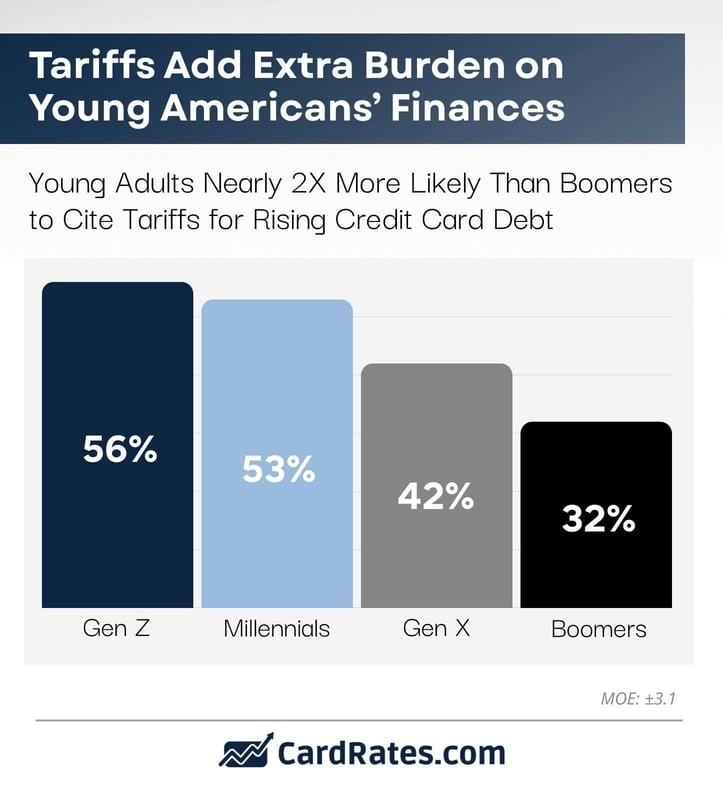
While only 32% of Boomers said tariffs increased their debt, nearly twice as many Gen Z (56%) and millennial (53%) respondents reported the same. Gen X (42%) respondents were also less likely than Gen Z and millennials to say tariffs affected their debt. These generational splits highlight how life stage can influence debt.
Younger Americans are currently facing a host of financial challenges, from housing crises and student loans to inflation. Adding tariff-driven debt only amplifies their financial woes, while older generations may feel the impact of these effects less, as they may have already reached a higher sense of financial stability and security.
“While age can be a factor in how economic policy impacts finances, it is clear that life stage is often the dominant factor when it comes to the tariff impact,” says Bobbi Rebell, CFP® and consumer finance expert at CardRates.com.
Rebell adds, “Life will always seem expensive, but the tariffs are amplifying those expenses for consumers who are often in the earlier life stages when they are trying to build a financial foundation that will set the tone of their future financial life.”
64% of Democrats Say Tariffs Increased Their Debt
Trade policies aren’t just a matter of economics — they’re also heavily intertwined with political affiliations. Americans’ perception of tariffs is sharply divided along party lines.
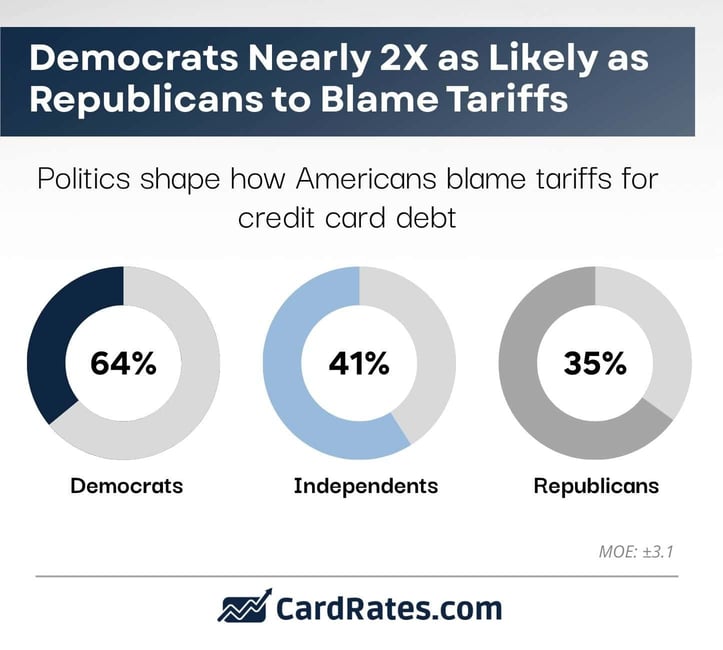
Our study found a clear partisan split: Democrats (64%) were nearly twice as likely as Republicans (35%) to report that tariffs drove up their credit card debt, while Independents (41%) fell in between, suggesting that the cost of tariffs may be a matter of perspective.
Political identity isn’t just shaping personal values and relationships — it’s framing financial mindsets.
While Democrats may be quick to disapprove and blame tariffs for increased prices, Republicans may view and support these trade policies as effective and necessary tools to boost the economy, making them less likely to write them off as financial deterrents.
62% of Hispanic Americans Say Tariffs Have Raised Their Debt
Tariffs don’t affect every household the same. In fact, our study found that minority families are much more likely to connect the impact of tariffs to their raised credit card balances.
And one minority group, in particular, says they’ve been hit the hardest: Hispanic Americans.
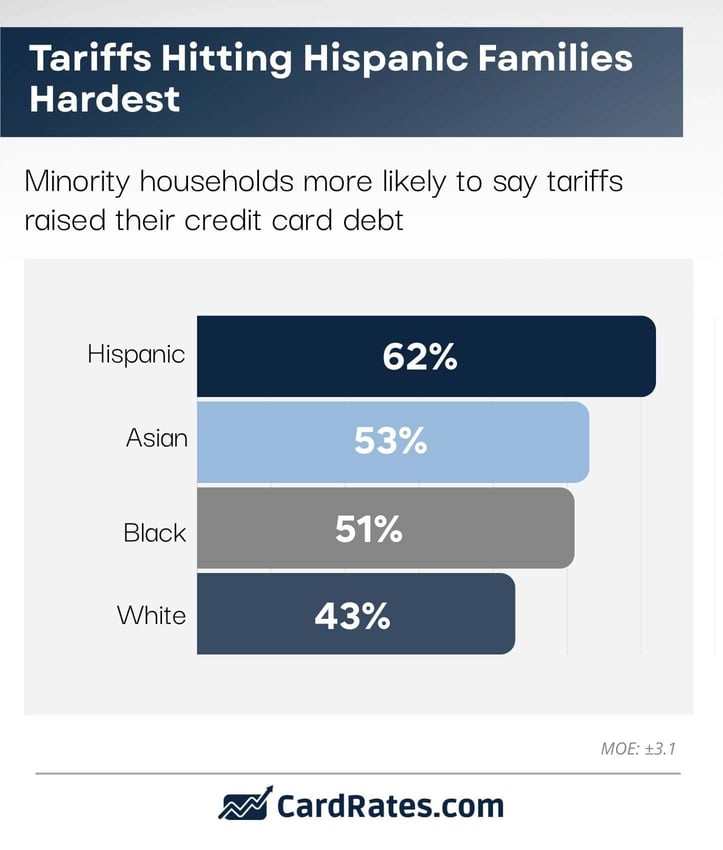
We found that Hispanic respondents were almost 20 percentage points more likely to blame tariffs for their increased debt than White Americans. Here is a complete breakdown of how the reporting numbers differed by race/ethnicity:
- Hispanic: 62%
- Asian: 53%
- Black: 51%
- White: 43%
Tariffs are disproportionately straining minority families, making their impact both a financial and an equity issue. Price increases and debt linked to trade policies will only exacerbate existing wealth gaps and disparities that have already caused financial distress for many minority communities.
Whether Americans blame tariffs for their debt or not, it’s clear that all eyes are fixed on the long-term impact of tariffs on the U.S. economy.
The takeaway: Tariffs have real-life consequences that many American households are already feeling. The impact is not just something they are hearing about. It is hitting much closer to home, including higher prices, slower economic growth, and added financial stress.
Methodology
This survey was conducted in July 2025 among 1,000 U.S. adults via an online panel. The sample is unweighted but includes a broad cross-section of respondents by age, gender, household income, and race/ethnicity.
All responses were single-selection, and each question received 1,000 completes. The margin of error is approximately ±3.1% at a 95% confidence level. Crosstabs by demographic group are available upon request.
For media inquiries, please reach out to catherine@cardrates.com.
Editorial Note: Our site content is not provided or commissioned by any credit card issuer(s). Opinions expressed on CardRates.com are the author's alone, not those of any credit card issuer, and have not been reviewed, approved, or otherwise endorsed by credit card issuers. Every reasonable effort has been made to maintain accurate information; however, all credit card offer details, including information about rewards, signup bonuses, introductory offers, and other terms and conditions, is presented without warranty. Clicking on any offer on CardRates.com will direct you to the issuer's website, where you can review the current terms and conditions of the offer.
About the Author