

Writer: Andrew Allen


Editor: Lillian Guevara-Castro


Reviewer: Adam West

Our experts and industry insiders blog the latest news, studies and current events from inside the credit card industry. Our articles follow strict editorial guidelines.
Key Takeaways
- Affirm’s debit card, which helped the company realize robust revenue increases in its first fiscal quarter ending Sept. 30, is expanding its BNPL program.
- Credit card issuers looking to fend off competition from BNPL providers can educate consumers about the value credit cards can bring to their lives.
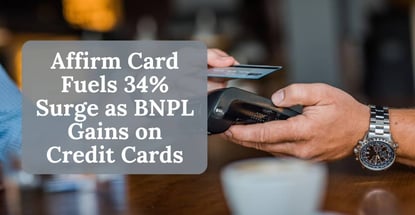
Buy now, pay later company Affirm rode the performance of its debit card to a strong first fiscal quarter ending Sept. 30 this year during which the company’s revenue increased by 34% in comparison to the same period in 2024.
The success of the Affirm Card, which allows cardholders to pay for purchases over time while sidestepping interest charges, positions the payment tool to take a greater market share from credit card issuers in the near future.
People can pay with the card wherever Visa cards are accepted, which allows more cardholders to use the company’s BNPL program.
Many in the credit card industry have likely already been tracking the inroads BNPL providers have made with consumers in 2025. A report from Newsweek indicates that more than half of consumers in the U.S. turn to BNPL options to complete purchases, with millennial and Gen Z consumers using them more often than other groups.
Avoiding interest is one of the primary reasons shoppers use BNPL programs. A Morgan Stanley report indicates that 86% of customers point to 0% APR offerings as the main factor that led them to use BNPL solutions, according to The Wall Street Journal (WSJ).
Millennial and Gen Z consumers lead the way when it comes to BNPL use.
With economic conditions driving consumer sentiment lower, more people may make use of BNPL tools over the holiday shopping season this year than they had in the past. But the BNPL industry may also be in a position to continue to grow over the long term.
“Over time, we anticipate BNPL will capture a larger share of discretionary spend, and Affirm will be the principal beneficiary,” Andrew Jeffrey, Research Analyst at William Blair, said in a recent American Banker report. “We reiterate our thesis that younger consumers are tired of inflexible and predatory bank products.”
Reminding Consumers of Credit Card Benefits
The number of people who own an Affirm Card grew by 500,000 in the company’s first fiscal quarter to reach a total of 2.8 million cardholders. Credit card issuers who fear the company’s base of card users will continue to expand may take heart in recent remarks from the company’s Chief Operating Officer, Michael Linford.
“We really can’t afford to go out and do like credit cards do,” Linford said, as reported by WSJ. “Credit cards can pay sometimes $500 to acquire a customer. That would never work for our business model.”
Having a deeper budget to spend on customer acquisition isn’t the only advantage a credit card issuer can have over a BNPL provider.
Affirm now serves 2.8 million cardholders with its debit card.
Issuers that fear further encroachment of BNPL products into traditional credit card territories have several options at their disposal to not only retain current customers but win over younger consumers.
For example, issuers can produce marketing messages that highlight the benefits that credit cards bring beyond payment flexibility. Credit card rewards allow shoppers to earn cash back or points on every purchase, which is a benefit many BNPL providers can’t match.
Credit cards also offer consumers a path to boost their credit scores over time. Issuers may see card activity rise after they educate their customers about how responsible card use can help them access more favorable terms on larger loans later in life.
Buy now, pay later outfits such as Affirm may enjoy a strong finish to 2025, but issuers are likely to ramp up their strategies to help credit cards gain more market share in the payments arena as the new year unfolds.
Editorial Note: Our site content is not provided or commissioned by any credit card issuer(s). Opinions expressed on CardRates.com are the author's alone, not those of any credit card issuer, and have not been reviewed, approved, or otherwise endorsed by credit card issuers. Every reasonable effort has been made to maintain accurate information; however, all credit card offer details, including information about rewards, signup bonuses, introductory offers, and other terms and conditions, is presented without warranty. Clicking on any offer on CardRates.com will direct you to the issuer's website, where you can review the current terms and conditions of the offer.
About the Author

![Credit Cards vs. BNPL Services: What to Know[updated_month_year before=" in "]](https://www.cardrates.com/images/uploads/2024/02/Credit-Cards-vs.-BNPL-Services.jpg?width=164&height=85 "Credit Cards vs. BNPL Services: What to Know[updated_month_year before=\" in \"]")

![Surge Credit Card: Review & 5 Alternatives[updated_month_year before=" (" after=")"]](https://www.cardrates.com/images/uploads/2016/11/surgecard.jpg?width=164&height=85 "Surge Credit Card: Review & 5 Alternatives[updated_month_year before=\" (\" after=\")\"]")

![3 FAQs: ATM Card vs. Debit Card vs. Credit Card[updated_month_year before=" (" after=")"]](https://www.cardrates.com/images/uploads/2016/05/atm-card-vs-debit-card-vs-credit-card--1.png?width=164&height=85 "3 FAQs: ATM Card vs. Debit Card vs. Credit Card[updated_month_year before=\" (\" after=\")\"]")
![Can I Use My Debit Card as a Credit Card? 3 Things to Know[updated_month_year before=" (" after=")"]](https://www.cardrates.com/images/uploads/2016/11/can-i-use-my-debit-card-as-a-credit-card--1.jpg?width=164&height=85 "Can I Use My Debit Card as a Credit Card? 3 Things to Know[updated_month_year before=\" (\" after=\")\"]")
![7 Best Prepaid Debit Cards for Bad Credit[updated_month_year before=" (" after=")"]](https://www.cardrates.com/images/uploads/2019/08/shutterstock_609135914-edit1.jpg?width=164&height=85 "7 Best Prepaid Debit Cards for Bad Credit[updated_month_year before=\" (\" after=\")\"]")