

Writer: Zina Kumok


Editor: Jon McDonald


Reviewer: Ashley Fricker

We deploy a step-by-step methodology to each piece of research we publish to ensure our studies offer complete coverage and meet our rigorous editorial standards.
Being delinquent on a credit card means that you’re at least 30 days late — or more — paying your bill. It might sound strange, but there’s a huge difference between being 29 days late and 31 days late. Once you’ve hit the 30-day mark, the late payment will show up on your credit report.
On-time payments make up 30% of your credit score, and even one late payment can dramatically drag it down.
Submitting a credit card payment a day or two late can happen if you simply forget to pay your bill, but being delinquent is often a symptom of something far worse: you’re spending more than you’re making.
Want to hear some scary facts? Keep reading for more statistics about credit card delinquencies.
1. Delinquency Rates Hit 2.94% in Q4 2025
Credit card delinquency rates often coincide with other major economic events. For example, late payments spiked during the Great Recession when millions of people lost their jobs.1 Delinquency rates tend to stabilize when unemployment is low and the economy is doing well.
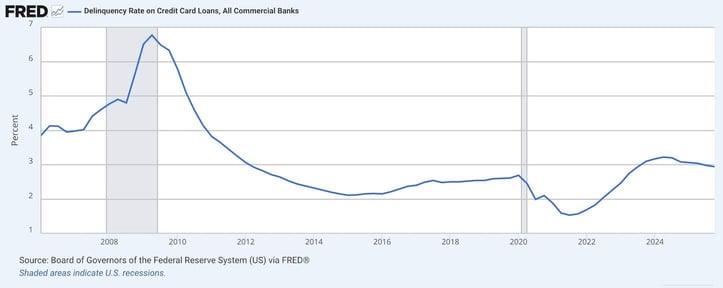
For example, the delinquency rate was 2.12% in 2015, compared to 6.77% during the Great Recession in 2009.2 However, even though unemployment rates are fairly low right now, delinquency rates are still hovering around 3%, and were at 2.94% in the fourth quarter of 2025.
2. Credit Utilization Has a Significant Impact on Delinquencies
One of the biggest comorbidity factors with late credit card payments is credit card utilization, which refers to how much of your credit card limit you are using. In general, the higher the credit card utilization, the more likely someone is to make a late payment.
High credit card utilization often means that a person is relying too much on credit and doesn’t have the funds to pay down their balance.
3. Low-Score Borrowers Pay 3.7 Late Fees Annually
It seems obvious, but people with higher credit scores are more likely to make late payments, and those with lower credit scores make up a larger share of delinquent customers.
People with credit scores of 580 or lower pay about 3.7 late fees each year.3 This is roughly 20 times more than those with the highest credit scores.
4. Private Label Cards Have a Higher Delinquency Rate of 1.3%
Many different factors influence the overall credit card delinquency rate, including the type of credit card that a person holds. Private label credit cards, which typically mean store-branded credit cards, seem to have higher delinquency rates than general credit cards.
| Credit Card Category | Delinquency Rate |
|---|---|
| Private Label (Store-Branded) | 1.3% |
| General Purpose (Major Bank) | 0.8% |
As of 2022, the delinquency rate for private-label cards was 1.3, compared to 0.8 for general-purpose credit cards.3 Store credit cards often have lower application standards, so it makes sense that they might also attract people more likely to make frequent late payments.
5. Delinquency Rates Hit a Record High Since 2012
In 2024, research from the Federal Reserve Bank of Philadelphia showed that delinquent credit card accounts had hit their highest rate since reporting began in 2012.4
Another important data point found that more Americans were only making the minimum payment on their loans. These trends were also seen for other types of loans. For example, both student loans and auto loans have seen higher-than-normal delinquency rates.
6. Seasonal Trends Peak in January and February
Delinquency rates tend to vary during the year, depending on external factors. For example, consumers are more likely to be late on their credit card payments in January and February because many people are still paying off Christmas presents, holiday travel, and more.4
| Time of Year | Delinquency Trend | Primary Economic Driver |
|---|---|---|
| January to February | Peak High | Post-Holiday Spending / Travel |
| March to April | Seasonal Dip | Tax Refund Liquidity |
| Summer | Stable | Normal Spending Cycles |
Then, when people start getting their tax refunds in the spring, rates tend to dip as people can afford to pay off their debts.
7. 90-Day Late Payments Recently Reached a 12-Year High
If you’ve been paying attention to the news, you probably know that affordability is becoming a major issue for the average consumer.
That may be why the rate of payments that were 90 days late or more hit a high in the third quarter of 2024, reaching the highest rate since 2012.4 This could be a huge indicator that many Americans are struggling with rising prices.
8. State Rates Vary from 14% in Florida to 37% in Mississippi
Where you live has a huge impact on your overall finances, and that’s also true for credit card delinquency rates. As of the second quarter in 2025, the lowest credit card delinquency rate in the U.S. was 14% (the state of Florida can claim that title).
However, rates are much higher in the rest of the South. Mississippi has a 37% rate, Louisiana has a 32% rate, Alabama has a 31% rate, and Arkansas has a 28% rate.5 The Carolinas are also struggling, with North Carolina having a 24% rate and South Carolina having a 25% rate.
| State | Delinquency Rate (%) |
|---|---|
| Mississippi | 37% |
| Louisiana | 32% |
| Alabama | 31% |
| Arkansas | 28% |
The South is known for having a lower cost of living, but that also comes with lower incomes and fewer social safety nets.
9. Expensive States Like California Maintain a Low 15% Rate
You might think that states with a high cost of living would have a high delinquency rate. However, many states with low delinquency rates have a high cost of living. Hawaii, Massachusetts, Washington, and California, which are some of the most expensive states to live in, also have some of the lowest delinquency rates at 15%.5
New York also has a low delinquency rate of 16%. This may be because those states also have higher overall average salaries, as well as stronger social welfare programs.
10. Midwest Delinquency Rates Reach up to 25%
The South isn’t the only part of the country that has higher-than-normal delinquency rates. Some parts of the Midwest also have the same issue.5
Indiana, West Virginia, and Kentucky have a 24% rate of late payments, while Oklahoma has a 25% rate. Missouri has a 22% rate, while Nebraska, Kansas, and Ohio have a 20% rate.
11. Multi-Debt Holders Have a 3.7% Transition Rate into Delinquency
Having a balance on a credit card — or multiple credit cards — isn’t the only reason for being late on your payments. If you only have a credit card balance and no other loans, you are less likely to be delinquent than those who also have auto and student loans.6
| Debt Profile | Transition Rate Into Credit Card Delinquency |
|---|---|
| Mortgage Holders | 1.2% |
| Student Loan + Auto Debt | 3.7% |
| National Average | 1.7% |
However, having a mortgage does not predispose you to being more delinquent on credit cards. It’s hard to say why that is, but one possibility is that homeowners may have access to their home equity to meet unexpected needs, instead of relying on credit cards.
12. 90-Day Delinquency for Consumers Under 40 Returned to Pre-Pandemic Levels
During the COVID-19 pandemic, some younger consumers found their finances improving, especially their savings and on-time payments.
However, since the end of lockdown, delinquency rates have been increasing. And for some groups, like those consumers 40 or younger, the 90-day-deliquency rate has already increased to where it was before the pandemic.6
13. Lower-Income Consumers Face Higher Delinquency Rates than Pre-COVID
Over time, individuals with higher incomes have found it easier to pay down their credit card balances and have seen lower increases in their overall credit card balances.
On the other hand, individuals with lower incomes now have higher delinquency rates than they did before the COVID-19 pandemic.7
14. Lowest-Income Zip Codes Have Substantially Higher Delinquency Rates
It may be no surprise to learn that those who live in less-affluent areas can also have a harder time paying their credit card bills on time.
The lowest-income 10% of zip codes had a substantially higher rate of credit card payments that were 30 days late or more.8 This was higher than the U.S. average and much higher than the rates in the highest-income 10% of zip codes.
15. Modern Delinquency is Rising Toward the 6.77% Recession Peak
If we use credit card delinquency rates as a barometer for the country’s overall financial health, then there may be a reason to worry. Research from the Federal Reserve Bank of St. Louis found that delinquency rates are similar to what they were in 2008.8
| Era | Delinquency Context | Rate Benchmark |
|---|---|---|
| 2008 – 2009 | Great Recession Peak | ~6.77% |
| 2015 – 2019 | Pre-Pandemic Baseline | ~2.12% |
| 2025 Q1 | Modern Economic Strain | ~3.06% (Rising) |
While credit card delinquency was not a big factor in the Great Recession, it was certainly widespread during its aftermath. That’s why it is worrying when so many people are having trouble paying their credit card bills right now.
16. The 90-Day Late Rate Hit 11% in 2025
There are two main benchmarks researchers track when it comes to late credit card payments: 30 days late and 90 days late.
Once you’re 30 days late or more, the late payment will appear on your credit report. However, being 90 days late indicates a more serious problem, that you could not cover your bills for three months in a row.
As of 2025, the rate of 90-day late payments was about 11%, while the rate of 30-day late payments was roughly 12%.9
17. Consumers Over 40 Experience a Slower Rate of Late Payments
According to data from the New York Federal Reserve, those older than 40 have also seen higher rates of 90-day delinquent payments, but at a slower cadence than younger cardholders.6
Older consumers may be more likely to have higher salaries and other credit sources that are easier to pay back.
18. Poor Zip Codes Have Seen a 59% Increase in Delinquency Since 2022
People living in the poorest 10% of zip codes were more likely to have a higher rate of late credit card payments. They also saw a larger increase in late payments compared to richer consumers.
| Year/Quarter | 90-Day Delinquency Rate (%) |
|---|---|
| 2022 Q3 | 12.6% |
| 2023 Q3 | 15.1% |
| 2024 Q3 | 17.6% |
| 2025 Q1 | 20.1% |
The rate of increase is alarmingly high for those in low-income zones, rising 59% from 2022 to 2025. In the first quarter of 2025, the 90-day delinquency rate was 20.1%, up from 12.6% in the third quarter of 2022.8
19. Bottom 10% Earners Experienced a 63% Rise in Delinquencies
Credit cards aren’t the only accounts that are seeing higher rates of late payments. According to the New York Times, consumers are also having trouble paying other types of loans on time.10
| Income Bracket | Growth in Delinquency Rate (%) |
|---|---|
| Bottom 10% Earners | 63% |
| Top 10% Earners | 44% |
However, credit cards do typically have higher interest rates than other types of loans, such as mortgages and car loans.
20. The Poorest 10% Surpassed 20% Delinquency, Matching 2008 Levels
During the Great Recession, the rate of 90-day credit card delinquency was slightly higher than 20% for the poorest 10%.10
In 2025, the rate just passed 20%. What is interesting, though, is that the richest 10% are not close to where they were during the Great Recession in terms of 90-day late payments.
21. Subprime Delinquency Rates Decreased in January 2025
According to data from the Federal Reserve Bank of Kansas City, in January 2025, the delinquency rate for subprime borrowers decreased.11
There’s more good news for subprime borrowers: the average APR for subprime credit cards also fell.
22. 7.13% of Credit Cards Became Delinquent in Q4 2025
According to the Federal Reserve Bank of New York12, about 7.13% of credit cards became delinquent in the fourth quarter of 2025. This was slightly better than the previous year, at 7.18%. However, this was the second-highest rate of flow after student loan debt.
23. 12% of Gen Z Consumers Paid a Late Fee in 2025
It’s probably not surprising that age could play a significant role in credit card delinquency rates. Younger people are much more likely to make late payments than other age groups.3
| Generation | Paid a Payment Late Fee |
|---|---|
| Gen Z | 12% |
| Millennials | 9% |
| Gen X | 8% |
| Baby boomers | 4% |
| Silent and older | 5% |
| Total | 8% |
As of 2025, according to the Consumer Financial Protection Bureau, about 12% of Gen Z consumers paid a late payment fee. Millennials were the second-most likely to make a late payment, at 9%. The overall late payment rate among all age groups was 8%.
There’s No Single Reason For Higher Credit Card Delinquency
There are many reasons for high delinquency rates, and it’s hard to place all the blame on a single factor. In general, lower income, limited access to other types of credit, and higher prices are major contributing factors to delinquency.
The concerning issue is that the poorest Americans are struggling the most right now, while the richest Americans can generally avoid those struggles. The wealthiest Americans may even be benefiting from positive stock market returns.
That may drive an even bigger gap between the haves and the have-nots. And since credit card interest rates are still high, this may make it even harder for consumers to pay down their balances.
Data Sources:
1 https://www.bls.gov/opub/mlr/2018/article/great-recession-great-recovery.htm
2 https://fred.stlouisfed.org/series/DRCCLACBS
3 https://www.fool.com/money/research/credit-card-late-fee-statistics/
4 https://www.cnbc.com/select/credit-card-delinquent-record-high/
5 https://www.visualcapitalist.com/mapped-u-s-credit-card-delinquency-rates-by-state-2025/
6 https://economics.td.com/us-rising-consumer-deliquencies
7 https://www.federalreserve.gov/econres/notes/feds-notes/a-note-on-recent-dynamics-of-consumer-delinquency-rates-20251124.html
8 https://www.stlouisfed.org/on-the-economy/2025/may/broad-continuing-rise-delinquent-us-credit-card-debt-revisited
9 https://www.consumerfinance.gov/about-us/blog/credit-card-delinquencies-are-higher-than-in-2019-because-lenders-took-on-more-risk/
10 https://www.nytimes.com/interactive/2025/05/15/business/economy/us-economy-recession-consumer-spending.html
11 https://www.kansascityfed.org/research/economic-bulletin/subprime-credit-card-delinquencies-have-fallen/
12 https://www.newyorkfed.org/newsevents/news/research/2026/20260210
Editorial Note: Our site content is not provided or commissioned by any credit card issuer(s). Opinions expressed on CardRates.com are the author's alone, not those of any credit card issuer, and have not been reviewed, approved, or otherwise endorsed by credit card issuers. Every reasonable effort has been made to maintain accurate information; however, all credit card offer details, including information about rewards, signup bonuses, introductory offers, and other terms and conditions, is presented without warranty. Clicking on any offer on CardRates.com will direct you to the issuer's website, where you can review the current terms and conditions of the offer.
About the Author