

Writer: Lynn Cadet


Editor: Ashley Fricker


Reviewer: Adam West

We deploy a step-by-step methodology to each piece of research we publish to ensure our studies offer complete coverage and meet our rigorous editorial standards.
Key Takeaways
- Southern households are hit hardest, with 31% still carrying 2024 holiday credit card debt, the highest rate in the country.
- Younger adults are struggling most: Both Gen Z and millennials report a 33% carryover rate, compared with just 11% of boomers.
- High incomes don’t guarantee a clean slate, as roughly 1 in 4 (25%) six-figure earners have yet to pay off their 2024 holiday debt.
As Black Friday approaches, Americans are gearing up for another annual round of holiday shopping. But here’s the kicker: Many are still carrying last year’s holiday bills with them into the season.
A recent CardRates.com poll reveals that 1 in 4 (26%) Americans have yet to pay off their credit card debt from last year’s holiday shopping season, highlighting how holiday spending can easily turn into revolving debt that persists well into the New Year or gift-giving season.
But the struggle to curb long-tail debt isn’t limited to the holidays. Credit card debt hit a record $1.233 trillion in the third quarter of 2025, according to the Federal Reserve Bank of New York. This shows holiday debt is just a piece of the debt crisis many Americans are facing.
Our data paints a sobering reality: As millions prepare to swipe their cards again this year, last year’s holiday purchases are still accruing interest.
31% of Southerners Still Carry Last Year’s Holiday Debt
Our study found key regional differences in how Americans approach holiday debt. The South stood out as the region most burdened by long-standing credit balances, with nearly a third of those surveyed admitting they’re still paying off last year’s holiday debt.
In contrast, residents from the Midwest hold the least holiday debt from last year, with a carryover rate of 21%. Take a look at the full regional breakdown below:
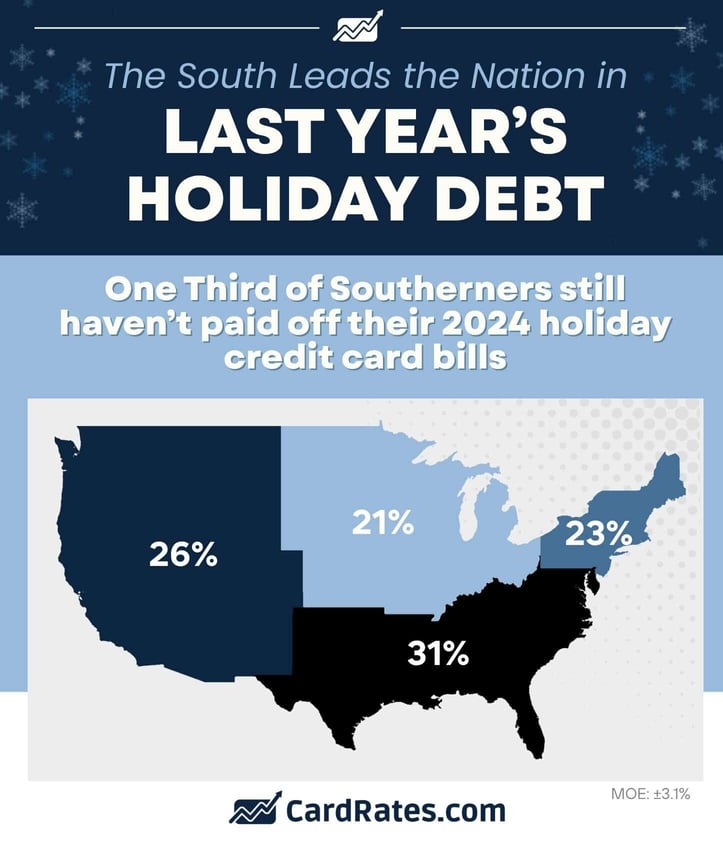
While everyone is feeling the mounting pressure of economic strain, differences in economic landscapes can help explain why some regions may feel more impacted by debt than others.
To put this into perspective, the South records some of the lowest income averages in the country. That, coupled with the general economic strain of rising prices, could make paying off debt more challenging for Southerners than other Americans.
On the other hand, the Midwest may have scored lower due to a much lower cost of living compared to its counterparts. Not only is it less expensive to reside in the Midwest in terms of housing, but the lower cost also extends to other expenses, such as groceries and utilities.
While Midwestern households still face affordability pressures, having a lower cost of living that’s consistent with their income can help make debt less sticky, even though they only average slightly more in wages than those in the South.
One Third of Younger Adults Haven’t Paid Off Last Year’s Holiday Spending
A year later, younger adults are still feeling the burn of 2024’s holiday spending on their wallets. In fact, Gen Z and millennials are entering the holiday season with some serious debt.
Tied at 33%, Gen Z and millennials were hit the hardest by last year’s holiday debt, carrying over balances at triple the rate of boomers (11%) and at a significantly higher rate than Gen X (21%).
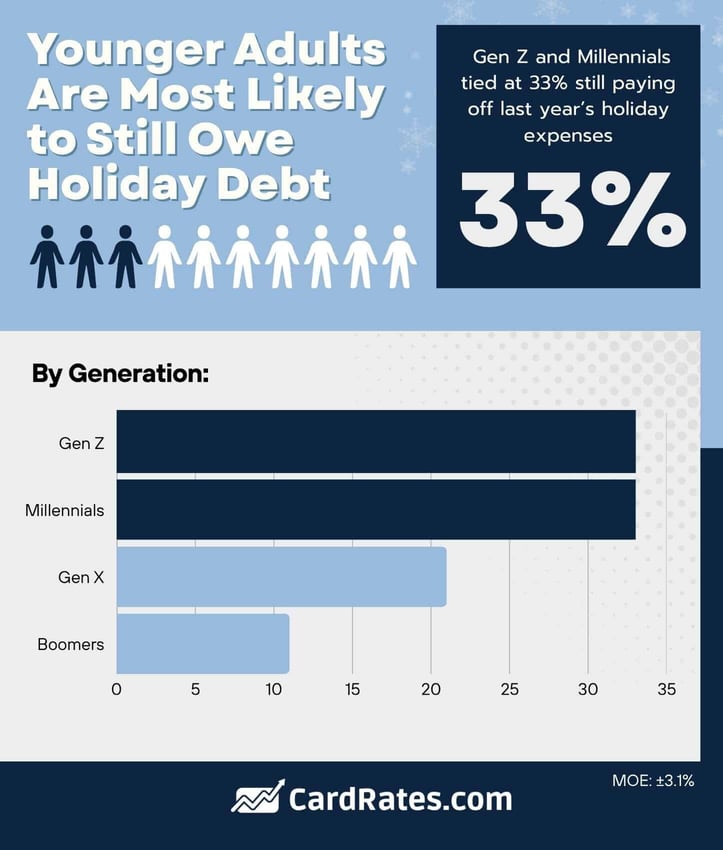
These results likely reflect the financial strain that younger adults are facing. Compared to older generations, younger adults are more likely to have less financial security and lower accumulated wealth while also balancing student loans and rising expenses. This could increase the difficulty of paying off lingering debts.
But what truly stands out in this generational divide is how much Gen X is also struggling to keep up with their payments.
Traditionally, in their peak earning years, Gen X would theoretically have the most income to work with, but our results suggest that other financial responsibilities may be getting in the way. It is possible that Gen X may be prioritizing other debts while putting off last year’s holiday bills as a result. Meanwhile, boomers remain largely insulated from the crisis.
Even High-Income Earners Are Carrying Holiday Debt Into the New Season
It seems holiday debt is a universal experience, regardless of how much you earn. Our data reveals that holiday debt carryover occurs across all household income thresholds, meaning that even high-income earners aren’t immune to the challenge of eliminating last year’s debt.
Holiday debt was persistent across the board for all earners:
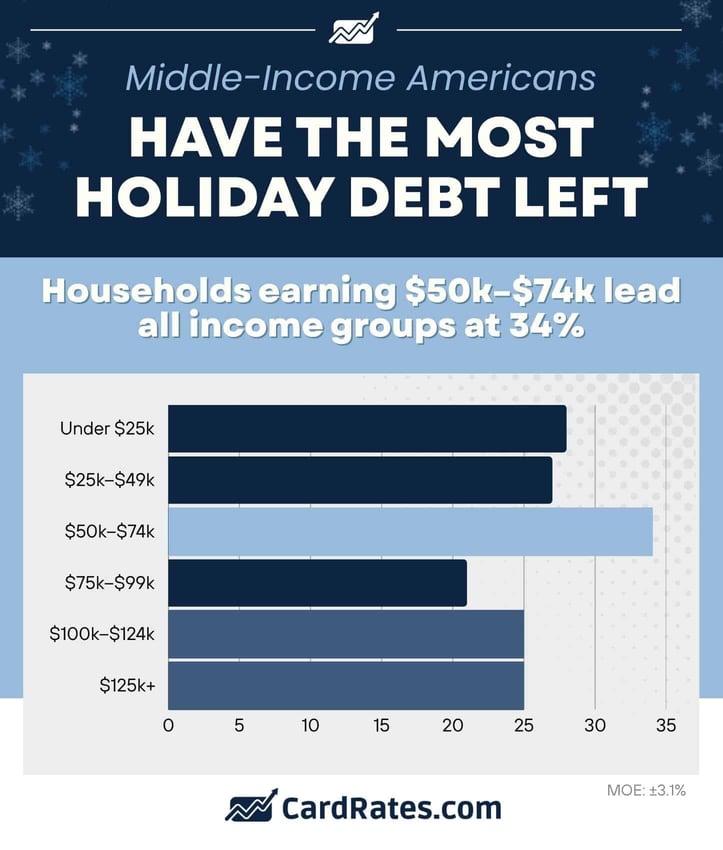
Most people love to splurge during the holidays, and it’s obvious that sentiment isn’t limited to any one income bracket. But these temporary splurges have quickly turned into long-term financial strain, even for the highest earners.
About 25% of six-figure earners say they still haven’t paid off last year’s holiday purchases, suggesting that lifestyle inflation, rising costs, or simply using credit to bridge holiday expenses may have contributed to this issue.
The American middle class, which has been shrinking for decades, also showed signs of strain. It recorded the highest level of debt difficulty at 34%, showing just how stretched middle-income earners have become.
“Holiday debt doesn’t disappear when the decorations go down; the memories begin to fade, but the debt still grows,” says Bobbi Rebell, consumer finance expert at CardRates.com. “This survey shows that long-term debt can become a year-round burden for millions of families. Revolving holiday debt becomes the gift that keeps giving, not in a good way.”
Americans are carrying more credit card debt than ever before. Unfortunately, holiday debt is only one piece that is further compounding the overarching problem. As consumers increasingly use credit cards to pay for their expenses and afford their purchases, it will be easy for holiday debt to be put off in favor of paying off more pressing debts.
So that leaves us with this question: What steps can Americans take to curtail holiday debt? Early budgeting, realistic spending limits, and debt planning can all help make this season a more jolly one.
Rebell adds, “The key is setting up systems ahead of time. Think about automating payments toward any balances you have heading into the holidays. Try to avoid using credit for anything that is not essential. Tell a friend your goals and ask them to hold you accountable. A little structure now can help break the cycle of carrying debt from this season to next.”
Methodology
This survey was conducted in 2025 among 1,000 U.S. adult credit card holders via an online panel. The overall margin of error is approximately ±3.1% at 95% confidence.
All questions were single-selection and each received 1,000 completes. Crosstabs by demographic group (gender, generation, geography, etc.) are available upon request.
For media inquiries, please reach out to catherine@cardrates.com.
Editorial Note: Our site content is not provided or commissioned by any credit card issuer(s). Opinions expressed on CardRates.com are the author's alone, not those of any credit card issuer, and have not been reviewed, approved, or otherwise endorsed by credit card issuers. Every reasonable effort has been made to maintain accurate information; however, all credit card offer details, including information about rewards, signup bonuses, introductory offers, and other terms and conditions, is presented without warranty. Clicking on any offer on CardRates.com will direct you to the issuer's website, where you can review the current terms and conditions of the offer.
About the Author




![7 FAQs: The Different Types of Credit Cards & Which to Carry[updated_month_year before=" (" after=")"]](https://www.cardrates.com/images/uploads/2017/11/types.png?width=164&height=85 "7 FAQs: The Different Types of Credit Cards & Which to Carry[updated_month_year before=\" (\" after=\")\"]")