


Writer: Andrew Allen


Editor: Lillian Guevara-Castro


Reviewer: Adam West

Our experts and industry insiders blog the latest news, studies and current events from inside the credit card industry. Our articles follow strict editorial guidelines.
Key Takeaways
- If the Illinois Interchange Fee Prohibition Act were to take effect on July 1, it would create a destabilizing and potentially unworkable standard for financial institutions, according to the Office of the Comptroller of the Currency.
- Cuts to interchange fees are likely to benefit merchants while creating financial difficulties for consumers.
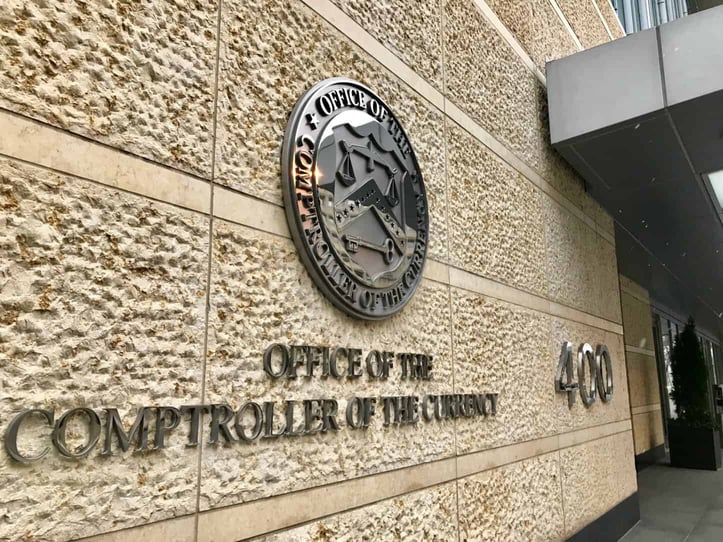
The future isn’t looking bright for the Illinois Interchange Fee Prohibition Act (IFPA). The Office of the Comptroller of the Currency (OCC) put out a press release explaining that the interim final rule the agency recently issued confirms the authority national banks have to impose certain fees under federal law.
The OCC said the IFPA would create a standard for national banks and payment card systems that is not only complex but also potentially unworkable. The act aims to block financial providers from charging interchange fees on the tax and tip portions of a bill a customer pays with either a credit or debit card.
The press release also suggested that other states may follow Illinois’s lead in pushing laws that create unworkable standards for financial institutions.
A bill in Colorado seeks to stop entities from charging interchange fees on the sales tax component of a transaction made from a credit or debit card. But Jenifer Waller, President and CEO of the Colorado Bankers Association, has used the recent announcement from the OCC regarding the Illinois act to support her organization’s position.
“[The] OCC makes it clear [that] states do not have authority over national banks regarding state attempts to regulate or limit interchange,” Waller wrote in a LinkedIn message she posted within the past week.
The OCC’s actions are the latest to affect IFPA, but more developments on the matter are expected in the ensuing months. The act was to take effect on July 1 of this year, but the Chicago Tribune reports that the Illinois Interchange Fee Prohibition Act may now face a delay in its implementation.
The OCC’s press release stated that parties wishing to submit comments on its interim final order and interim final rule have 30 days to do so following publication in the Federal Register.
While credit card companies and regulating bodies including the OCC oppose the IFPA, businesses that accept payments from cards are generally in favor of it. But merchants who would prefer their customers pay via a method other than a credit card may be overlooking the benefits cards bring to their businesses.
We recently caught up with Kelvin Chen, Senior Executive Vice President and Head of Policy at the Consumer Bankers Association. He told us that, while the amount merchants pay in interchange fees has grown over the years, the revenue they receive from cards has gone up as well.
“Cards are always innovating to provide their benefit to merchants,” Chen told us. “Everything from cashierless checkout to fraud protections to internet commerce, all of that is a service that enables merchants to do their thing. In exchange for that, there’s a charge for it.”
Examining the Impact on Consumers
As you may expect, groups representing merchant interests aren’t excited about the OCC’s stance on IFPA.
Rob Karr, President and CEO of the Illinois Retail Merchants Association, said in a statement to Payments Dive that — in preventing IFPA from moving forward — the federal government is prioritizing bank and credit union bottom lines over relief for consumers and businesses.
But cardholders may not see any relief from a pricing standpoint even if IFPA were to take effect on July 1. Adam Neiberg, Global Banking Senior Marketing Manager at SAS, told us that consumers may benefit if the act were to motivate merchants to eliminate surcharges from credit card transactions.
But he also said that merchants may just capture all the savings from lower interchange fees because they aren’t required to pass them on to consumers. Jim Widder, Travel Blogger at Travelwidstom, shared a similar opinion with us.
“Merchants will benefit most if interchange fees are reduced or eliminated,” Widder told us. “Rarely will they pass the savings on to consumers. This is especially true with [a large merchant that has] much greater volume than a small business does.”
Consumers have no guarantees that merchants would reduce prices — or even hold back from raising them — if interchange fees went down.
Widder added that some merchants have even raised their prices in the past when laws to reduce debit card interchange took effect.
In addition to missing out on savings at the point of sale, cardholders may face further obstacles if states succeed in reducing interchange fees. Cuts to those fees stand to financially harm cardholders if they lower the value of their favorite credit card programs.
“With a mandated reduction in interchange fees, banks would be forced to charge annual fees even on their entry-level or general-purpose credit cards,” Neiberg told us. “Reward programs would be scaled back, and travel perks and other rewards in those programs would now cost more to obtain.”
And Widder directed our attention to other areas where restrictions on interchange fees have affected credit card programs.
“All you need to do is look at places like Europe and Australia where interchange fees are capped,” Widder told us. “The credit card rewards in those places are much less than [they are in] the United States.”
Editorial Note: Our site content is not provided or commissioned by any credit card issuer(s). Opinions expressed on CardRates.com are the author's alone, not those of any credit card issuer, and have not been reviewed, approved, or otherwise endorsed by credit card issuers. Every reasonable effort has been made to maintain accurate information; however, all credit card offer details, including information about rewards, signup bonuses, introductory offers, and other terms and conditions, is presented without warranty. Clicking on any offer on CardRates.com will direct you to the issuer's website, where you can review the current terms and conditions of the offer.
About the Author





![7 Credit Card Fees & How to Avoid Them[updated_month_year before=" (" after=")"]](https://www.cardrates.com/images/uploads/2021/03/Credit-Card-Fees.jpg?width=164&height=85 "7 Credit Card Fees & How to Avoid Them[updated_month_year before=\" (\" after=\")\"]")


![6 Ways to Save on Credit Card Interest Fees[updated_month_year before=" (" after=")"]](https://www.cardrates.com/images/uploads/2021/11/Ways-to-Save-on-Credit-Card-Interest-Fees.jpg?width=164&height=85 "6 Ways to Save on Credit Card Interest Fees[updated_month_year before=\" (\" after=\")\"]")