
Writer: Andrew Allen


Editor: Adam West


Reviewer: Ashley Fricker

Our experts and industry insiders blog the latest news, studies and current events from inside the credit card industry. Our articles follow strict editorial guidelines.
Key Takeaways
- Housecall Pro is rolling out credit card surcharges to a limited group of home-service businesses.
- The surcharges apply only to eligible credit card payments, not debit cards or other payment methods.
- Surcharges can offset processing costs, but nearly one-third of merchants say they sometimes drive customers away.
People who call on a professional to service their air conditioners, furnaces, and other home systems or equipment may soon pay a bit more for that work when they pay by credit card.
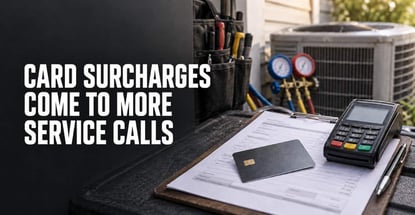
A new partnership between Yeeld and Housecall Pro allows participating home-service businesses to recover certain credit card processing costs by adding surcharges to eligible transactions. The feature is currently rolling out to a limited group of Housecall Pro users.
Yeeld assists merchants and platforms with designing and implementing payment systems. Housecall Pro provides software that home-service businesses use to schedule jobs, manage cash flow, and monitor revenue and employee performance.
The requirements for adding surcharges to payments made by credit card can differ depending on the state where a business operates and the payment system it uses.
The new surcharge feature could help those businesses keep more of what they collect from credit card payments. The companies also say the system is designed to help those businesses navigate the legal and card-network requirements surrounding surcharges.
Many small business owners have a seemingly never-ending to-do list on any given day. Keeping up with surcharging rules may be one task that gets pushed to the bottom of that list.
Not Every Card Payment Can Carry a Surcharge
Rules for surcharging can vary by card type, network, processor, and even the state where a home-service professional operates. Yeeld’s system is designed to determine when a surcharge is supported and apply it according to the legal and card-network requirements that apply to the transaction.
Surcharges apply only to eligible credit card payments. They do not apply to debit cards, prepaid cards, ACH, cash, checks, PayPal, Klarna, or other non-credit payment methods.
Housecall Pro says its system uses the information available for each transaction to automatically determine whether a surcharge can be added. The company still advises businesses to consult a legal, tax, or compliance professional about their individual obligations.
Emily Tsitrian, CEO of Yeeld, said in the release that the company aims to help Housecall Pro and the professionals who use its services capture eligible processing costs and remain compliant without making their operations more complicated.
Surcharges Can Save Money but Cost Customers
Credit card processing fees are relatively small on a per-transaction basis, often amounting to just a few percentage points of the overall purchase price. But those small amounts can add up quickly over the course of many transactions.
Tsitrian said home-service businesses process millions of dollars in card payments each day.
That’s where surcharging can help a business. It gives the business a way to protect its margins, even if doing so means adding more money to a customer’s total bill.
Surcharging may not recover every processing expense, however. Housecall Pro also charges businesses a fee equal to 0.50% of successfully surcharged credit card transactions.
“Our pros work hard for every dollar they earn, and processing costs can take a meaningful bite out of their margins,” Ethan Senturia, President, Platform, at Housecall Pro, said in the press release.
“We’re always looking for ways to help them run stronger, more profitable businesses, and our partnership with Yeeld gives them a simple way to manage those costs right within Housecall Pro,” Senturia added.
Adding a surcharge to a bill may not be popular with customers, but it’s not necessarily uncommon.
J.D. Power reported earlier this year that 35% of small businesses surveyed add a surcharge when a customer pays with a credit card. But the move does not come without risks.
Nearly one-third of merchants surveyed, 32%, said their retail customers occasionally or frequently cancel a purchase when they see a surcharge added to the transaction.
Customers may be able to sidestep the surcharge by reaching for a debit card or paying by ACH, cash, or check instead.
Business owners must decide for themselves whether recovering some of their processing costs is worth potentially alienating a portion of their customer base.
According to a blog post on Yeeld’s website, surcharging allows a business to cover processing costs without raising base prices for every customer. Another option for service providers concerned about card-processing expenses is to offer a discount to customers who pay in cash.
Editorial Note: Our site content is not provided or commissioned by any credit card issuer(s). Opinions expressed on CardRates.com are the author's alone, not those of any credit card issuer, and have not been reviewed, approved, or otherwise endorsed by credit card issuers. Every reasonable effort has been made to maintain accurate information; however, all credit card offer details, including information about rewards, signup bonuses, introductory offers, and other terms and conditions, is presented without warranty. Clicking on any offer on CardRates.com will direct you to the issuer's website, where you can review the current terms and conditions of the offer.
About the Author

![7 Best Credit Cards for Auto Repairs[updated_month_year before=" (" after=")"]](https://www.cardrates.com/images/uploads/2019/12/Best-Credit-Cards-for-Auto-Repairs.jpg?width=164&height=85 "7 Best Credit Cards for Auto Repairs[updated_month_year before=\" (\" after=\")\"]")

![Can I Use Credit Cards Before Closing on a Home?[updated_month_year before=" (" after=")"]](https://www.cardrates.com/images/uploads/2022/06/Can-I-Use-My-Credit-Card-Before-Closing-on-a-Home.jpg?width=164&height=85 "Can I Use Credit Cards Before Closing on a Home?[updated_month_year before=\" (\" after=\")\"]")
![8 Best Home Improvement & Repair Loans[updated_month_year before=" (" after=")"]](https://www.cardrates.com/images/uploads/2021/09/Best-Home-Improvement-Repair-Loans.jpg?width=164&height=85 "8 Best Home Improvement & Repair Loans[updated_month_year before=\" (\" after=\")\"]")
![3 FAQs: ATM Card vs. Debit Card vs. Credit Card[updated_month_year before=" (" after=")"]](https://www.cardrates.com/images/uploads/2016/05/atm-card-vs-debit-card-vs-credit-card--1.png?width=164&height=85 "3 FAQs: ATM Card vs. Debit Card vs. Credit Card[updated_month_year before=\" (\" after=\")\"]")
![Can You Pay a Credit Card with a Credit Card? 3 Ways Explained[updated_month_year before=" (" after=")"]](https://www.cardrates.com/images/uploads/2017/02/card-with-card-2.png?width=164&height=85 "Can You Pay a Credit Card with a Credit Card? 3 Ways Explained[updated_month_year before=\" (\" after=\")\"]")