
Writer: Gerri Detweiler


Editor: Jon McDonald


Reviewer: Ashley Fricker

Opinions expressed here are ours alone, and are not provided, endorsed, or approved by any issuer. Our articles follow strict editorial guidelines and are updated regularly.
If you find your credit card statement confusing, you’re not alone. Whether you check online, on your issuer’s app, or get snail mail statements, you’ll see several balances listed, and it’s logical to wonder which one you have to pay.
Here’s how one Redditor explained their confusion:
“Can someone explain “current” vs “statement” balance in simple terms? This is my first (credit card), and I tried to do some googling, but I’m still kind of confused. Which one is the most important one that I need to pay? The first few times that I’ve seen a balance, I’ve just paid the whole thing, but apparently I don’t need to. That’s why I’m kind of confused. How does interest work? So far, I have not had to pay any interest. I thought that’s how a CC works though?”
To add to the confusion, each issuer may use slightly different wording or formats to present your statement.
Here, I’ll explain what each term means, how to choose which payment to make based on your credit and financial goals, and share examples from a few major card issuers.
Let’s start with the main terms you are likely to see:
Current Balance or Total Balance
This is what you owe right now. It includes any unpaid balances carried over from the previous month plus new charges that you’ve incurred since your last statement, minus any refunds, credits, or payments that have been processed.
What it doesn’t include: Any transactions (purchases, refunds, fees, interest, or payments) that have not yet been posted to your account.
Pay this amount if: you want to zero out your balance. You may want to do this for budgeting purposes or to keep your balance low going into the next billing cycle.
If you are trying to earn a welcome bonus, the sooner you pay charges, the sooner you can get your rewards, provided you meet the minimum spending requirement.
Statement Balance
This is the balance that appears on your credit card statement as the total owed at the end of a billing period. It’s usually smaller than your current balance if you use your card regularly.
What it doesn’t include: Any transactions that occur after the closing date of the billing cycle. (It may be listed on your statement as the statement closing date.)
Pay at least this amount if: your card has a grace period and you want to avoid interest charges by paying in full each month.
It’s worth noting that this balance is likely the amount that gets reported to credit reporting agencies. If you are trying to improve your credit scores, you’ll want to pay close attention to this amount. We’ll discuss this in more detail below.
Minimum Payment
This is the amount you must pay to avoid incurring a late fee. It is also the least amount you can pay to keep your account current for credit reporting purposes.
What it doesn’t include: If this amount is smaller than your statement balance, it likely doesn’t cover all charges, interest, and/or fees.
Pay this amount if: you cannot afford to pay more, and don’t want to incur a late fee or risk a late payment on your credit reports.
In summation:
| Balance Type | What It Means | When to Pay |
|---|---|---|
| Statement Balance | Amount owed when the billing cycle ended | Pay to avoid interest |
| Current Balance | Total amount owed right now | Pay if you want a $0 balance |
| Minimum Payment | Smallest amount required to avoid late fees | Pay only if necessary |
Now, let’s walk through some specific credit cards to show you how this works.
Chase: Current Balance vs Statement Balance
Here’s an example of a Chase credit card account summary showing a current balance of $701.43, a statement balance of $118.09, and a minimum payment of $40.
If money is really tight, you can make the minimum payment of $40, but then you will incur interest charges on your average daily balance.
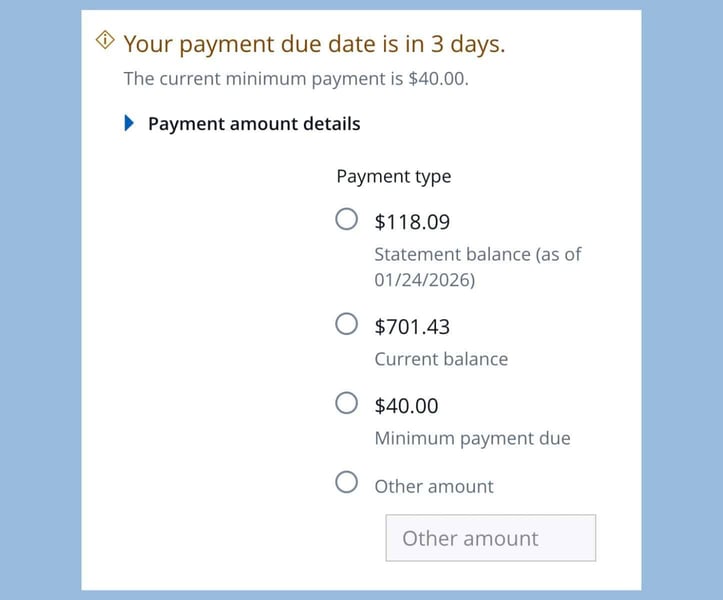
If you want to get as close as possible to a zero balance on your account, you can pay $701.43. If no new charges are posted, you’ll see a balance of $0 once that payment is credited to your account.
Your other choice is to pay the statement balance of $118.09. If you consistently pay the statement balance each month by the due date, you can avoid interest charges. (Caveat: the card must offer a grace period to avoid interest, but most do.)
The benefit of this last approach is that you’ll keep more money in your bank account, but the drawback is that the next time you log in, the remaining charges of approximately $580 ($701.43 – $118.09) will carry over to the next billing cycle. Add in new charges, and you could be facing a large balance next month.
American Express: Total Balance vs Statement Balance
Here’s an example of an online snapshot for an American Express credit card account:
Note that American Express uses the words “total balance” to describe the current balance.

In this example, there is no minimum payment due because that amount was already paid. But to avoid interest if you regularly pay in full, you’d need to pay at least $128.11 to cover the remaining statement balance.
Capital One: Current Balance vs Statement Balance
If you log into your Capital One account and click on the words Make Payment, you’ll see a summary of the amounts you can pay that looks like this:
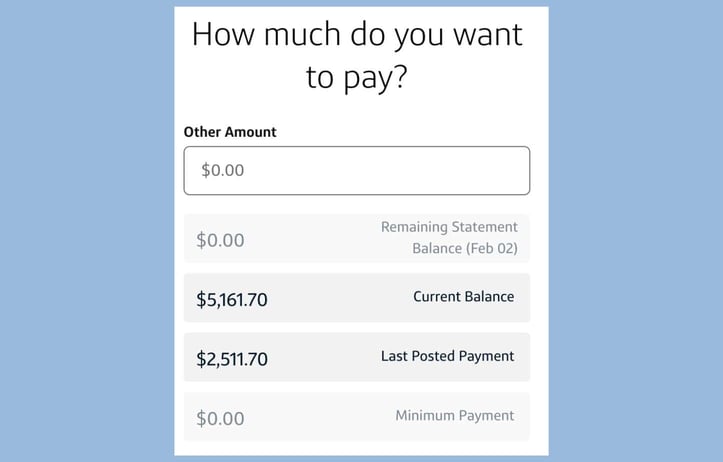
In this example, the previous statement balance has been paid, so there is no remaining statement balance or minimum payment due.
Making Payments to Improve Credit Scores
Earlier, I talked about how these different payment amounts may fit your financial goals. Let’s talk about how they can affect your credit scores.
Credit utilization is a factor that can heavily impact credit scores. It typically compares your current reported balance to your credit limit on each card, plus all total balances compared to all total limits.
For example, if your credit limit is $1,000 and the balance listed on your credit report is $250, your credit utilization is 25%. (To calculate it yourself, just divide your balance by your credit limit, then multiply by 100.)
The key here is that most issuers report the statement balance to the credit bureaus. They don’t wait to see how much you pay this month, but instead tell the credit bureaus how much you owe at the end of your billing period.
In other words, you can pay off your current balance before the due date, but your credit report may list a balance based on your statement balance that was reported to the bureau before your payment arrived.
What does this mean for your credit scores?
If credit utilization is hurting your credit scores, you may want to make your payment a few days before the end of the billing cycle so it is posted to your account before the statement closing date to lower the amount that gets reported to the credit bureaus.
Additionally, if you are building or rebuilding your credit, paying on time is absolutely critical.
As long as you make the minimum payment on time, you will avoid a late payment on your credit reports (or any late fees).
If you only pay the minimum payment, and it is smaller than your statement balance, you’ll be charged interest on your average daily balance, but at least you’ll avoid the possibility of a negative item on your credit report that can remain for seven years.
Editorial Note: Our site content is not provided or commissioned by any credit card issuer(s). Opinions expressed on CardRates.com are the author's alone, not those of any credit card issuer, and have not been reviewed, approved, or otherwise endorsed by credit card issuers. Every reasonable effort has been made to maintain accurate information; however, all credit card offer details, including information about rewards, signup bonuses, introductory offers, and other terms and conditions, is presented without warranty. Clicking on any offer on CardRates.com will direct you to the issuer's website, where you can review the current terms and conditions of the offer.
About the Author