
Writer: Lynn Cadet


Editor: Ashley Fricker


Reviewer: Adam West

We deploy a step-by-step methodology to each piece of research we publish to ensure our studies offer complete coverage and meet our rigorous editorial standards.
Key Takeaways
- More than 1 in 3 Americans (37%) say they would trust AI to book and pay for their entire trip using their credit card.
- Men are significantly more likely than women to trust AI with their credit card information (45% vs. 29%).
- Despite their digital-first reputation, Gen Z lags behind millennials in trusting AI to book their travel (37% vs. 45%), suggesting tech comfort may not equate to handing over their card.
Summer travel is getting more expensive. Rising fuel prices have sent U.S. flight costs soaring, with domestic fares up 10 to 15% and European travel up 20%, according to the Dollar Flight Club. Even road trips, long the budget-friendly fallback, have gotten pricier.
With more variables to juggle and more money at stake, travelers are under mounting pressure to plan smarter. That pressure may be pushing some Americans toward an unlikely solution: letting AI do the planning for them, card and all.
A new CardRates.com study finds that over 1 in 3 Americans (37%) would let AI use their credit card to book and pay for their entire trip, handing over control of their itinerary and spending.
But convenience has a catch. AI doesn’t always get the details right, and a misbooked flight or surprise charge hits harder when summer travel budgets are already stretched thin.
So how much financial control are consumers actually willing to surrender, and who’s most ready to let go? We asked, and here is what we found out.
For Some Travelers, Convenience Outweighs Credit Card Caution
As Americans reach deeper into their wallets for summer travel this year, some are letting convenience outweigh their financial caution.
While most Americans remain skeptical, over a third of Americans polled said they are willing to delegate the most sensitive part of travel — their spending — to AI. This reveals a clear shift: People aren’t just using AI for advice or information; they’re using it for real financial execution.
“Handing over your credit to AI after it has planned your vacation in full may not feel that different from giving it to a trusted travel agent. After all, in many cases, there has been what feels like a real conversation and an almost human-like partnership in planning the vacation,” says Bobbi Rebell, consumer finance expert at CardRates.com.
Rebell adds, “The reality is that many Americans are already giving out their financial information for online transactions. They do know the risks, but they also know the protections that credit card companies have in place should something go wrong.”
Despite concerns of security, privacy, and accuracy, AI is gaining trust among a significant number of Americans. But under the appeal of convenience and automation are real financial risks.
Firsthand travel experiences show AI travel planning can go awry quickly. While AI can streamline decisions and build efficient itineraries, it can make major mistakes and miss important details, underscoring whether it can really be trusted to complete sensitive tasks, like booking and paying for a trip, without oversight.
Men and Millennials Are the Earliest Adopters of AI Spending
We found clear demographic variances in who is more open to using AI for travel planning and spending. Interestingly, willingness to allow AI to make financial transactions skews male and millennial.
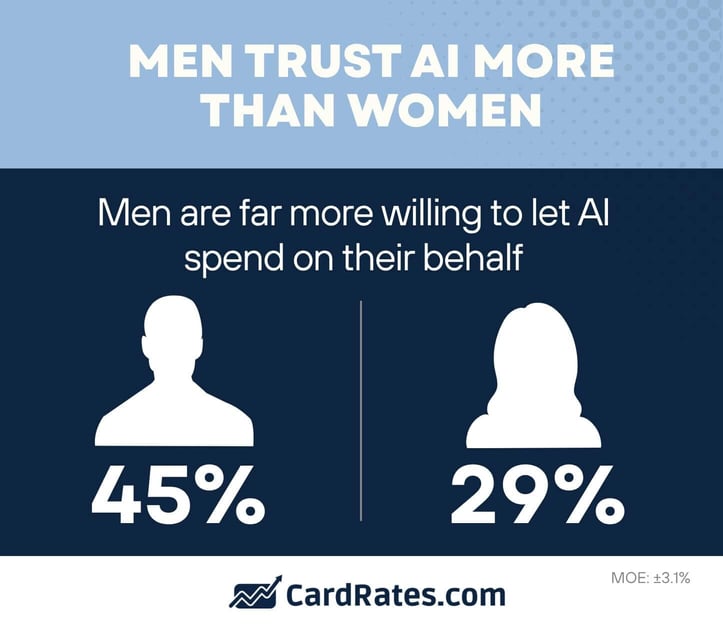
Men (45%) were far more likely to trust AI to book and pay for their trips than women (29%), highlighting a significant gender gap across AI trust, financial decision-making, and risk tolerance.
Millennials also showed a higher level of trust in AI than other generations:
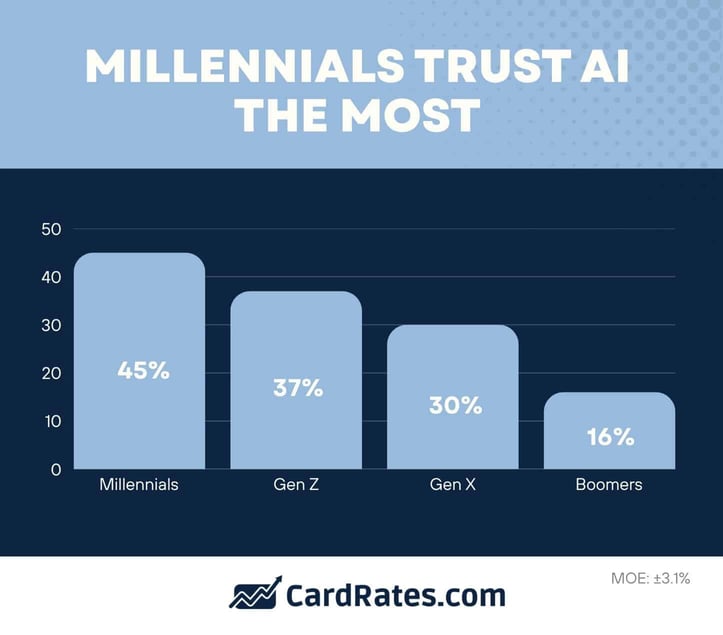
Notably, millennials beat out Gen Z, often considered the digitally native generation, in their support. This suggests that an inclination toward technology doesn’t necessarily translate into trust, especially where AI-based actions are concerned.
Per Rebell, “It is interesting that younger Americans are less likely to hand over the financial reins to AI. They may have less room for error because they aren’t as financially established as their older peers. They also may be savvy enough to wonder if the AI has the same security protocols in place as financial institutions and retailers that we tend to trust with our data.”
Unsurprisingly, trust also dramatically declines with age. While there is a considerable drop in trust among boomers, 1 in 6 are still open to the idea of AI managing their vacation spending, showing growing digital trust among older Americans.
As AI Moves From Planning to Purchasing, Oversight Matters
Having AI as a travel agent may have seemed like a pipedream a few years ago. But today, it’s a real consideration for millions of travelers.
AI can offer genuine convenience by helping consumers find affordable deals and plan trips with more efficiency and ease. The risks aren't with AI as a resource, but with removing humans from decisions that carry real financial consequences.
As AI moves from suggesting trips to booking and paying for them, a few guardrails are worth keeping in place. Booking through a credit card, for instance, offers built-in fraud protection and dispute rights that can be a safety net if something goes wrong.
Travel insurance is another layer worth considering, especially when AI-generated itineraries involve non-refundable bookings. And simply reviewing what AI has booked before confirming, rather than granting fully autonomous access, can catch errors before they become expensive ones.
Keeping a human in the loop can make a major difference in AI travel planning, ensuring your credit health, privacy, and vacation plans stay secure and accurate.
Methodology
This survey was conducted among 1,000 U.S. adults via an online panel. The overall margin of error is approximately ±3.1% at 95% confidence. All questions were single-selection, and each received 1,000 completes. Crosstabs by demographic group (gender, household income, race, parental status, etc.) are available upon request.
For media inquiries, please reach out to catherine@cardrates.com.
Editorial Note: Our site content is not provided or commissioned by any credit card issuer(s). Opinions expressed on CardRates.com are the author's alone, not those of any credit card issuer, and have not been reviewed, approved, or otherwise endorsed by credit card issuers. Every reasonable effort has been made to maintain accurate information; however, all credit card offer details, including information about rewards, signup bonuses, introductory offers, and other terms and conditions, is presented without warranty. Clicking on any offer on CardRates.com will direct you to the issuer's website, where you can review the current terms and conditions of the offer.
About the Author