
Writer: Zina Kumok


Editor: Jon McDonald


Reviewer: Ashley Fricker

We deploy a step-by-step methodology to each piece of research we publish to ensure our studies offer complete coverage and meet our rigorous editorial standards.
If you have trouble paying your credit card bills, your credit card issuer may eventually write off the balance. This is known as a credit card charge-off, which typically occurs after you’ve missed payments for six months or more.
Basically, the issuer decides you’re unlikely to pay off your debt and writes it off on their books (and potentially sells the balance to a debt collector).
While charge-offs can significantly damage a consumer’s credit score, they can also highlight more serious problems with the economy. For example, low credit charge-off rates mean that consumers are not having trouble paying their bills.
On the other hand, rising charge-off rates indicate that more people are struggling, which can negatively impact the economy. Charge-off rates have swung back and forth in recent years, mainly due to lingering effects from the COVID-19 pandemic and more recent global economic issues.
Keep reading to understand the ins and outs of charge-off rates, when they occur, and what they may actually mean for consumers.
1. Credit Card Charge-Off Rates Have Dropped to 3.82% From 2024 Highs
Credit card charge-off rates hit an all-time low of 1.63% in late 2021, likely due to greater leniency from issuers and COVID-19 stimulus payments helping people stay afloat.
However, they have increased since 2020, peaking at 4.69% in mid-2024 before falling slightly to 3.82% in the first and second quarters of 2026.¹
Credit Card Charge-Off Rates Since 2024
Source: FRED, Federal Reserve Bank of St. Louis
But this may not necessarily mean that consumers are avoiding default. It could show that issuers are being a little more selective with who they extend credit to.
2. Consumers Added $21 Billion to Their Credit Card Debt in Q2 2026
While consumers actually reduced their overall credit debt by $25 billion in the first three months of 20262, that relief was short-lived. Instead of continuing to lower debt, borrowing picked up quickly in Q2.
According to the Federal Reserve, Americans added $21 billion in new credit card debt in Q2 2026, pushing total credit card balances to a near-record $1.263 trillion.3
3. 2026 Rates Continue a Stabilization Trend That Started in 2025
While charge-off rates are under 4% now, they have been volatile since 2020. First, they dropped dramatically to 1.63% in Q4 2021. As issuer leniency (and stimulus packages) ran out, there was a significant spike in charge-offs, and the rate reached 4.69% by Q3 2024.
| Quarter | Credit Card Charge-Off Rate |
|---|---|
| Q1 2025 | 4.44% |
| Q2 2025 | 4.19% |
| Q3 2025 | 4.18% |
| Q4 2025 | 4.09% |
| Q1 2026 | 3.82% |
| Q2 2026 | 3.82% |
But 2025 was a year for stabilization, as the charge-off rate came down, but more importantly stayed down, throughout the year.4 And that stabilization continued into the first half of 2026, with the rate holding flat at 3.82% for two straight quarters. So, hopefully that downward trend continues.
4. Capital One's Charge-Off Rate Is Higher Than the Overall Rate
In Capital One's July 2026 credit performance report, it reported a 4.12% charge-off rate.5 While that is less than a point higher than the overall credit card charge-off rate, Capital One has seen a lot higher.
According to data released in November 2024, Capital One's charge-off rate stood at 6.1%, which was nearly 1% higher than its 5.2% rate at the same time in 2023.6 So, it may seem high, but it has been trending down.
5. Despite Charge-Offs, Bank Income Still Rose 12% in Q2 2026
While banks and credit card companies have had to charge off a large amount of money in the last couple of years, they’ve still remained highly profitable. According to FDIC data, bank income rose 12.0% to $90.1 billion in the second quarter of 2026, up from $80.5 billion in Q1.7
Part of this could be due to the fact that banks increased their non-interest income by 6.1% in Q2 2026. This includes things like interchange fees (which merchants pay when you swipe your card), account fees, annual fees, and even late fees.
6. Credit Card Defaults Outpace Consumer Loans by 1.16%
Compared to other types of consumer loans, credit cards have higher charge-off rates.
| Consumer Loan Category | Q2 2026 Charge-Off Rate |
|---|---|
| Credit Cards | 3.82% |
| All Consumer Loans | 2.66% |
For example, the rate for credit card charge-offs was 3.82% in the second quarter of 2026, while it was 2.66% for other types of consumer loans.8
7. Higher APRs May Lead to High Charge-Off Rates
Credit card interest rates are always high compared to most other loans, but they’ve been at near-peak rates lately, with the average credit card APR at roughly 22.15%.9 This can have a large impact on credit card charge-off rates.10
That's why consumers who are worried should pay attention to see if the Federal Reserve Board will lower rates at some point in 2026.
8. Serious Credit Card Delinquency Has Nearly Doubled in Four Years
The share of credit card debt that's seriously delinquent (90+ days past due) has steadily climbed higher since 2022, nearly doubling from 7.6% to a record 13.1% in Q1 2026, before easing slightly to 12.9% in Q2 2026.11 That's the highest level in over a decade.
Serious Credit Card Delinquencies
The precentage of credit card payments reported as 90+ days late
Now, one thing to keep in mind is that a big chunk of this is old, already charged-off debt lingering on credit reports longer than it used to, rather than a fresh wave of new defaults. The pace at which new balances are falling behind has stayed relatively flat over the same stretch.
9. Credit Card Delinquencies Have Increased at a Higher Rate Than Other Types of Loans
While delinquency rates were largely unchanged for student loans, auto loans, mortgages, and home equity lines of credit (HELOCs), they did trend upward for some credit cards, and, to a lesser extent, auto loans.
Between 2023 and 2026, the percentage of people struggling to pay their credit cards jumped from about 5% to nearly 7%.
This was a much sharper increase than what happened with other debts over the exact same time. By mid-2026, nearly 7% of credit card payments were seriously late, compared to just 3% for car loans and about 1.5% for house payments.12
10. Smaller Banks Have Seen Charge-Off Rates as High as 8.8%
It’s not exactly clear why, but smaller banks outside of the top 100 institutions face a bigger challenge, reporting an elevated, though declining, charge-off rate of 7.8% in Q2 2026, down from a recent high of 8.81% in Q3 2025.13
But there's a massive discrepancy between large and small financial organizations, as smaller firms discharge significantly more bad debt relative to their overall credit lines.
11. Recent Yearly Charge-Off Rate Highs Haven't Been Predictable
Data from the Federal Reserve shows that charge-off amounts are not equal quarter-to-quarter.¹ And different years have different high quarterly totals.
| Year | Peak Charge-Off Quarter | Low Charge-Off Quarter |
|---|---|---|
| 2024 | Q3 (4.69%) | Q1 (4.40%) |
| 2025 | Q1 (4.44%) | Q4 (4.09%) |
For example, in 2024, the highest charge-off rate was hit in the third quarter. But, shifting into 2025, the first quarter had the highest charged-off amount. So far in 2026, there hasn't been a difference in highs or lows as both Q1 and Q2 had 3.82% charge-off rates.
12. The Two Late Payment Rates: 2.85% vs. 12.9%
The Federal Reserve tracks two completely different numbers that show how many people are falling behind on their credit card payments. One official report says the late payment rate recently dropped to 2.85%, which is a three-year low.14
But another report says the rate is at a 15-year high of roughly 12.9%, nearly double what it was in 2022.15 Both numbers are correct, but they measure different things. The lower number just looks at the debt banks keep on their books.
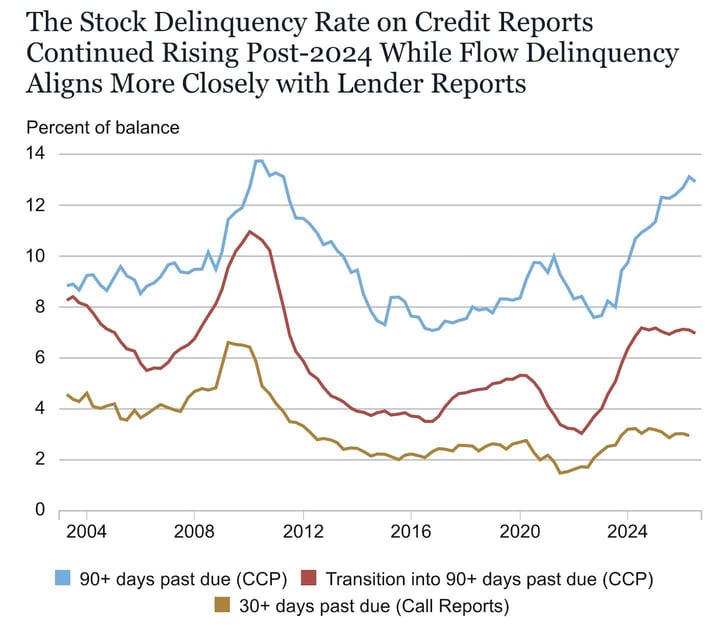
Banks are quick to remove bad debt from their active records, so their rate stays pretty low. The higher number tracks that same unpaid debt for a lot longer through credit reports.
Basically, one number shows how healthy the banks look, while the other shows the real amount of debt people are still struggling with.
13. Tightening Bank Standards Slowed New Credit Card Account Growth
When credit card issuers approve more credit cards, this can lead to an increase in credit card charge-offs.
However, in 2026, issuers have been tightening their credit card approval standards for consumers seeking credit cards. In Q2 2026, the Federal Reserve reported that 2% of domestic banks were tightening their standards.16
But that number rose sharply to 6.7% in Q3 2026, showing that banks are becoming much more selective. This may be another reason why charge-off and delinquency rates are improving (or steady).
14. Charge-Offs Stall Despite Stagnant Wage Growth
In 2025, many experts thought fewer people were defaulting on their credit cards because they were earning more money at work. But that explanation doesn't make as much sense today.
Between late 2025 and late 2026, the actual buying power of a typical worker's paycheck actually dropped by 0.1% after factoring in the cost of living, even though basic wages looked about 3.8% higher earlier in the year.17
Basically, people's money wasn't stretching any further than it did a year ago. Even so, the charge-off percentage kept dropping anyway and has settled at 3.82%. Since bigger paychecks aren't the reason for improvement, it's likely that the rate dropped because banks simply got stricter about who they let borrow money.
15. Total Credit Card Debt is at $1.37 Trillion (Inflation-Adjusted)
While the average credit card charge-off rate has fallen recently, total outstanding consumer credit card debt remains near historical highs at $1.37 trillion when adjusted for inflation.18
| Quarter | US Credit Card Debt (Estimated After Inflation-Adjustment) |
|---|---|
| Q3 2024 | $1.29 Trillion |
| Q4 2024 | $1.34 Trillion |
| Q1 2025 | $1.29 Trillion |
| Q2 2025 | $1.32 Trillion |
| Q3 2025 | $1.33 Trillion |
| Q4 2025 | $1.38 Trillion |
| Q1 2026 | $1.35 Trillion |
| Q2 2026 | $1.37 Trillion |
After peaking at an all-time high of $1.38 trillion in the final quarter of 2025, a post-holiday paydown of more than $30 billion pulled overall credit card balances down to $1.35 trillion in the opening quarter of 2026.19 But that didn't quite hold as it ticked back up to $1.37 trillion in Q2 2026.
16. Charge-Offs Actually Beat Some Predictions for 2026
Back in December 2025, TransUnion (one of the big 3 credit bureaus) predicted credit card delinquency (90+ days late) to barely move in 2026, ticking up to 2.57%.20
That's a different metric than the charge-off rate we've mentioned in this guide, but the two often move together. However, the charge-off rate actually kept falling, hitting 3.82% by mid-2026 rather than flattening out at the beginning of the year.
17. Synchrony Bank Recently Hit a 5.43% Charge-Off Rate
The CFO of Synchrony Bank said in an earnings release that its charge-off rates were 5.43% in Q2 2026, which was down from 5.70% in Q2 2025.21
This is much higher than the overall average of 3.82%, and shows again just how vulnerable smaller banks are to charge-offs.
18. Net Charge-Off Rates for Big Banks Reached 6.02% in 2025
While the overall industry average remained lower due to seasonal adjustments, a specialized Federal Reserve index revealed that large banks were hurt the most by charge-offs early in 2025.
| Calendar Quarter Period | Large Bank Credit Card Net Charge-Off Rate |
|---|---|
| Q4 2024 | 5.71% |
| Q1 2025 | 6.02% |
| Q2 2025 | 5.33% |
| Q3 2025 | 4.99% |
| Q4 2025 | 5.13% |
| Q1 2026 | 5.2% |
Specifically, the net charge-off rate for large bank consumer credit card balances hit a sharp peak of 6.02% during the first quarter of 2025 and settled down at 5.13% by year's end, and rose to 5.2% in Q1 2026.22
19. Credit Card Charge-Offs Dwarf the Real Estate Default Rate
Credit cards have the highest charge-off rates of any major loan category, and the gap has only gotten bigger. As of Q2 2026, the credit card charge-off rate stood at 3.82%, while the charge-off rate on single-family residential mortgages at commercial banks came in at 0.00%, per the Federal Reserve.23
Now, that is rounded to 0.00%, so it doesn't mean there were none, but it shows that banks are essentially not writing off home loans right now, a trend that's held for the last five quarters.
Why Credit Card Charge-Off Rates Matter
Credit card charge-off rates can act as a fortune teller for the rest of the economy. These figures illustrate whether the average American is struggling, surviving, or thriving.
If Americans are doing well, charge-off rates will be low. But the reverse is also true. Monitoring charge-off rates is similar to tracking bankruptcy data. The lower, the better for everyone.
Paying attention to credit card charge-off rates is particularly important for economists and those who pay attention to the stock market. It is one of many economic indicators that people need to be aware of.
Data Sources:
1 https://fred.stlouisfed.org/series/CORCCACBS
2 https://www.cnbc.com/2026/08/11/ny-fed-credit-card-debt-hits-1point26-trillion-k-shaped-divide-persists.html
3 https://www.newyorkfed.org/newsevents/news/research/2026/20260811
4 https://www.federalreserve.gov/releases/chargeoff/chgallsa.htm
5 https://www.tradingview.com/news/tradingview:ed2a75346a9e5:0-capital-one-posts-july-2026-monthly-charge-off-and-delinquency-metrics-for-credit-card-and-auto-portfolios/
6 https://www.pymnts.com/credit-cards/2024/credit-card-defaults-surge-to-14-year-high/
7 https://www.fdic.gov/quarterly-banking-profile/quarterly-banking-profile-2q-2026
8 https://fred.stlouisfed.org/series/CORCACBS
9 https://www.federalreserve.gov/releases/g19/current/
10 https://www.pbs.org/newshour/show/credit-card-debt-surges-in-u-s-as-high-interest-rates-make-it-harder-to-pay-off
11 https://ycharts.com/indicators/us_credit_card_accounts_late_by_90_days
12 https://www.foxbusiness.com/economy/new-york-fed-finds-credit-card-auto-loan-delinquencies-remain-elevated
13 https://fred.stlouisfed.org/series/CORCCOBS
14 https://fred.stlouisfed.org/series/DRCCLACBS
15 https://libertystreeteconomics.newyorkfed.org/2026/08/how-distressed-are-consumers-reconciling-diverging-credit-card-delinquency-measures/
16 https://fred.stlouisfed.org/series/DRTSCLCC
17 https://www.bls.gov/news.release/realer.nr0.htm
18 https://wallethub.com/edu/d/household-debt-report/120725
19 https://wallethub.com/edu/credit-card-debt-report/127704
20 https://newsroom.transunion.com/2026-consumer-credit-forecast/
21 https://www.sec.gov/Archives/edgar/data/1601712/000160171226000030/earningsrelease2q26.htm
22 https://fred.stlouisfed.org/series/RCCCBNCOPCT
23 https://fred.stlouisfed.org/series/CORSFRMACBN
Editorial Note: Our site content is not provided or commissioned by any credit card issuer(s). Opinions expressed on CardRates.com are the author's alone, not those of any credit card issuer, and have not been reviewed, approved, or otherwise endorsed by credit card issuers. Every reasonable effort has been made to maintain accurate information; however, all credit card offer details, including information about rewards, signup bonuses, introductory offers, and other terms and conditions, is presented without warranty. Clicking on any offer on CardRates.com will direct you to the issuer's website, where you can review the current terms and conditions of the offer.
About the Author

![18 Revealing Credit Card Ownership Statistics[updated_month_year before=" (" after=")"]](https://www.cardrates.com/images/uploads/2023/11/00-credit-card-ownership-statistics-feature.jpg?width=164&height=85 "18 Revealing Credit Card Ownership Statistics[updated_month_year before=\" (\" after=\")\"]")


![3 Key Differences: Charge Card vs. Credit Card[updated_month_year before=" (" after=")"]](https://www.cardrates.com/images/uploads/2017/03/charge-card-vs-credit-card.jpg?width=164&height=85 "3 Key Differences: Charge Card vs. Credit Card[updated_month_year before=\" (\" after=\")\"]")