

Writer: Lynn Cadet


Editor: Lillian Guevara-Castro


Reviewer: Ashley Fricker

We deploy a step-by-step methodology to each piece of research we publish to ensure our studies offer complete coverage and meet our rigorous editorial standards.
Key Takeaways
- Nearly 7 in 10 Americans admit they don’t fully understand how credit card interest works.
- 85% of millennials and 84% of Gen Z say they’re confident in understanding how credit is calculated, but they’re also the most likely to believe debunked credit myths.
- Among first-time cardholders, the most common myth believed by 1 in 5 young adults is that carrying a balance improves your credit score.
Americans are leaning harder than ever on credit cards, and they’re doing it with a shaky understanding of how that debt works.
Despite record-high credit card debt and APRs, nearly 7 in 10 Americans admit they don’t fully understand how credit card interest works, according to a new CardRates.com survey. While younger generations expressed more confidence than their older counterparts, they were also more likely to say they believed in costly credit card myths when they first started using credit.
That gap between usage and understanding may be putting millions at financial risk, especially younger Americans who may soon be applying for their first credit cards as they enter college, trade schools, or join the workforce.
The findings reveal a growing mismatch between confidence and comprehension, particularly among younger cardholders who overestimate what they know.
Only 1 in 3 Americans Confident Explaining Card Interest
The U.S. surpassed $1.13 trillion in credit card debt in 2024, according to the Federal Reserve, an all-time high. Many may be treating credit cards like income or short-term loans, without realizing the compounding effect of interest, especially with average APRs now above 20%.
We asked respondents to rate their confidence level in understanding how credit card interest rates are calculated.
Just under one-third (31%) reported being very confident in their understanding, while 47% said they were only somewhat confident, and 22% admitted they had little to no confidence at all. These findings reveal a disconnect: Americans are widely using credit cards, but few fully understand how they work, increasing the risk of debt accumulation rather than strategic use.
When asked about their understanding of how credit card interest works, younger Americans rated themselves the most confident, despite likely having less hands-on experience with credit overall.
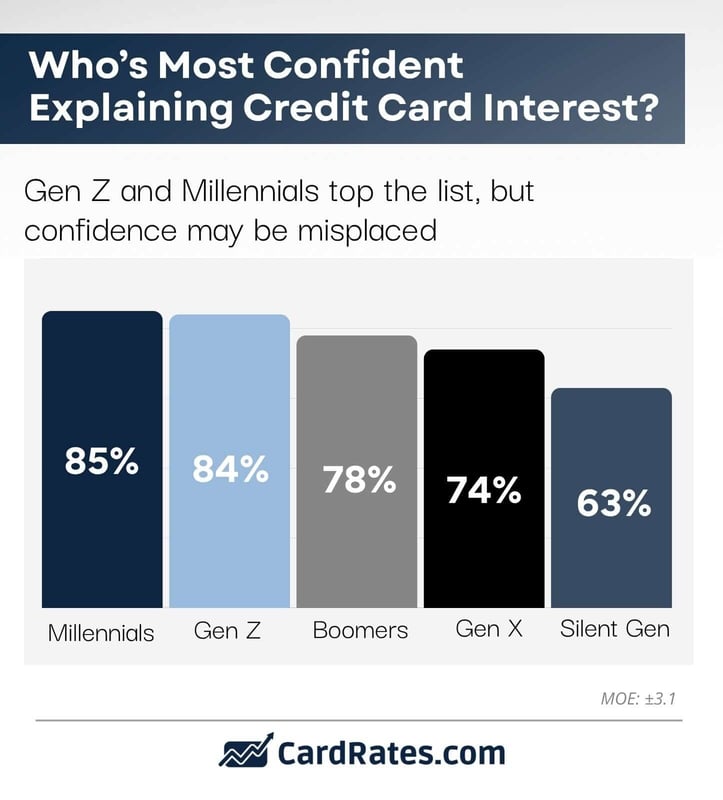
Millennials and Gen Z are the most confident credit card users, and the most likely to get it wrong. A full 85% of millennials and 84% of Gen Z respondents say they’re confident explaining how credit card interest works, more than Gen X (74%), baby boomers (78%), and the Silent Generation (63%).
It’s a striking generational paradox: The Americans with the least credit experience report the most confidence, while older adults, who’ve spent decades using credit, are more cautious in their understanding.
And that confidence may come at a cost: Younger adults were also the most likely to say they believed common, costly credit myths when they got their first card.
1 in 5 First-Time Cardholders Wrongly Believe Carrying a Balance Boosts Their Credit
Many Americans aren’t just confused about how credit cards work; they’re carrying dangerous misconceptions into their very first swipe.
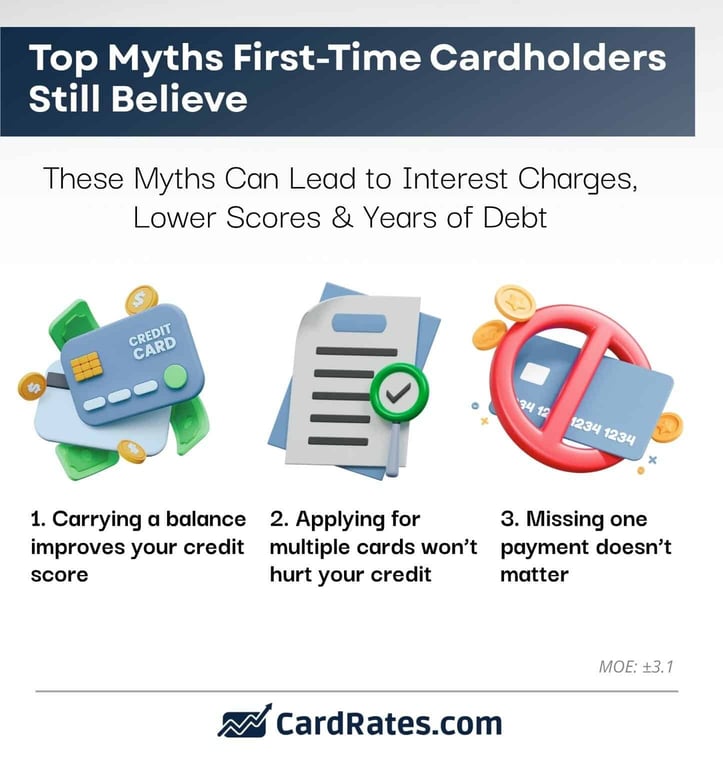
The most common? The belief that carrying a balance improves your credit score, a myth that leads to unnecessary interest payments and long-term credit damage. Nearly 1 in 5 Americans surveyed (17%) said they believed this when they got their first card.
But the risk isn’t evenly spread: Millennials (22%) and Gen Z (19%), the two generations most confident in their understanding of how interest works, were the most likely to believe this costly myth.
And that confidence gap runs deep:
- Missing Payments: 13% of Gen Z respondents believed missing one payment “doesn’t really matter,” nearly double the U.S. average (7%) and more than twice the number of boomers (5%) who said they believed the same.
- Income-Based Limits: 19% of Gen Zers surveyed said they thought credit limits are based only on income, nearly three times more than respondents in the Silent Generation (7%) and nearly double millennials (11%).
- Multiple Cards: 15% of Gen Z respondents — at least 5 percentage points higher than any other generation — said they believed applying for multiple cards won’t hurt credit.
These aren’t minor misunderstandings; they’re beliefs that can trigger higher debt, lower scores, and long-term financial setbacks. And the surveyed groups most confident in their credit knowledge, millennials and Gen Z, were also the most likely to believe them.
86% of Gen Z Started Their Credit Journey Believing at Least One Myth
With the fall semester on the horizon, younger Americans, particularly Gen Z college students, are approaching a pivotal moment in their financial lives: applying for their first credit cards. That first card often sets the tone for long-term financial behavior, influencing credit scores, debt habits, and overall money management.
But most aren’t starting from a place of clarity.
According to our study, just 14% of Gen Z respondents said they had no misconceptions when they got their first credit card, the lowest of any generation surveyed. That’s in contrast to how older adults answered the same question:
- Millennials: 22%
- Gen X: 31%
- Boomers: 43%
- Silent Generation: 59%
This early gap in knowledge is especially striking when paired with their confidence: Gen Z also reported the highest self-assurance in understanding credit interest, despite being the most likely to start misinformed. In other words, they felt prepared, but most weren’t.
“Information is only power if it is accurate,” said Bobbi Rebell CFP® and consumer finance expert at CardRates.com. “Young adults need to make sure they are going to the right sources for their information, to avoid consequences that can follow them well into their adult lives.”
As credit cards become a lifeline for more Americans facing high costs and tight budgets, the gap between how they’re used and how they’re understood is more than a knowledge issue; it’s a financial liability.
This survey reveals that confidence, especially among younger generations, doesn’t always translate into comprehension. And without early, accurate credit education, first-time cardholders risk learning the hard way, through interest charges, credit score hits, or years of financial recovery.
In today’s high-interest economy, understanding how credit works is not optional. It is the difference between building a healthy financial future and digging into avoidable debt.
Methodology
This survey was conducted online among a nationally representative sample of 1,000 U.S. adults ages 18 and older who are credit card holders. Respondents were selected from a third-party research panel, and results were weighted to align with U.S. Census benchmarks for age, gender, region, and race/ethnicity.
The survey explored consumer understanding of credit card interest calculations and common misconceptions held before obtaining a first credit card. Questions examined confidence levels, generational and gender differences, and specific beliefs about how credit card use affects credit scores and borrowing behavior.
The overall margin of error is ±3.1 percentage points at the 95% confidence level. Margins of error are higher for subgroups such as generation, race/ethnicity, gender, or income level.
For media inquiries, please reach out to catherine@cardrates.com.
Editorial Note: Our site content is not provided or commissioned by any credit card issuer(s). Opinions expressed on CardRates.com are the author's alone, not those of any credit card issuer, and have not been reviewed, approved, or otherwise endorsed by credit card issuers. Every reasonable effort has been made to maintain accurate information; however, all credit card offer details, including information about rewards, signup bonuses, introductory offers, and other terms and conditions, is presented without warranty. Clicking on any offer on CardRates.com will direct you to the issuer's website, where you can review the current terms and conditions of the offer.
About the Author





![How the Chase 5/24 Rule Works & Which Credit Cards It Affects[updated_month_year before=" (" after=")"]](https://www.cardrates.com/images/uploads/2018/03/5242.png?width=164&height=85 "How the Chase 5/24 Rule Works & Which Credit Cards It Affects[updated_month_year before=\" (\" after=\")\"]")