
Writer: Lynn Cadet


Editor: Ashley Fricker


Reviewer: Adam West

We deploy a step-by-step methodology to each piece of research we publish to ensure our studies offer complete coverage and meet our rigorous editorial standards.
Key Takeaways
- Women are far more likely than men to equate financial secrecy with infidelity, with nearly half of women (46%) agreeing with this opinion, compared to just 30% of men.
- Baby boomers (48%) are nearly twice as likely as Gen Z (29%) and millennials (24%) to say hiding debt is as bad as cheating.
- About 4 in 10 Democrats, Independents, and Republicans agree that financial secrecy can be just as damaging as infidelity, a rare point of consensus across party lines.
Romantic betrayal, though often viewed as physical cheating, can take many forms. A new CardRates.com study reveals 4 in 10 surveyed Americans say hiding credit card debt is just as bad as cheating, highlighting the impact financial betrayal can have on a relationship.
While half of Americans still rank physical infidelity as their biggest relationship dealbreaker, our study shows that how people define infidelity is expanding. And for many, romantic transgressions don’t just involve other people, but also money.
Finances and relationships have long been intertwined. In fact, disputes over money are one of the leading causes of divorce in the U.S., right up there with infidelity and commitment issues. As our study reveals, relationships are about more than just love, and overstepping financial boundaries can lead to a serious breakdown of trust between partners.
Women More Likely to Equate Secret Debt to Cheating
Our findings reveal how men’s and women’s views differ when it comes to finances and moral boundaries. Interestingly, there was a significant deviation in the perception of financial dishonesty between the two genders.
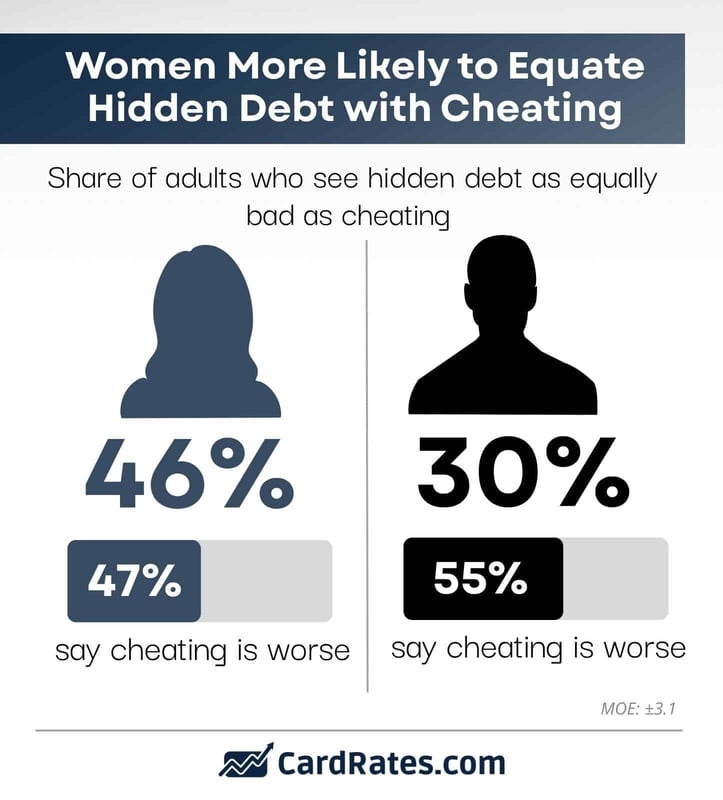
Women (46%) are significantly more likely than men (30%) to say hiding debt is as bad as cheating, suggesting gendered differences in what feels like betrayal. Perceptions of betrayal vary, reflecting how personal and situational financial trust can be.
Women were more likely to interpret hidden credit card debt as a breach of emotional trust, while men tended to view it as less severe. The gap highlights how discussions about financial transparency may play a larger role in building trust for women than for men.
Boomers Twice as Likely as Millennials to See Debt Secrecy as Cheating
Infidelity has become much more nuanced in recent years, especially with the rise of AI and social media. But financial dishonesty isn’t some new-age issue; it’s a generational one.
Our survey found that older generations were nearly twice as likely as younger adults to view financial secrecy as an act of infidelity. Boomers had the highest likelihood of equating financial dishonesty with cheating, compared to other groups.
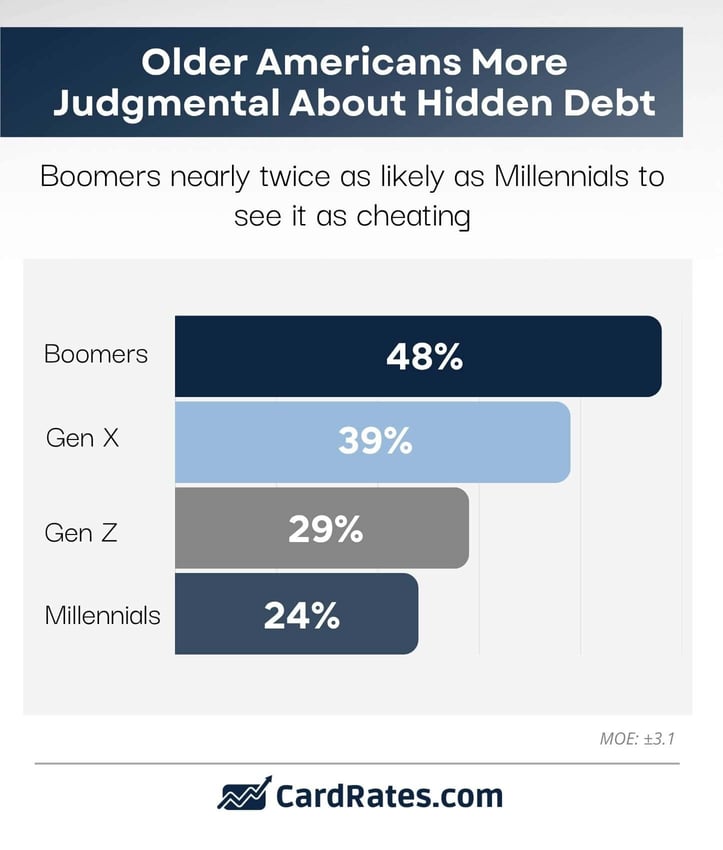
Here is how the numbers broke down by generation, stating that credit card debt is equally as bad as cheating:
- Boomers: 48%
- Gen X: 39%
- Gen Z: 29%
- Millennials: 24%
Life stage and shared financial responsibility could explain why older adults have a harder stance on honesty than their younger counterparts. As people and their relationships age, the more intertwined their finances can become, which can lead to higher emotional stakes within the relationship.
A partner finding out about hidden debt in a long-term commitment, such as marriage, is more likely to view this as an act of emotional betrayal, whereas a younger adult who has been dating their partner for several months may not share the same sentiments or understand its gravity.
Financial Honesty Transcends Party Lines
Americans across the political spectrum are drawing a line in the sand on financial infidelity. And as it happens, constituents from multiple sides of the aisle are seeing eye to eye on the matter.
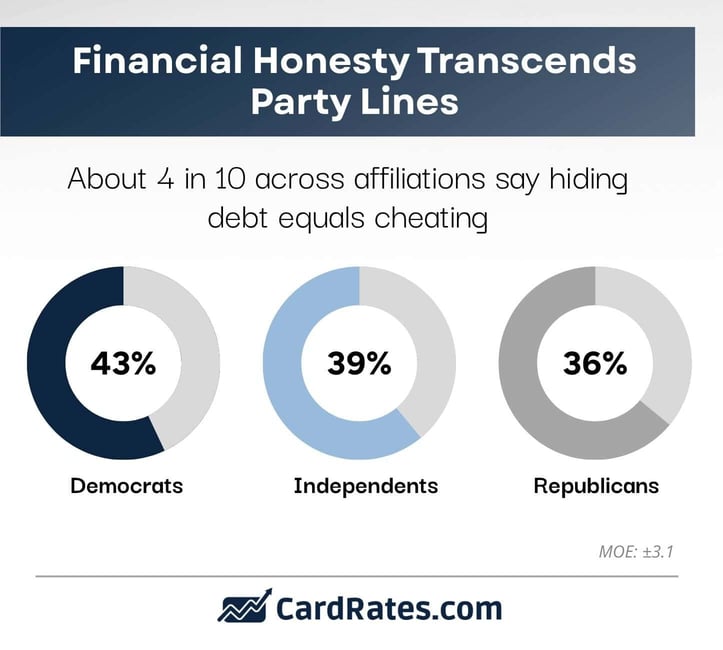
Our study found that about 4 in 10 across all political affiliations agree that hiding debt is as bad as cheating. The numbers held steady, showing a consistency in perception:
- Democrats: 43%
- Independents: 39%
- Republicans: 36%
Despite polarization on many issues, moral boundaries surrounding money and honesty are one thing people from opposing party lines can agree on. There is no divide on how they plan to view financial boundaries, only shared values.
“When you are in a committed relationship, it’s always a good idea to discuss how you will treat credit cards and set guidelines you can both live with,” said Erica Sandberg, consumer finance expert at CardRates.com.
Sandberg adds, “If that means charging in any way that you want without having to disclose purchases and account management, so be it. But if you agree to be transparent, go with that. Just remember that if your financial obligations start to affect the other person, they deserve to know about it.”
In today’s world, financial honesty has become a clear measure of trust in relationships, especially as couples face more financial uncertainty. As relationships and finances intersect, the emotional stakes surrounding money matters will only increase, showing why financial transparency is essential to building relational trust.
Methodology
This survey was conducted in 2025 among 1,000 U.S. adults who hold credit cards via an online panel. The overall margin of error is approximately ±3.1% at 95% confidence. Subgroup margins of error are higher and are noted alongside base sizes. All questions were single-selection and each received 1,000 completes. Crosstabs by demographic group (gender, generation, political affiliation) are available upon request.
For media inquiries, please reach out to catherine@cardrates.com.
Editorial Note: Our site content is not provided or commissioned by any credit card issuer(s). Opinions expressed on CardRates.com are the author's alone, not those of any credit card issuer, and have not been reviewed, approved, or otherwise endorsed by credit card issuers. Every reasonable effort has been made to maintain accurate information; however, all credit card offer details, including information about rewards, signup bonuses, introductory offers, and other terms and conditions, is presented without warranty. Clicking on any offer on CardRates.com will direct you to the issuer's website, where you can review the current terms and conditions of the offer.
About the Author