
Writer: Jon McDonald


Editor: Lillian Guevara-Castro


Reviewer: Ashley Fricker

We deploy a step-by-step methodology to each piece of research we publish to ensure our studies offer complete coverage and meet our rigorous editorial standards.
Navigating significant financial decisions such as buying a home, consolidating credit card debt, or even declaring bankruptcy are among the most challenging and impactful choices people face in their lives. These decisions carry substantial emotional and financial weight, making it crucial to approach them with a clear and rational mindset.
But many Americans, when confronted with these difficult financial choices, often resort to avoidance strategies rather than addressing them directly. Alarmingly, one such strategy includes turning to alcohol as a coping mechanism.
A recent survey of 3,000 Americans conducted by CardRates.com revealed that a whopping 21% (1 in 5) admit to turning to alcohol when faced with major financial decisions.
-
Navigate This Article:
1 in 5 Use Alcohol to Make Major Financial Decisions
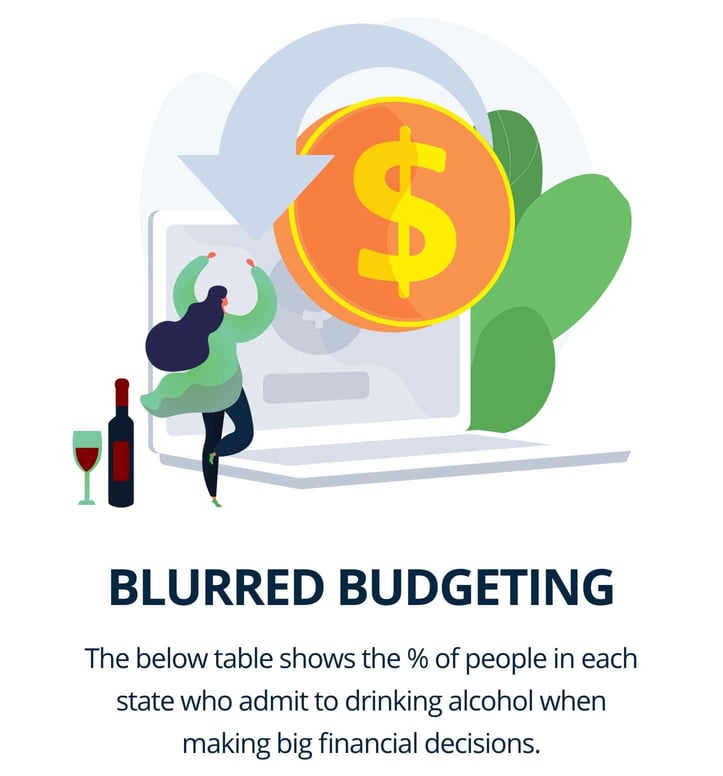
Survey results reveal that Arizona residents are the most likely to use alcohol to help them make big decisions, with 38% admitting to this behavior. Conversely, only 9% of Utah residents reported using alcohol in this context.
Here is a graphic showing the breakdown across each state:
| State | Percent |
|---|---|
| Alabama | 25% |
| Alaska | 20% |
| Arizona | 38% |
| Arkansas | 26% |
| California | 23% |
| Colorado | 28% |
| Connecticut | 17% |
| Delaware | 20% |
| Florida | 16% |
| Georgia | 15% |
| Hawaii | 25% |
| Idaho | 20% |
| Illinois | 16% |
| Indiana | 24% |
| Iowa | 27% |
| Kansas | 21% |
| Kentucky | 19% |
| Louisiana | 35% |
| Maine | 27% |
| Maryland | 19% |
| Massachusetts | 21% |
| Michigan | 17% |
| Minnesota | 25% |
| Mississippi | 31% |
| Missouri | 11% |
| Montana | 20% |
| Nebraska | 12% |
| Nevada | 23% |
| New Hampshire | 20% |
| New Jersey | 20% |
| New Mexico | 31% |
| New York | 24% |
| North Carolina | 12% |
| North Dakota | 20% |
| Ohio | 14% |
| Oklahoma | 9% |
| Oregon | 18% |
| Pennsylvania | 18% |
| Rhode Island | 10% |
| South Carolina | 29% |
| South Dakota | 23% |
| Tennessee | 12% |
| Texas | 27% |
| Utah | 9% |
| Vermont | 20% |
| Virginia | 26% |
| Washington | 28% |
| West Virginia | 20% |
| Wisconsin | 23% |
| Wyoming | 20% |
Reasons Americans Are Turning to Alcohol
The survey also explored which financial decisions most commonly lead to alcohol consumption:
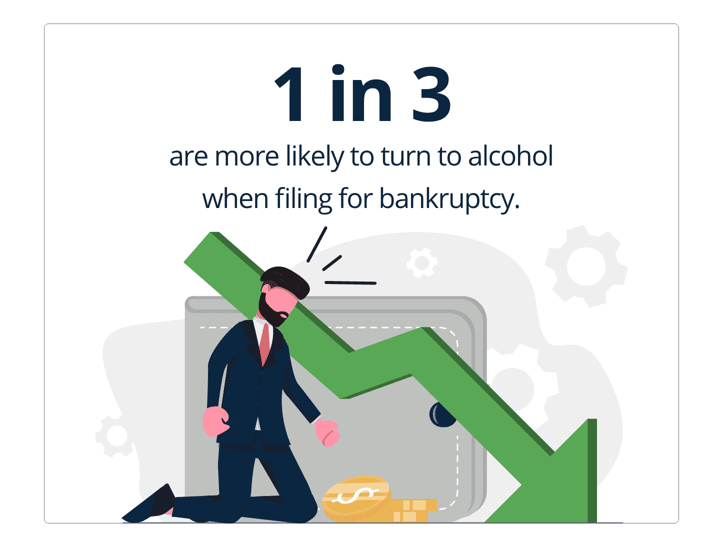
- Filing for bankruptcy: 32%
- Taking out a loan (personal, auto, mortgage, etc.): 15%
- Dealing with credit card debt: 13%
- Retirement planning: 11%
- Divorce: 10%
- Changing jobs/careers: 8%
- Making a large purchase (home, car, etc.): 6%
- Investing a large sum of money: 5%
“All of the listed financial events that people approach while drinking alcohol are inherently stressful,” said Erica Sandberg, Consumer Finance Expert at CardRates.com. “A few of them, though, such as going through the bankruptcy process, ending a marriage, and confronting high consumer debt, are especially difficult life events.”
“Drinking to relax can make sense at the time, but it’s best to make such choices while you are fully aware of what you are doing,” Sandberg continued. “And in general, that means being sober. This way, you can intellectualize the issues and approach them rationally rather than emotionally or while impaired.”
Main Takeaways
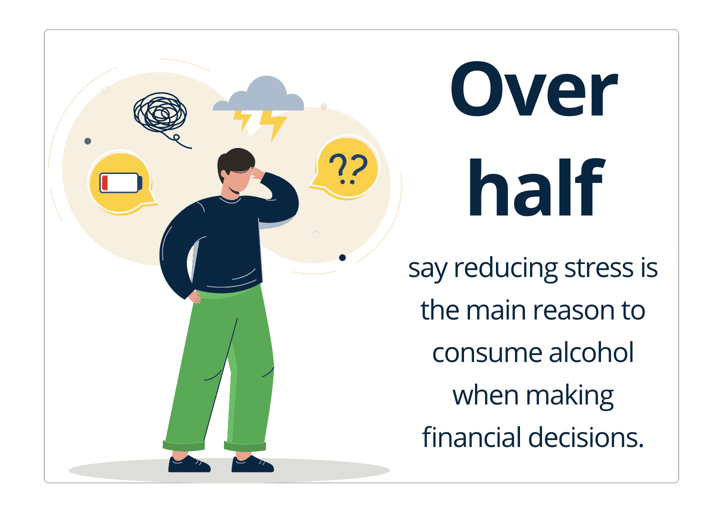
Over half (51%) of respondents noted that reducing stress levels associated with their financial situations was the primary reason for drinking. Interestingly, 25% admitted that they would drink alcohol to toast success in recent financial decisions they had made.
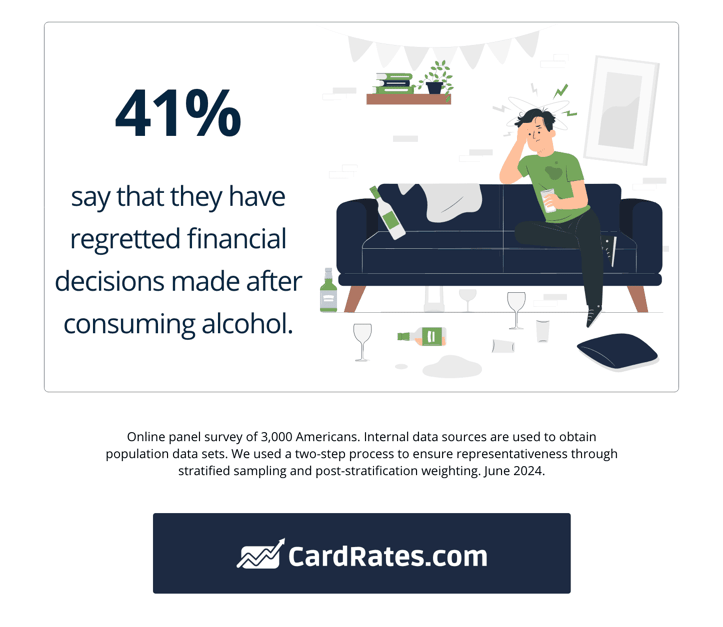
Additionally, 12.5% reported drinking specifically to help them make a financial decision, while 9% drank as an avoidance technique before making a decision. Unsurprisingly, 41% of respondents regretted making some financial decisions while inebriated.
Finally, almost two-thirds of respondents acknowledged that drinking alcohol impairs their ability to make sound financial decisions, much like it affects their ability to do other activities such as driving. However, a concerning 18% of respondents said they believed that alcohol improved their decision-making abilities.
Methodology
An online panel survey of 3,000 Americans was conducted in June 2024. Internal data sources were used to obtain population data sets. We used a two-step process to ensure representativeness through stratified sampling and post-stratification weighting.
Editorial Note: Our site content is not provided or commissioned by any credit card issuer(s). Opinions expressed on CardRates.com are the author's alone, not those of any credit card issuer, and have not been reviewed, approved, or otherwise endorsed by credit card issuers. Every reasonable effort has been made to maintain accurate information; however, all credit card offer details, including information about rewards, signup bonuses, introductory offers, and other terms and conditions, is presented without warranty. Clicking on any offer on CardRates.com will direct you to the issuer's website, where you can review the current terms and conditions of the offer.
About the Author



![9 Best Study Abroad Credit Cards for Students[updated_month_year before=" (" after=")"]](https://www.cardrates.com/images/uploads/2018/06/Best-Study-Abroad-Credit-Cards.jpg?width=164&height=85 "9 Best Study Abroad Credit Cards for Students[updated_month_year before=\" (\" after=\")\"]")