
Writer: Andrew Allen


Editor: Lillian Guevara-Castro


Reviewer: Adam West

Our experts and industry insiders blog the latest news, studies and current events from inside the credit card industry. Our articles follow strict editorial guidelines.
Key Takeaways
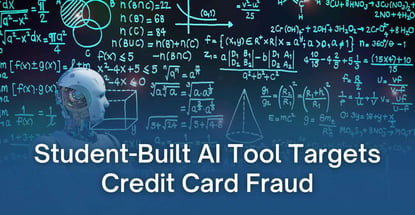
A graduate student out of the University of Ottawa has created a tool that may one day help financial institutions crack down on credit card fraud.
Payment fraud is a big problem for credit card issuers and their customers, but emerging technologies may soon help industry stakeholders avoid it.
Card fraud is a widespread problem in the U.S., with 62 million people reporting fraudulent charges on their credit or debit card accounts in 2024. Unauthorized purchases from fraudulent card transactions top $6.2 billion per year, according to a report from Security.org.
But bad actors who engage in card fraud may see their time in the sun come to an end soon.
We sat down with Bahar Emami Afshar, the University of Ottawa student referenced earlier in this story, to learn firsthand about the program she’s built to help combat credit card fraud.
Overcoming credit card fraud is challenging in today’s world, according to Afshar.
More than 60 million people in the U.S. had fraudulent charges on their credit or debit cards in 2024.
“Credit card fraud is one of the biggest issues in today’s world,” Afshar explained. “It used to be just related to a stolen card that was going to be used to make unauthorized transactions at ATMS. But nowadays, with eCommerce and online activity growing, fraud has become very complicated.”
Afshar has been interested in machine learning for a long time. She studied computer engineering in her undergrad days, and she decided to pursue a master’s degree in computer science to explore how AI solutions can help businesses overcome dilemmas.
Afshar fears that the fraud statistics don’t tell the whole story.
“It’s a problem that we have a lot of fraud that is underreported,” Afshar told us. “For example, in Canada, only 5% to 10% of fraud is reported, and fraud losses are expected to grow in the country in 2025.”
Striving to Build on Past Success
Machine learning can involve training a system to predict outcomes.
Afshar calls the machine learning tool she uses ITERADE. We’re grateful she uses that name because it stands for Iterative Anomaly Detection Ensemble, which doesn’t slide off the tongue as easily.
ITERADE selects the most suspicious or anomalous cases in the data to help labeling experts identify instances of fraud more easily. Afshar uses card transactions as her data when working with the tool.
“The ensemble selects a subset of the data that has a higher chance of containing fraud,” Afshar said. “And when we compare these to other detection techniques, my approach was able to perform three to 15 times better. So, I can select a subset of the data and your chances of capturing fraud in it is that much higher than in other approaches.”

The tool isn’t necessarily a be-all, end-all solution that credit card issuers can use to detect every instance of credit card fraud. But it gives them a solid starting point.
The system can help companies save resources, Afshar said, including two that are extremely important in the business arena: money and time.
Her method for detecting fraud may become even more accurate over time as she accumulates more data. That’s because more labeled data can allow people to build models that perform better.
She also plans to use Large Language Models (LLMs) to help describe patterns in the data. In artificial intelligence, explainability refers to the ability to describe the output from a machine learning model in a way that makes sense to people.
“We need explainability because companies are going to be working with clients and the clients can wonder why certain cases are flagged,” Afshar said. “We want to know the patterns behind that, and the explainability can also be used as a tool for the technical user.”
The Hidden Costs of Fraud
Credit card fraud can harm multiple stakeholders in the credit card space. For issuers, that harm can lead to financial losses.
At times, issuers may need to offer reimbursement to cardholders who are victims of credit card fraud. Issuers may also incur more expenses from chargebacks and the cost of investigating fraud cases when card fraud increases.
Card fraud can also cause problems in other areas of society. That’s why Afshar’s work may have significant impacts beyond the credit card ecosystem.
“Credit card fraud can be connected to other crimes as well,” Afshar told us. “For example, when someone steals your credit card, they may also steal your identity. And that can be used for other illegal activities. When you see the whole impact of card fraud it makes more sense why it is so important to find ways to stop it.”
Of course, credit card fraud can also introduce other costs to financial institutions that aren’t easy to quantify.
Credit card issuers may suffer reputational damage as a result of card fraud.
People who become victims of credit card fraud may lose trust in their credit card issuer’s ability to shield them from bad actors.
Social media empowers people to share their experiences as customers of a business nearly instantly with countless online users. That means that even a single case of credit card fraud can lead to an issuer experiencing reputational damage across the globe.
Afshar’s tool isn’t available for credit card issuers to add to their fraud-fighting arsenal just yet. She told us she’s working on trying to refine the model.
“After this whole phase of experimentation and evaluation is done, we’ll see where things stand,” she told us.
For credit card issuers looking to ramp up their ability to mitigate the risks of fraud, the release of a new solution that helps them accomplish that will be welcome news.
Editorial Note: Our site content is not provided or commissioned by any credit card issuer(s). Opinions expressed on CardRates.com are the author's alone, not those of any credit card issuer, and have not been reviewed, approved, or otherwise endorsed by credit card issuers. Every reasonable effort has been made to maintain accurate information; however, all credit card offer details, including information about rewards, signup bonuses, introductory offers, and other terms and conditions, is presented without warranty. Clicking on any offer on CardRates.com will direct you to the issuer's website, where you can review the current terms and conditions of the offer.
About the Author