
Writer: Lucy Lazarony


Editor: Adam West


Reviewer: Ashley Fricker

Our experts and industry insiders blog the latest news, studies and current events from inside the credit card industry. Our articles follow strict editorial guidelines.
Key Takeaways
- Bitcoin value has fallen considerably in recent months from its high of more than $126,000.
- Investing in an exchange-traded fund or buying stocks that benefit from Bitcoin are two other ways to invest in Bitcoin.
- Buying Bitcoin as a credit card transaction could trigger a cash advance fee of 3% to 5% and a high interest rate that takes effect immediately.
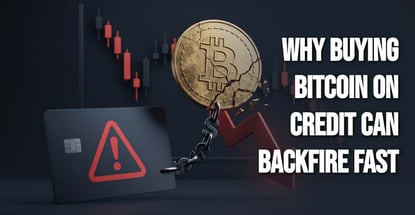
Bitcoin’s steep price drop may tempt bargain hunters, but using a credit card to buy the dip can quickly turn a risky trade into an expensive one.
That’s because buying Bitcoin or other cryptocurrencies with a credit card transaction could trigger a cash advance fee of 3% to 5% and a high interest rate on the amount of the transaction. If that happens, interest may begin accruing immediately, with no grace period. So consider these additional costs before reaching to buy crypto with a credit card.
If the transaction is treated as a cash advance, paying the balance off quickly may limit the interest charges, but it won’t erase the upfront cash advance fee. You may still be stuck paying a cash advance fee, often the greater of a minimum charge such as $10 or a percentage of the transaction.
And you can forget about earning credit card rewards. Cash equivalent transactions on credit cards are typically excluded from rewards. You may not earn rewards if the transaction is treated as a cash advance or cash-equivalent transaction so always check the card terms.
A $1,000 Bitcoin purchase could carry a $30 to $50 cash advance fee before interest even begins.
Is a cryptocurrency investment that many may see as risky worth the cost? Is it worth triggering a cash advance on your credit card to do so? Think over the costs carefully.
Would buying into an exchange-traded fund (ETF) with crypto exposure be a more pragmatic move? Investing in companies with Bitcoin exposure is another way to bring crypto into your portfolio.
A Lower Bitcoin Price Does Not Make It Safer
First, a little background on the world’s most popular cryptocurrency, which recently had a market cap of roughly $1.2 trillion, depending on the day’s price.
Bitcoin, invented in 2009, is the world’s first decentralized digital currency. That means it operates without a central bank and allows users to send and receive money online without intermediaries such as commercial banks.
Some investors view Bitcoin as a hedge against inflation. Others use it as a speculative investment or digital currency. But Bitcoin is also known for extreme volatility, which means its price can move sharply in either direction.
Some Financial Professionals Urge Caution
Bitcoin has recently traded near or below $60,000, a sharp drop from its October 2025 all-time high of $126,198. For consumers interested in cryptocurrency, that kind of decline can make Bitcoin look tempting.
But a lower price does not necessarily mean Bitcoin is a safe buy.
Marc Lescarret, a certified financial planner with Marc Alan Wealth Management calls such a move “pure gambling.”
“What’s the difference between gambling and real investing? It is earnings or at least the potential for earnings. Bitcoin has no real use so if its existence continues I would expect a return of money supply growth, which is close to 5% a year, with an average standard deviation of 50%” Lescarret told us.
“Consider a hedged ETF product, an ETF with put protection, or buying stocks that benefit from Bitcoin.” — Marc Lescarret of Marc Alan Wealth Management
He urges people who are looking to buy Bitcoin to steer clear of buying it directly.
“Based on volatility and money supply growth, owning Bitcoin directly can easily wipe out your investment,” Lescarret said.
There are other ways to get Bitcoin exposure, though they still carry risk.
“Consider a hedged ETF product, an ETF with put protection, or buying stocks that benefit from Bitcoin,” Lescarret told us.
Editorial Note: Our site content is not provided or commissioned by any credit card issuer(s). Opinions expressed on CardRates.com are the author's alone, not those of any credit card issuer, and have not been reviewed, approved, or otherwise endorsed by credit card issuers. Every reasonable effort has been made to maintain accurate information; however, all credit card offer details, including information about rewards, signup bonuses, introductory offers, and other terms and conditions, is presented without warranty. Clicking on any offer on CardRates.com will direct you to the issuer's website, where you can review the current terms and conditions of the offer.
About the Author