
Writer: Erica Sandberg


Editor: Jon McDonald


Reviewer: Ashley Fricker

Opinions expressed here are ours alone, and are not provided, endorsed, or approved by any issuer. Our articles follow strict editorial guidelines and are updated regularly.
There is no need to panic if you missed your credit card’s due date. Although there may be some unpleasant repercussions if you’re a day (or 29) behind, you can avoid credit damage as long as you fix the issue before it turns into a serious problem.
I’m glad to be addressing this topic because it’s a great opportunity to both emphasize the importance of keeping your account in good standing and to alleviate unnecessary worry.
So, stay positive! I’ll tell you what happens and help you figure out what to do if you’re late.
Why Your Credit Score Is Safe (For Now)
There is a world of difference between missing a due date and skipping an entire billing cycle. The former will have no effect on your credit score, but the latter can certainly shave off some points.
It’s important to learn your credit card’s due date. For almost all credit cards, it will be the same day of every month. So if it’s the 25th in March, it will be the 25th in April, and every month after that.
As long as you get your payment in by that date (and you send at least the minimum required amount and keep the revolving balance under the credit limit), your account will be considered in good standing. That’s what you want.
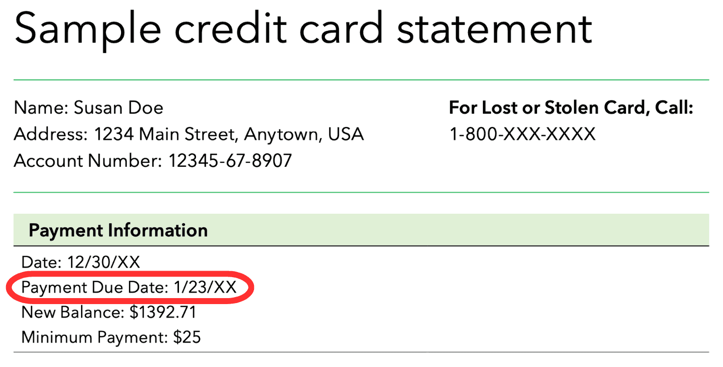
However, if you pay after that date or in less than the minimum due, the issuer will consider your account to be late. That usually results in an automatic late fee, which will be added to your balance.
Each issuer has its own late fee structure, so review the terms associated with your account. Most will charge $25 or $29 for the first late and can go up to $40 for subsequent violations.
In addition to the late fee, you might experience other repercussions for being even a day late, though, which may have you saying:
Goodbye 0% APR Deal
If your credit card has a 0% APR promotional rate on purchases or balance transfers for a certain number of months, that special deal may evaporate early.
That can be a huge disappointment when you got it specifically to finance something at the lowest possible cost.
So Long, Interest-Free Grace Period
The marvelous aspect about charging items with your credit card is that you have an interest-free grace period on balances you pay in full before the due date.
But if you pay late, interest will be assessed and added to the balance.
Hello, Higher Regular Interest Rate
Some credit card issuers will hike up the regular rate to a penalty rate if you miss the due date.
Maybe your account came with a 15.99% APR, but now it’s 29.99%. The higher the rate, the more your revolving balances will cost.
Now the Good News – the Bureaus Won’t Know
The credit card issuer will not notify TransUnion, Equifax, and Experian (the three major credit reporting agencies) that you have fallen behind.
Because when you are anywhere between 1 and 29 days late, your secret is safe with your card issuer.
What Happens if You’re 30+ Days Late
Uh oh. Your credit card payment was due on April 25, and it’s now May 26th, and you still haven’t paid? So much for your secret.
The credit card issuer will furnish that information to the credit reporting agencies, and your credit file will clearly show that the account is 30 days past due.
That delinquency notation will be stuck to your report for seven years from the date it happened, and anyone who pulls your report will see it and can make an informed business decision.
For example, imagine you’re applying for an apartment. If the landlord pulls your credit report, they will see that you are behind and may choose to go with someone who has a clean file.
| Timeline of Late Payment Impacts | ||
|---|---|---|
| 30-59 Days Late | 60-179 Days Late | 180+ Days Late |
| Bank will charge another late fee | Bank continues to charge late fees | Account closed |
| Penalty APR likely goes into effect | Your account may be closed | Debt sold to collections agency or other debt buyer |
| Account reported to the major credit bureaus as late | Accounts later than 90 days considered seriously delinquent | Bank may sue you |
| Your credit score will start to drop | Account may go to collections | Defaulted account remains on your credit report for seven years |
Or maybe you want a credit card with amazing perks and benefits. A late payment that makes it to your report can put you out of the running immediately.
And then there’s the credit damage. Payment history is the most important factor in both FICO Scores and VantageScores. A single 30-day delinquency can drag your scores down by 50 to over 100 points, depending on other data on your reports.
The scoring damage intensifies as the delinquency stretches to the next month.
Then you will receive a 60-day past-due notice attached to your report.
Keep going, and it will be a 90-day late notice, and so on, until you are past due by 180 days. At that point, your account will be in default, and your scores will almost surely be very low.
Steps to Take When You Realize You’re Late
In light of all the terrible things that can happen if your credit card account goes 30-plus days late, you can see how being a few days behind the due date isn’t so bad.
But you do want to attack the problem quickly.
1. Send The Money
If you have at least the minimum payment, send it now.
There’s no reason to sit on the cash when that’s exactly what the credit card issuer is waiting for!
2. Contact The Credit Card Issuer
Look, everybody makes mistakes. Maybe you went on vacation and completely forgot about that bill.
If you’ve had that account for years and have always paid on time, you may be able to convince the issuer to waive the fee with a quick phone call.
| How to Contact Your Issuer If You’re Late | |
|---|---|
| Issuer | Customer Service Phone Number |
| American Express | 1-800-528-4800 |
| Bank of America | 1-800-732-9194 |
| Barclaycard | 1-888-232-0780 |
| Capital One | 1-800-227-4825 |
| Chase | 1-800-432-3117 |
| Citibank | 1-800-950-5114 |
| Discover | 1-800-347-2683 |
| U.S. Bank | 1-800-344-5696 |
| Wells Fargo | 1-800-642-4720 |
You may also request that other repercussions to be changed, too. There’s no guarantee, but it never hurts to try.
3. Stay On Schedule
By far the best way to ensure that your payments are always in by the due date is to enroll in automatic bill pay. Do it through your issuer instead of your bank because you will have more options.
You can arrange for minimum payments, a fixed payment, or a complete payment to be deducted from your checking account every month, with no fear of delay.
4. Get Alerts
All major credit card issuers have a system that you can opt into that pings you before a payment is due. It’s a useful reminder because it gives you the opportunity to review your bank account and make sure there is sufficient cash for the transaction.
If you’re short, you can adjust a fixed or complete payment to one that is at least the minimum, keeping you in the safe zone.
Don’t Sweat Paying a Day Late, But Don’t Make it a Habit
Now you know that being a few days behind on a credit card isn’t the end of the world. Your credit report and scores will be safe from harm.
Just get back on track as soon as possible. Calmer? Excellent!
Editorial Note: Our site content is not provided or commissioned by any credit card issuer(s). Opinions expressed on CardRates.com are the author's alone, not those of any credit card issuer, and have not been reviewed, approved, or otherwise endorsed by credit card issuers. Every reasonable effort has been made to maintain accurate information; however, all credit card offer details, including information about rewards, signup bonuses, introductory offers, and other terms and conditions, is presented without warranty. Clicking on any offer on CardRates.com will direct you to the issuer's website, where you can review the current terms and conditions of the offer.
About the Author