
Writer: Eric Bank


Editor: Lillian Guevara-Castro


Reviewer: Adam West

Our experts and industry insiders blog the latest news, studies and current events from inside the credit card industry. Our articles follow strict editorial guidelines.
Key Takeaways
- PayPal's CEO, Alex Chriss, was replaced this week after PayPal said that the growth of its branded checkout service had slowed.
- For card issuers and the card issuing networks, the execution issues that PayPal has created again raise the question of who actually owns the checkout process and where customer loyalty and rewards should appear.
- With new CEO Enrique Lores, PayPal can now change how it integrates with card issuers, merchants, and other competitive wallets.
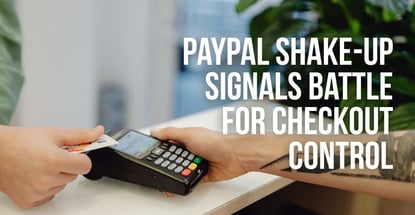
The board of PayPal acted quickly this week when it removed CEO Alex Chriss and named Enrique Lores as his successor. The removal of Chriss occurred on the same day that PayPal issued a disappointing quarterly report and announced that its branded checkout service was experiencing a sharp deceleration in growth.
Immediately following the issuance of the earnings report, PayPal stock declined approximately 17%. Analysts at JPMorgan Chase stated that the quarterly results and guidance “add fuel to the bear thesis that PayPal will struggle to maintain share in the market,” and indicated the negative reaction from the investment community.
PayPal’s financial position is but one piece of this larger puzzle. For years, PayPal branded its checkout as its largest strategic asset. That asset sits between the merchant, consumer, and card network. The failure of that asset impacts the entire card ecosystem.
The change in leadership for PayPal’s CEO is not necessarily a reflection of a new or different strategy, but rather due to credit card issuers, networks, and payment strategists.
The problem is a combination of weak execution and an increasingly difficult consumer landscape, especially among lower-to-mid-income segments that are a large portion of PayPal’s base of users.
PayPal CFO Jamie Miller cited what she called a “K-shaped” economy when describing the issue and said the results reflect both stress among PayPal’s lower-to-mid-income customers and also some internal challenges.
The digital checkout layer is getting more pressure. There is increasing competition for control of how card networks display cards, offer rewards, and manage their economics.
Why Branded Checkout Matters to Card Programs
Branded checkout accounts make up nearly half of PayPal’s profits. A slowdown in these profits over the past four quarters has added to the concern. PayPal’s branded flow declined by 4 percentage points from the third quarter to the fourth quarter (approximately 5% in the third to 1% in the fourth) of 2025.
The decline in PayPal’s branded flow will be important to credit card programs since it competes directly with network native acceptance and other digital wallets. Consumers choosing to shop online must decide which button to hit on their checkout page.
When consumers perceive that the PayPal-branded button adds little or no additional value, it highlights co-branded rewards and issuer-managed installment options to the merchant. PayPal’s current struggles show that convenience is no longer enough for wallets and branded checkouts.
Issuers must now provide evidence that they create measurable additional value beyond the existing benefits, such as rewards, fraud prevention, and loyalty programs, that cards currently offer customers.
Checkout Competition Is Intensifying
Thus, Lores may focus on faster execution — not a complete strategy change. He has the experience of leading large-scale technological transitions.
The fragmentation of these options for card issuers creates opportunities and risks. If wallets (such as those created by Apple, Amazon, etc.) can successfully remove the card from the consumer’s experience, card issuers may lose the visibility they require to grow their brands.
But, if wallets fail, card issuers will gain negotiating power with merchants and technology partners.
The current challenges faced by PayPal show that merchants are becoming pickier. In addition to evaluating conversion rates, merchants are also beginning to evaluate the complexity of integrating payment solutions, the quality of the customer service provided by each solution provider, and their long-term flexibility.
These evaluation criteria favor card networks and the issuers who are investing in tokenization, streamlined APIs, and embedded loyalty solutions.
What a New PayPal CEO Might Change
Competition to PayPal is growing as merchants have an increasing number of alternatives, including Apple Pay, Shop Pay, network-branded checkout solutions, and Buy Now Pay Later services that are blurring the lines between cards and alternative financing options.
Credit card professionals want to know how this focus on execution will affect the products PayPal develops. The disciplined approach to rolling out new products will likely positively influence PayPal’s merchant integrations.
This discipline in execution may also cause PayPal to make tough decisions on which features receive priority for development. This includes the prominence of cards in PayPal’s wallet flows.
Additionally, Lores’ background provides an opportunity to further invest in the PayPal platform.
Improved APIs, better tokenization, and tighter integration of loyalty rewards with card programs can either enhance card programs or be competitive with issuer-led card programs — depending on how PayPal decides to position itself vis-à-vis card program competition.
What Card Issuers Should Watch Next
The change in PayPal leadership will likely take some time to make a noticeable difference. But it could be the start of a strategic reevaluation. Card issuers may see changes in merchant support, checkout design, and how rewards and installments are displayed as part of PayPal’s wallet experience.
The PayPal leadership change reinforces an important lesson for the card industry. Who controls the checkout process is constantly evolving as wallets, networks, and issuers all fight for this real estate, and an issuer’s failure to execute can quickly move the power dynamic.
In the short term, the reset at PayPal reminds card programs that good product offerings, visible rewards, and continued execution are much more important than brand-name.
Editorial Note: Our site content is not provided or commissioned by any credit card issuer(s). Opinions expressed on CardRates.com are the author's alone, not those of any credit card issuer, and have not been reviewed, approved, or otherwise endorsed by credit card issuers. Every reasonable effort has been made to maintain accurate information; however, all credit card offer details, including information about rewards, signup bonuses, introductory offers, and other terms and conditions, is presented without warranty. Clicking on any offer on CardRates.com will direct you to the issuer's website, where you can review the current terms and conditions of the offer.
About the Author