
Writer: Lucy Lazarony


Editor: Lillian Guevara-Castro


Reviewer: Adam West

Our experts and industry insiders blog the latest news, studies and current events from inside the credit card industry. Our articles follow strict editorial guidelines.
Key Takeaways
The K-shaped economy was one of the top stories of 2025, and credit card issuers should be considering how this bifurcated market affects their business in 2026 and beyond.
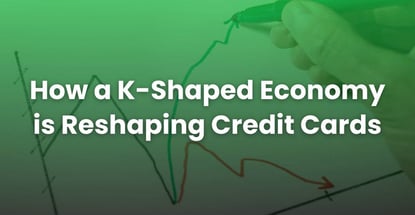
What is a K-shaped economy? American households with higher incomes are seeing advantages, including stock market gains and increasing home values, while lower income households are stuck getting by with no financial growth.
What does this mean for credit cards? Wherever they land in the K-shaped economy, consumers are continuing to turn to credit cards as a payment choice.
Credit card spending accounts for more than one-fifth of U.S. gross domestic product, according to the Consumer Bankers Association. Millions of Americans use credit cards for everyday expenses, emergencies, and to build credit histories, according to a blog on the Consumer Bankers Association website.
Rising Credit Card Debt
Credit card balances rose by $24 billion during the third quarter of 2025 and total $1.23 trillion, 5.75% above a year ago, according to the Federal Reserve Bank of New York.
How much credit card debt are individual Americans carrying? The average credit card balance per consumer is $6,523, according to a quarterly credit industry report from TransUnion.
Impact of K-Shaped Economy on Credit Cards
Here’s where the divide comes in. Some Americans are handling credit cards very well while others are struggling and under stress.
“We are seeing a divergence in consumer credit risk, with more individuals moving toward either end of the credit risk spectrum. While super prime has steadily grown since the pandemic, subprime has returned to pre-pandemic levels, leaving the middle tiers increasingly thinner,” said Jason Laky, Executive Vice President for TransUnion in a report.
“This shift suggests that while many consumers are navigating the current economic climate well, others may be facing financial strain.”
CardRates asked industry experts to give their insights on the K-shaped economy and credit cards. Here is a roundup of what they had to say.
Plentiful Credit Lines
“Within the U.S. market, there’s more than $5 trillion in open credit lines. So the first takeaway is there’s lots of credit out there in the first place,” said Brian Riley Co-Head of Payments for Javelin Strategy & Research.
“When you start talking about a K-shaped recovery, it’s important to note, let’s talk about what a K-shape is. You think about a K and it’s got an up and a down angle. And the up means that some will do really well and the down means that others are gonna be stressed,” Riley said.
Impact of Wages and Inflation
“Consumers on the whole have seen nice appreciation in wages over the years, real estate values, equity values. So their overall balance sheets are generally quite sound,” said Doug Villone, Head of US Cards and Partnerships at Barclays.
“Even though you see headlines about indebtedness having increased, if you actually adjust it for inflation and look at it as compared to wages over time, it’s actually quite in check overall.”
Prime Credit Card Customers Do Well
“I’d say, within generally the prime credit space, we continue to see a resilient consumer, the one that continues to think about how they’re spending their money and making sure they do so wisely,” Villone says.
How Issuers Approach the Credit Card Market
Some issuers, like American Express, focus on the higher end of the spectrum, and other issuers, like Bank of America and Chase, are more interested in having products across the credit spectrum, said Matthew Goldman, Founder and Managing Member of Totavi, LLC.
“Capital One made their name figuring out how to offer products to subprime consumers,” Goldman said. “And they still offer, I think, some of the best secured card products. Actually, Discover has a great secured product as well. Give people that path.”
High-charging consumers continue to have appeal to credit card issuers.
“But if one user is spending $500 a month and one is spending $5,000, you can make more money off the user spending $5,000. I think that’s part of why there’s that focus there. But I think they have to continue to do both,” Goldman said.
New Competition Enters Lower End of Card Market
“A lot of the fintechs are leaning on that lower end of the market with both credit card and buy now, pay later as revenue streams,” said Tony DeSanctis, Senior Director at Cornerstone Advisors.
“And I think the concentration at the high end of the market within the sort of three or four big players … is really why I think about the credit card market as a bifurcated market.”
Why APRs Aren’t Falling
“I think that as we’ve seen interest rates starting to fall, I don’t think we’ve really seen commensurate drops in APRs. And I personally think that that has to do with risk and this perception that the economy is actually getting much worse for those that are not at the top,” said Dave Grossman, Founder & CEO at MilesTalk and Your Best Credit Cards.
Keeping APRs higher helps issuers build in for that credit risk, Grossman said.
The Bottom Line
The K-shaped economy is affecting the credit card market with prime credit card customers doing well and customers near the bottom of the credit spectrum feeling stress and struggling.
There is little middle ground anymore.
Editorial Note: Our site content is not provided or commissioned by any credit card issuer(s). Opinions expressed on CardRates.com are the author's alone, not those of any credit card issuer, and have not been reviewed, approved, or otherwise endorsed by credit card issuers. Every reasonable effort has been made to maintain accurate information; however, all credit card offer details, including information about rewards, signup bonuses, introductory offers, and other terms and conditions, is presented without warranty. Clicking on any offer on CardRates.com will direct you to the issuer's website, where you can review the current terms and conditions of the offer.
About the Author