
Writer: Marcie Geffner


Editor: Jon McDonald


Reviewer: Ashley Fricker

Opinions expressed here are ours alone, and are not provided, endorsed, or approved by any issuer. Our articles follow strict editorial guidelines and are updated regularly.
I have a love/hate relationship with interest: I love to earn it on my savings accounts. I hate to pay it on my credit cards.
Because why would anyone rather pay than earn? Short answer: they wouldn’t.
Understanding how interest is charged on your cards and why charges can show up on your account even when you pay your balance in full may help you avoid having to pay these charges.
Here’s what you should know:
1. You May Have Lost Your Grace Period
One reason interest charges may appear on your account even when you pay your balance in full is that you lost your grace period.
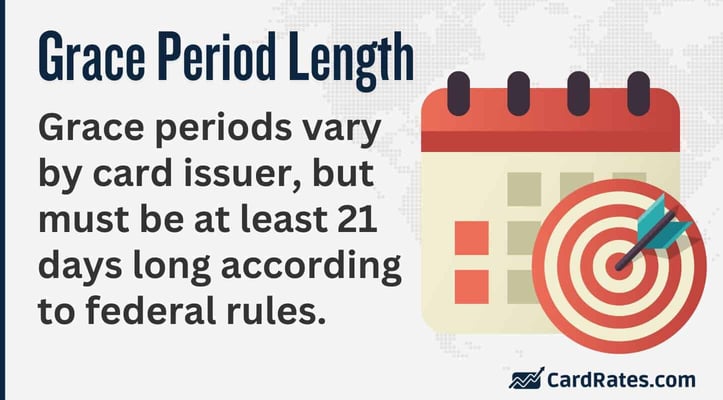
A grace period is a set number of days between the end of your billing cycle and your payment due date. With most cards, billing cycles are 28 to 31 days, and payment due dates are 21 to 25 days after each billing cycle ends.
The variations are adjustments for weekends, holidays, and months of different lengths.
During a grace period, your balance and new purchases accrue interest, but you won’t have to pay it if you paid your previous balance in full before the previous grace period ended and you pay your current balance in full before the current grace period ends.
In effect, the grace period allows you to wipe out the interest charges by paying the amount you owe in full. It’s a good incentive to pay on time or early every month.
If you carry a balance from one billing cycle to the next or you pay your balance in full but only after your grace period ends, you won’t receive a grace period for your next billing cycle.
The result could be interest charges on your next statement, even if you pay your balance in full during what would’ve been your grace period.
An important exception occurs if you accept a promotional 0% introductory rate offer, such as for new purchases or a balance transfer.
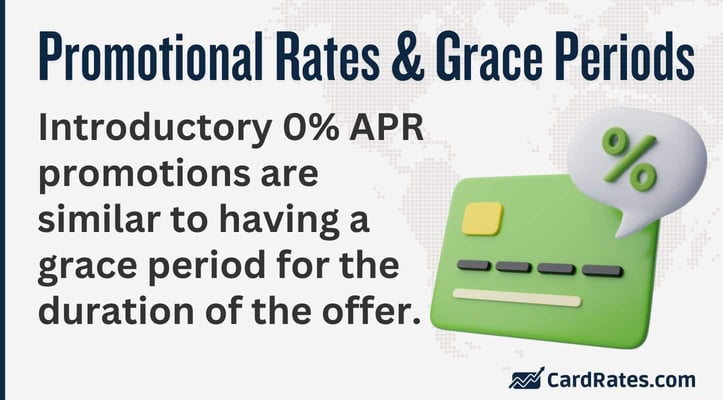
As long as that offer is active on all or a portion of your balance, you shouldn’t be charged interest for that debt even if you lose your grace period for that billing cycle.
You may still owe interest on other portions of your balance. Keep in mind that a grace period can roll over from one billing cycle to the next, while a promotional rate has an end date when that rate expires.
Most cards come with a grace period, but some don’t allow one. Secured cards, which require a cash deposit, and business cards are two types that are unlikely to come with a grace period benefit. If a grace period is offered, it must be at least 21 days.
If there’s no grace period or you lost that benefit, you won’t be able to avoid interest charges for your balance until you pay it in full. Instead, you’ll owe interest for the balance you carry over from each billing cycle to the next.
Given how high card rates are, these charges can prove substantial and can mount up quickly even if your balance seems relatively small.
2. You Only Paid the Minimum Payment
Residual or trailing interest is a technical term that refers to the interest that’s charged for your card balance and new purchases after your billing cycle ends if you didn’t pay your balance in full and instead carried over part of it to your next billing cycle.
Residual or trailing interest can show up even if you paid your minimum payment on or before your payment due date.
That’s because your minimum payment may not be your full balance.
3. You Purchased Something Not Covered By the Grace Period
While your grace period may help you avoid interest charges on your purchases, this benefit typically doesn’t stretch to certain other types of transactions.
Examples include cash advances, convenience checks, balance transfers, and purchases of items that are equivalent to cash, such as money orders, traveler’s checks, or casino gaming chips. These transactions are subject to separate rates and terms that don’t include a grace period.
Examples of Items Not Covered By Your Grace Period
| ❌ Cash Advances | ❌ Convenience Checks |
| ❌ Balance Transfers | ❌ Money Orders |
| ❌ Traveler’s Checks | ❌ Casino Gaming Chips |
These types of transactions may also involve other charges and fees. That’s one reason you should take all the time you need to read and understand the disclosures before you proceed.
Comparing the rates and terms of several offers may help you find one that’s appropriate for your financial situation.
Some transactions that aren’t covered by a grace period may be eligible for a promotional rate, but unless a 0% rate is specified in the offer terms, you’ll typically see interest charges for such transactions from day one until you pay your balance in full.
You may still have a grace period in effect for other transactions, such as purchases.
How to Eliminate Future Interest Charges
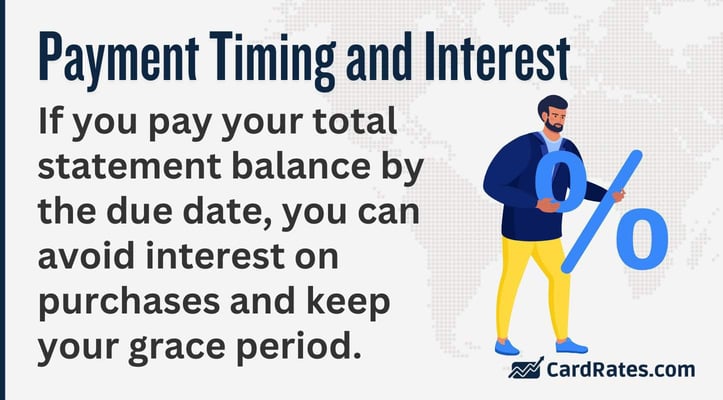
Grace periods and promotional 0% rate offers can help you avoid unexpected interest charges if you paid your previous balance in full within the grace period, and you pay your new balance in full within the grace period.
If you can’t pay your balance in full every month, you should review your spending habits and look for ways to bring your expenses in line with your income.
The best way to avoid losing your grace period and being hit with unexpected interest charges is to pay your balance in full every month as soon as you receive your statement.
If you need to delay your payment, mark your due date on your calendar and set up an alert to remind yourself to make your payment before that date.
Being late even one day could suspend your grace period benefit and start a cycle of interest charges every month until your balance is paid in full.
To avoid losing a promotional rate, including one that’s a 0% offer, you’ll need to pay at least your minimum payment on or before your due date for every billing cycle.
Pay late (or not at all) even once, and your promotional rate could be canceled immediately. From that point forward, you’ll owe interest on your balance until you pay it in full.
To find out if your card offers a grace period or when a promotional rate expires, read your cardholder agreement and promotional rate offer, or contact your card company and ask for the information.
If you carried over all or part of your card balance in the previous month and you now want to pay your balance in full, you should contact your card company to find out the exact amount that you owe, including any residual or trailing interest that may not be shown on your latest statement.
The total may be higher than the sum of your carried-over balance plus any new purchases due to residual or trailing interest.
One more way to avoid interest charges is to check your current balance before you make your payment, and if you have extra cash available, pay your statement balance plus any new charges you made after your billing cycle ended.
While paying ahead may seem counterintuitive since it’s not required, you could be pleasantly surprised with a lower balance when you receive your next statement.
Paying ahead can also lower your interest charges if you later carry a balance.
It Still Pays to Pay Your Credit Card Balances in Full
Paying your card balance in full every month is a smart financial habit that could save you money even if your card doesn’t offer a grace period or you temporarily lose that benefit.
Once your balance is paid in full on or before your payment due date, you may receive a grace period for future payments, and that could save you even more in interest charges.
Pay in full within your grace period every month, and you’ll never have to pay interest for your purchases with your card.
Take that a step further and deposit your interest savings into an interest-bearing account, and you could earn interest rather than pay it. Now that’s what I call a win-win.
Editorial Note: Our site content is not provided or commissioned by any credit card issuer(s). Opinions expressed on CardRates.com are the author's alone, not those of any credit card issuer, and have not been reviewed, approved, or otherwise endorsed by credit card issuers. Every reasonable effort has been made to maintain accurate information; however, all credit card offer details, including information about rewards, signup bonuses, introductory offers, and other terms and conditions, is presented without warranty. Clicking on any offer on CardRates.com will direct you to the issuer's website, where you can review the current terms and conditions of the offer.
About the Author