
Writer: Lucy Lazarony


Editor: Ashley Fricker

Reviewer: Ashley Fricker
We deploy a step-by-step methodology to each piece of research we publish to ensure our studies offer complete coverage and meet our rigorous editorial standards.
Key Takeaways
- Two-thirds of respondents have traveled with a friend on a noticeably smaller budget, and 42% say that friend was them.
- Budget gaps can cost more than money. 1 in 5 people say a group trip damaged a friendship, and another 29% felt tension before eventually patching things up.
- It’s toughest on the friend with the smallest budget. Among people who’ve been in that spot, 37% say a friendship took a hit.
- Accepting help isn’t always easy. 1 in 4 would take a friend’s money but feel like a “charity case,” and that jumps to 39% among Gen Z.
- Most people (62%) would step in if a friend couldn’t afford the trip, but only 12% think the wealthier friend should quietly cover the difference.
The group chat has picked the beachfront Airbnb, the tasting menu and the sunset catamaran. Your bank account has picked… a strongly worded ‘maybe.’ If that sounds familiar, you’re far from alone.
A new CardRates.com survey of 1,001 U.S. adults asked what really happens when friends travel together on very different budgets. The answers show that the gap is incredibly common; it can quietly strain friendships, and even well-meaning offers to help don’t always land the way they’re intended.
“Having been on both ends of this throughout the years, I understand the problems that can occur when traveling with people who have very different budgets,” says Erica Sandberg, personal finance expert at CardRates.com. “To reduce or even eliminate tension, set clear expectations right from the beginning.”
42% Have Been the Friend Pinching Pennies on a Trip
Turns out the budget gap is less of an edge case and more of a group-trip rite of passage. About two-thirds of respondents (66%) have been on or planned a trip where someone had a noticeably smaller budget than everyone else.
And, in fact, 42% say they were the friend with the smaller travel budget, while 23% say it was someone else on the group trip with the smaller budget. Only 34% say they have never had this happen on a group trip.
“If you can’t afford all the extras involved in a shared excursion, explain that during the planning process,” says Sandberg. “Assure the others that you are more than happy to do something else. While others in the group are dining at a five-star restaurant, you can be experiencing the joys of street food, then you can all get together afterward for a stroll around the city.”
Half Say Budget Differences Have Caused Tension, and 20% Lost Ground in a Friendship
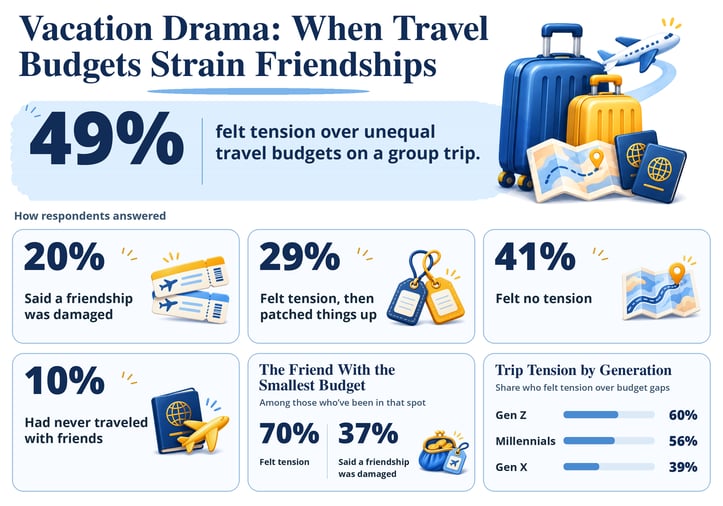
Money and friendship don’t always travel well together. One in five respondents (20%) say a budget mismatch on a group trip did real damage to a friendship, and another 29% say it caused tension they eventually smoothed over.
On the bright side, 41% said a difference in budgets on a group trip did not cause any tension at all. Only 10% of those surveyed said they had never traveled with friends.
Among people who’ve been the friend with the smallest budget, 70% said they have felt tension, and 37% said it damaged a friendship.
Younger travelers reported experiencing greater tension when on trips with friends with different budgets, with 60% of Gen Z saying they experienced tension compared with 56% of millennials and 39% of Gen X travelers.
1 in 4 Would Accept a Friend’s Help but Feel Like a “Charity Case”
One way to handle the difference in budgets among friends on a group trip is to offer to help the friend with the smallest budget. Offering to help may be kind, but it may make the friend receiving the help feel uncomfortable.
“If you are the one with a bigger budget, you may want to help your friend with a few niceties, whether it’s an upgraded room that you share or a taxi from the airport instead of the bus,” says Sandberg. “You don’t have to buy their souvenirs, but an extra cocktail at the swim-up bar is a lovely gesture.”
While 50% of those surveyed said that if friends offered to cover some of their travel costs, they would accept and feel grateful, others would not feel good about receiving this kind of help, with 25% saying they would feel like a “charity case.”
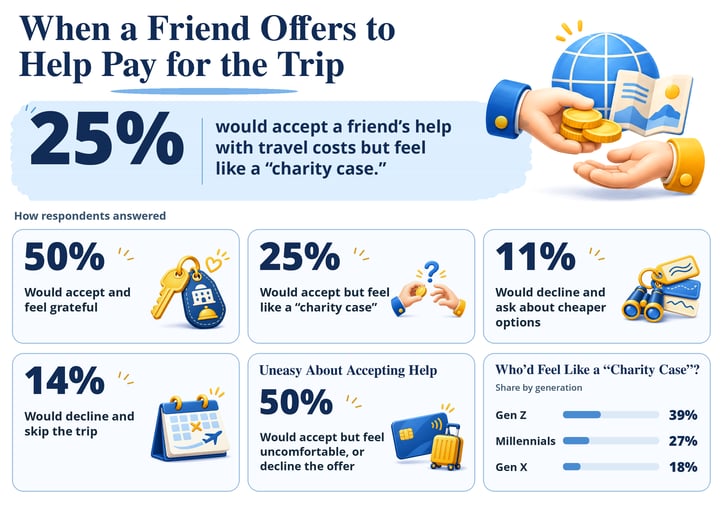
Another 11% of those surveyed said they would decline the offer of help and ask about cheaper options, and 14% said they would decline the help and skip the trip. So all told, half of those surveyed wouldn’t feel comfortable accepting help from friends on a group trip.
The younger generation, Gen Z, is most likely to say they would feel like a “charity case” when accepting help from friends on group trips, with 39% of Gen Z saying they feel this way compared with 27% of millennials and 18% of Gen X.
“If there are financial inequities when you travel, be sure to check in with each other throughout the trip, too,” says Sandberg. “Resentment can build when one of you feels you’re spending more than you expected, or the other feels inhibited with what they really wanted to do.”
62% Would Help a Friend Who Can’t Afford the Trip, but Few Think the Wealthier Friend Should Pay
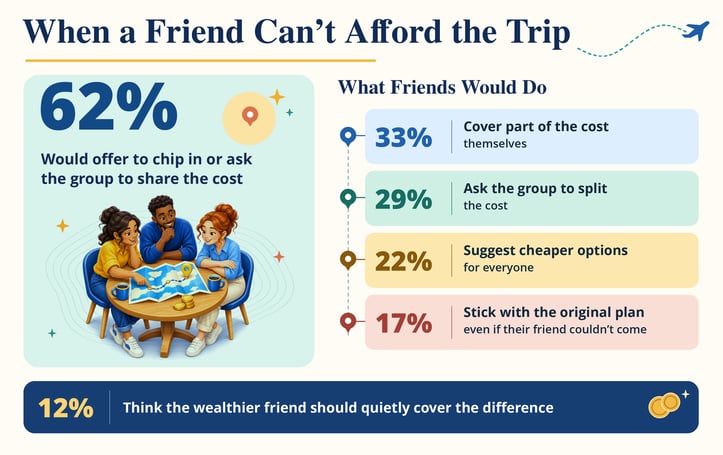
Flip the scenario, and most people say they’d step up, but stepping up doesn’t mean picking up the whole tab. If a friend couldn’t afford a group trip, 33% said they would cover part of the cost themselves, 29% said they would ask the group to split the costs, and 22% said they would push for cheaper options for everyone.
Not everyone would hold the trip, though. For the less helpful friends, 17% said they would go ahead with the original plan, even if a friend couldn’t come.
How Should Costs Be Split When Budgets Differ?
So what’s the fair way to divide the bill? The most popular answer is a middle ground: 42% say shared costs like lodging should be split equally, with everyone covering their own extras. Others offered a stricter approach to splitting costs, with 31% saying everyone pays equally, with no exceptions.
Some respondents, 15%, said they are open to planning the whole trip around the lowest budget, and 12% said the higher earners should quietly cover the difference for a friend with less means.
Interestingly, it is the people whose friendships were damaged who are the strictest about splitting costs, with 48% of them saying “everyone pays equally, no exceptions,” compared with 31% overall.
Those who have been the friend with the smallest travel budget in a group trip themselves are the most generous, with 41% saying they would personally cover part of a friend’s trip costs.
Methodology
CardRates.com surveyed 1,001 U.S. adults ages 18 to 61 from October 27 to November 5, 2026.
Respondents were asked about traveling with friends on different budgets, including whether budget gaps have caused tension or damaged friendships, how they’d feel about accepting financial help from friends, and how costs should be split when budgets differ. Results are based on raw, unweighted responses.
The approximate margin of error is ±3.1 percentage points for the full sample at the 95% confidence level. Margins of error are larger for demographic subgroups. Percentages may not total 100% due to rounding.
For media inquiries, please email catherine@cardrates.com.
Editorial Note: Our site content is not provided or commissioned by any credit card issuer(s). Opinions expressed on CardRates.com are the author's alone, not those of any credit card issuer, and have not been reviewed, approved, or otherwise endorsed by credit card issuers. Every reasonable effort has been made to maintain accurate information; however, all credit card offer details, including information about rewards, signup bonuses, introductory offers, and other terms and conditions, is presented without warranty. Clicking on any offer on CardRates.com will direct you to the issuer's website, where you can review the current terms and conditions of the offer.
About the Author