
Writer: Lynn Cadet


Editor: Ashley Fricker


Reviewer: Adam West

We deploy a step-by-step methodology to each piece of research we publish to ensure our studies offer complete coverage and meet our rigorous editorial standards.
Key Takeaways
- 58% of U.S. adults said they would need to borrow money to pay for a funeral, one of the few expenses in life that's guaranteed.
- Loans were reported as the most common way to finance a funeral, but 1 in 4 Americans (26%) said they would rely on a credit card, turning funeral costs into potentially high-interest debt.
- Even older generations aren’t prepared: 51% of Gen X and 52% of Baby Boomers said they would need to borrow to cover a burial.
Americans are often told to prepare for the big financial milestones — buying a home, saving for retirement, and keeping an emergency fund for the unexpected.
Yet death, the most universal human experience, remains a blind spot in financial planning. Not to be morbid, but that is a problem that can lead to unnecessary financial strain on top of all the other stressors that accompany grief.
The median cost of a funeral with a burial is $8,300, according to The National Funeral Directors Association. But the median account balance for Americans in 2025 was only $8,000, according to the Federal Reserve’s Survey of Consumer Finances. One death can drain your account and leave you in debt in the same week.
That’s why planning ahead — before the loss — matters.
A new CardRates.com survey reveals just how unprepared most Americans are, with 58% of adults admitting they would need to borrow money to cover the cost of a funeral. For most families, loss brings both grief and debt.
“Having cash tucked away for a loved one’s end-of-life costs is ideal, but our poll shows many Americans may be left unprepared, “ says Erica Sandberg, consumer finance expert at CardRates.com. “Shock and grief can cause you to not think clearly.”
Sandberg adds, “Without enough funds available, you may use a credit card you have on hand for all the expenses. But is it the best financial choice? Not necessarily. Adding $8,000 to a credit card with a 24% APR will cost $2,151 in interest if you paid it off in two years.”
1 in 4 Americans Would Put Funeral Costs on a Credit Card
Benjamin Franklin famously once said, “In this world, nothing is certain except for death and taxes.” Yet, millions of Americans aren’t certain about how they’ll pay for their own or a loved one’s funeral.
The most common approach for those who need to borrow? Taking out a loan.
According to our results, these are the most popular methods people would use to cover funeral costs:
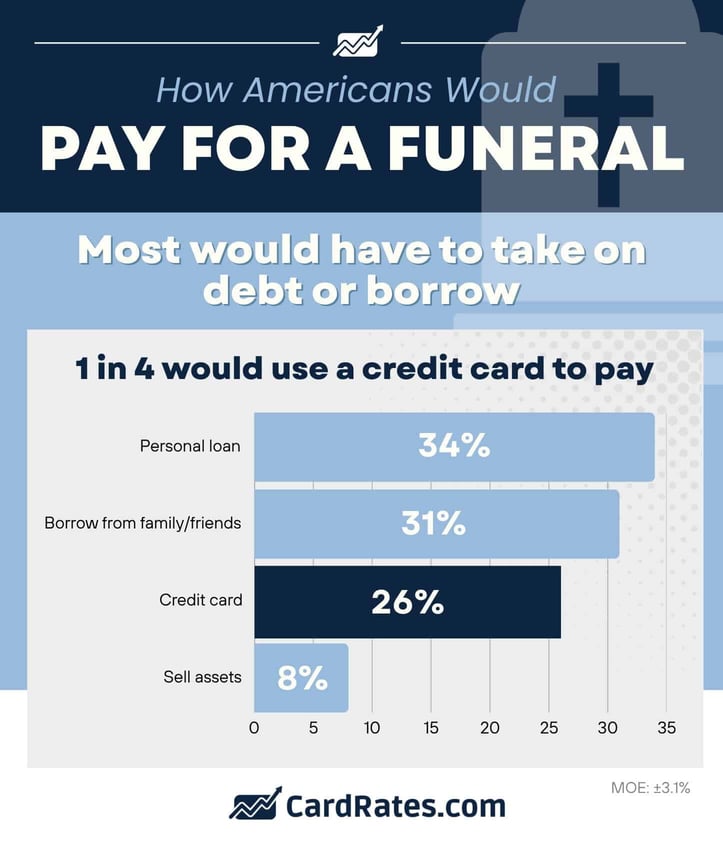
While these options may ease financial strain in the short term, they can carry significant trade-offs. A loan or credit card forces borrowers into monthly payments and interest charges that they have to pay over time.
Borrowing from family and friends may be a reasonable idea on the surface, but it can lead to tension and complicated family dynamics when repayment isn’t as agreed upon.
Families are juggling multiple expenses in their everyday lives. So, funeral and other end-of-life costs taking the back seat for most people isn’t shocking; it’s understandable.
End-of-life planning requires time and intention. While funeral costs may not seem as urgent as other expenses in the everyday flow of things, the intentional act of planning for them can be what helps you or your family avoid debt in the long run.
No Generation is Fully Prepared for the Cost of Death
Afterlife planning may seem like something most people have figured out by the time they get older. But our study reveals that many Americans are not prepared for the costs that come with it, regardless of life stage.
Surprisingly, the lack of readiness is multi-generational.
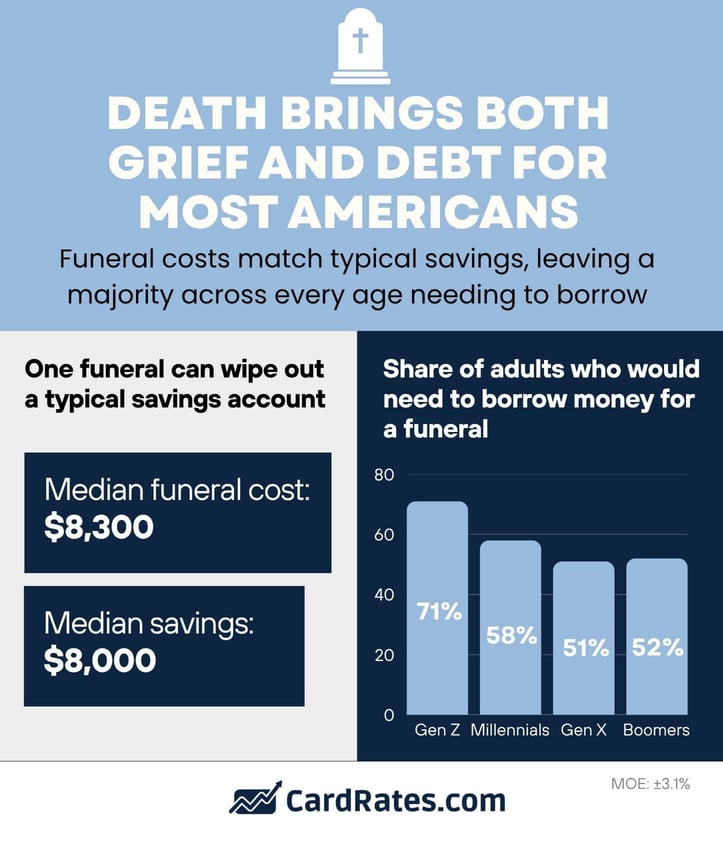
When asked, ‘If a funeral had to be paid for today, would you or your family need to borrow money to cover the cost?’ the generational breakdown of those who said “yes” was:
- Gen Z: 71%
- Millennials: 58%
- Gen X: 51%
- Boomers: 52%
Gen Z and millennials’ unpreparedness is expected, as they are early in their financial lives. But Gen X and boomers are the real story. These are Americans in their peak earning years or approaching retirement, if not already retired, who have had decades to plan, yet still more than half have not.
Our results show that borrowing isn’t limited to one group, and rising costs and debt are also impacting older Americans’ path to fully prepared, end-of-life arrangements, even though life stage may make it appear otherwise.
Sandberg continues, “An $8,000 loan with a 24-month term will cost $1,309 in interest, but a $2,000 loan will cost $328. That doesn’t include the origination fee, which is usually a few percentage points of the loan amount.”
Regarding financial fallbacks, Gen X (35%) was the most likely cohort to say they would rely on borrowing from family or friends for emergency burial assistance, suggesting that the cost isn’t borne solely by the individual and can become a shared burden.
“Gen X is on the right track by asking close relatives and friends to pitch in”, according to Sandberg. “Have a conversation about who can help, and in what increments. Financial gifts are preferable, since personal loans come with emotional connections. A low-interest bank loan can help, but borrow as little as possible.”
“When faced with excess funeral costs, you may want to consider opening a 0% APR credit card for this purpose. You’ll have at least 12 months to delete the balance with no interest added, with no origination fees.”
“In the meantime, if you know a funeral may be on the horizon, try to add to a savings account now. Think about how much you can set aside, then set up automatic savings with your bank. A monthly deposit of $350 a month will total $8,400 in two years.”
Our data makes it clear: While death is inevitable, millions of Americans aren’t preparing themselves for the costs associated with it. End-of-life planning is an essential part of financial planning, but most people don’t treat it as such, even older Americans.
To keep from shouldering unexpected expenses, Americans can plan accordingly for end-of-life preparations and seek out methods, e.g., budgeting and life insurance, to ensure they can cover costs without the added debt.
Methodology
This survey was conducted among 1,000 U.S. adults via an online panel. The overall margin of error is approximately ±3.1% at 95% confidence.
All questions were single-selection, and each received 1,000 completes. Crosstabs by demographic group (gender, household income, race, parental status, etc.) are available upon request.
For media inquiries, please reach out to catherine@cardrates.com.
Editorial Note: Our site content is not provided or commissioned by any credit card issuer(s). Opinions expressed on CardRates.com are the author's alone, not those of any credit card issuer, and have not been reviewed, approved, or otherwise endorsed by credit card issuers. Every reasonable effort has been made to maintain accurate information; however, all credit card offer details, including information about rewards, signup bonuses, introductory offers, and other terms and conditions, is presented without warranty. Clicking on any offer on CardRates.com will direct you to the issuer's website, where you can review the current terms and conditions of the offer.
About the Author